
- FROM AGEING INFRASTRUCTURE TO A NEW-AGE GATEWAY: Redevelopment vision puts passenger safety, comfort and Mumbai’s cultural identity at the centre of terminal design
- 33% CAPACITY BOOST, BIGGER PROCESSING POWER: Annual passenger-handling capacity planned to rise from 15 million to 20 million, with more check-in counters and expanded security facilities
- FLAMINGOS, GREEN SPACES AND RUNWAY VIEWS: Proposed architectural concepts blend local art, indoor greenery, expansive glass facades and a signature flamingo sculpture
- A MAJOR AVIATION TRANSITION AHEAD: Demolition targeted to begin in April 2027, with the new Terminal 1 scheduled for completion in December 2030
NE AVIATION BUREAU
MUMBAI, OCT 29
What if Mumbai’s next airport experience began not with a queue or a crowded terminal, but with soaring architecture, sunlit spaces, lush greenery and a striking flamingo sculpture celebrating the city’s natural heritage? That is the ambition behind the proposed redevelopment of Chhatrapati Shivaji Maharaj International Airport’s (CSMIA) Terminal 1 (T1)—a transformation that seeks to redefine how passengers experience one of India’s busiest aviation hubs.
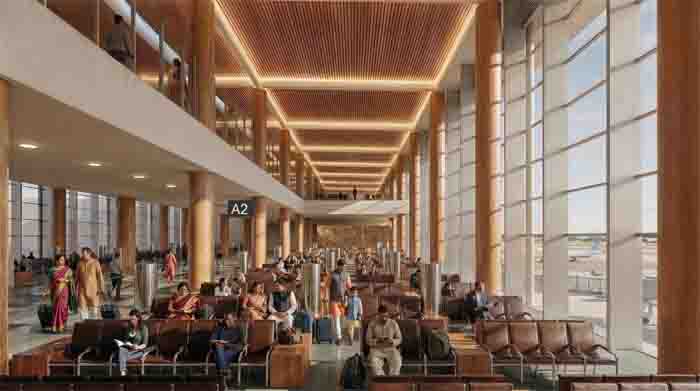
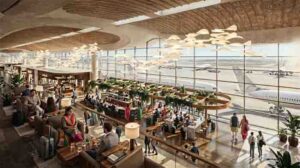
CSMIA has shared artistic impressions of the proposed Terminal 1 redevelopment during its meeting with the Airport Airline Operators Committee (AOC). The visuals offer a glimpse of the architectural vision for Mumbai’s future domestic aviation gateway, emphasising passenger convenience, operational efficiency, cultural expression and contemporary design.
These are artistic impressions of the proposed development, not a definitive representation of the finished terminal. The project envisages replacing an ageing facility with modern infrastructure designed to accommodate growing passenger demand while creating a more distinctly Mumbai experience.
Reimagining the passenger journey
Commissioned in 1964, the existing Terminal 1 is an ageing facility. According to the project information shared by CSMIA, independent audits by Structwel in 2017 and IIT Bombay in 2024 highlighted serious safety and structural vulnerabilities, strengthening the case for its replacement.
The redevelopment vision extends beyond a conventional infrastructure upgrade. It seeks to reshape the passenger journey from arrival at the terminal to check-in, security screening, boarding and baggage collection.
The proposed departure kerbside features a sweeping entrance intended to create a welcoming first impression. Inside, the check-in hall is envisioned as a spacious, sunlit, column-free environment, with murals reflecting Mumbai’s cultural heritage.
The departure hold area is planned as a calmer passenger environment featuring indoor greenery, premium lounges and expansive glass facades overlooking the runways. At the arrival kerbside, a giant flamingo sculpture is envisaged as a signature artistic feature inspired by Mumbai’s biodiversity.
Together, these concepts aim to combine functional airport design with a stronger sense of place.
More capacity, faster processing and better connectivity
The proposed redevelopment also targets significant improvements in passenger-handling infrastructure.
Annual passenger-handling capacity is planned to increase by 33%, from 15 million passengers per annum (mppa) to 20 mppa.
The number of check-in counters is expected to rise by 47%, from 74 to 109, while security infrastructure is planned to expand to 15 passenger screening lanes and five transfer screening lanes.
Another major proposed change concerns aircraft boarding. Contact stands are expected to increase 3.5 times, from seven to 25, reducing dependence on remote boarding arrangements. The plan also envisages replacing conventional boarding gates with 12 state-of-the-art e-gates.
For arriving passengers, baggage reclaim facilities are planned to expand from five belts to 11—more than doubling the number available.
These proposed enhancements are intended to strengthen passenger-processing capacity and improve movement through the terminal. Their eventual operational impact will depend on the completed infrastructure, implementation and airport operations.
Keeping Mumbai flying during the transition
Replacing an operational airport terminal presents a significant logistical challenge: construction must be coordinated with the continuing movement of passengers and aircraft.
According to the proposed transition plan, demolition of the existing Terminal 1 is scheduled to begin in April 2027. To help accommodate interim domestic passenger traffic, the G+3 Terminal 2 North-West Pier expansion is expected to become operational by March 2029.
The replacement Terminal 1 is targeted for completion in December 2030. The wider development plan envisages increasing Mumbai airport’s overall capacity to 65 million passengers per annum.
The phased approach is intended to maintain airport operations while the redevelopment progresses. Timelines remain subject to project execution and the relevant implementation requirements.
A distinctly Mumbai gateway
Airports are more than transport infrastructure: they are often the first and last impressions visitors carry of a city. For Mumbai, an international financial and commercial centre with a distinctive cultural identity, the proposed Terminal 1 redevelopment offers an opportunity to bring architecture, passenger convenience and local character together.
The artistic impressions present an ambition for a gateway that is more spacious, efficient and welcoming, with design elements that draw inspiration from the city’s cultural and natural environment.
The ultimate test, however, will lie in delivery: safer infrastructure, smoother passenger movement, reliable operations and an experience that lives up to the vision.
If realised as envisaged, the redevelopment could mark a significant new chapter for Mumbai’s domestic aviation infrastructure.