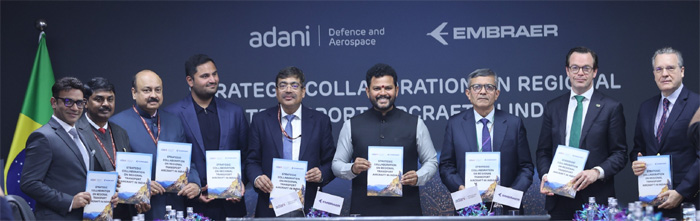
- Strategic MoU Targets End-to-End Regional Transport Aircraft Ecosystem
- Assembly Lines, Indigenisation & Skill Creation Anchored in Aatmanirbhar Bharat
- Partnership Aligns with UDAN to Transform Tier-2 and Tier-3 Air Connectivity
- India–Brazil Aerospace Ties Strengthened Through Industrial Collaboration
- High-Skill Jobs, Global Supply Chains & Long-Term Aviation Sovereignty in Focus
NE BUSINESS BUREAU
NEW DELHI, JAN 27
In a landmark move poised to reshape India’s civil aviation and aerospace manufacturing landscape, Adani Defence & Aerospace and Brazil-based aerospace major Embraer on Tuesday announced a strategic partnership to establish a comprehensive Regional Transport Aircraft (RTA) ecosystem in India.
The two companies have signed a Memorandum of Understanding (MoU) to collaborate across aircraft manufacturing, supply chain development, aftermarket services, and pilot training, marking one of the most significant private-sector initiatives in India’s regional aviation segment.
Made-in-India Aircraft, Phased Indigenisation
The collaborative industrial partnership envisions the establishment of an aircraft assembly line in India, followed by a phased increase in indigenisation, supporting the country’s long-term Regional Transport Aircraft programme. The initiative aligns closely with the Aatmanirbhar Bharat mission and the government’s UDAN regional connectivity vision, aimed at linking underserved and remote regions.
“Regional aviation is the backbone of economic expansion. With initiatives like UDAN transforming air connectivity across Tier 2 and Tier 3 cities, the need for an indigenous regional aviation ecosystem has become critical,” said Jeet Adani, Director, Adani Defence & Aerospace.
“This partnership will also strengthen strategic relations between India and Brazil, bringing complementary capabilities together.”
Complementary Strengths, Global Ambition
The proposed collaboration brings together Embraer’s deep expertise in aircraft design, engineering and manufacturing with Adani’s fast-expanding aviation value-chain footprint, spanning airport infrastructure, aerospace manufacturing, MRO services and pilot training.
“We are shaping India’s regional transport aircraft ecosystem, a bold stride toward Aatmanirbhar aviation that bridges urban-rural divides, generates high-skill employment, and elevates India’s position in the global aerospace industry,”
said Mr Ashish Rajvanshi, President & CEO, Adani Defence & Aerospace.
The ecosystem is designed to meet India’s growing domestic demand for regional air travel while creating substantial direct and indirect employment across engineering, manufacturing, logistics and support services.
India a Strategic Market for Embraer
Reaffirming its long-term commitment to India, Embraer said the partnership would explore the most advanced, efficient and viable solutions to support the country’s RTA ambitions.
“India is a pivotal market for Embraer, and this partnership combines our aerospace expertise with Adani’s strong industrial capabilities and commitment to indigenisation,”
said Arjan Meijer, President & CEO, Embraer Commercial Aviation.
“Together, we will evaluate the most viable, advanced and efficient solutions in support of India’s RTA ambitions, and their potential for implementation.”
Embraer has a strong and expanding footprint in India, with nearly 50 aircraft across 11 variants operating in commercial, defence and business aviation. The Indian Air Force operates Embraer-based platforms, including the Legacy 600 and the ‘Netra’ AEW&C aircraft derived from the ERJ145. In the commercial segment, Star Air operates a fleet of 13 E175 and ERJ145 aircraft.
Adani Defence’s Expanding Aerospace Play
Adani Defence & Aerospace is India’s largest integrated private aerospace and defence player, with capabilities spanning aircraft manufacturing, unmanned systems, avionics, weapons and sustainment. Backed by the country’s largest MRO ecosystem and a rapidly scaling pilot training platform, the company is building a future-ready aviation value chain aligned with national security priorities and global standards.