


- Ancient Sanskrit scholarship finds a contemporary Gujarati voice
- Collected works released to widen access to Sanatan philosophical thought
- Affordable publishing legacy of Sastu Sahitya Mudranalaya Trust highlighted
- Adi Shankaracharya hailed as a walking university and master synthesiser of ideas
- Knowledge, dialogue and integration emerge as enduring pillars of Sanatan Dharma
NE LITERARY BUREAU
AHMEDABAD, JAN 15
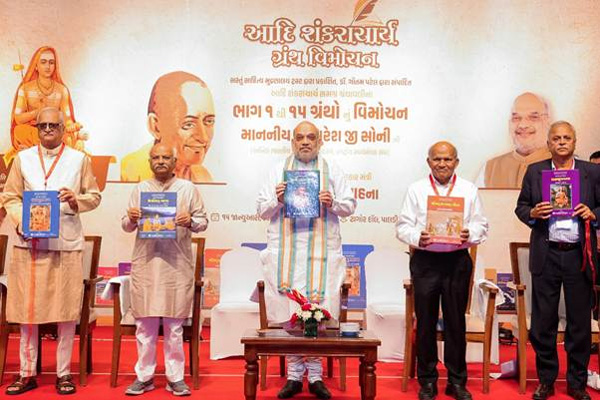
In a significant moment for India’s literary and philosophical landscape, the Gujarati edition of the collected works of Adi Shankaracharya, published by the Sastu Sahitya Mudranalaya Trust, was released in Ahmedabad, making one of Sanatan Dharma’s most profound bodies of knowledge accessible to a wider Gujarati readership, especially the youth.
The release brings Gyan Sagar, originally composed in Sanskrit by Adi Shankaracharya, into Gujarati, ensuring that timeless spiritual and philosophical insights reach contemporary readers in their mother tongue. The initiative was described as a major step in preserving, propagating and democratising classical Indian thought through affordable literature.
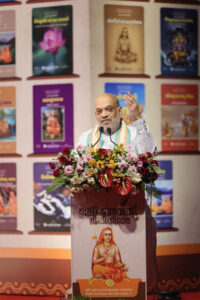
Speaking at the event, Amit Shah said the availability of Gyan Sagar in Gujarati was a moment of great joy for readers in Gujarat. “The collected works of Adi Shankaracharya in Gujarati are a priceless intellectual treasure for the youth. When discussions on meaningful literature take place in the future, the efforts of the Sastu Sahitya Mudranalaya Trust will be remembered,” he said.
Reflecting on the legacy of Swami Akhandanand, Shah noted that his life and work were so impactful that people themselves added the word ‘Bhikshu’ to his name. “Akhandanand dedicated his entire life to literature related to Ayurveda and Sanatan Dharma, presenting noble ideas to society. His vision was to make high-quality literature available to common people at the lowest possible cost,” he said.
He recalled that Akhandanand established a major institution during his lifetime and published numerous texts, including the Bhagavad Gita, Mahabharata, Ramayana, Yoga Vasishtha, Ramkathamrit, works of Swami Ramtirtha, and several books on ethics and moral values. “Through this effort, he played a decisive role in shaping Gujarat’s collective character,” Shah said.
Highlighting the relevance of books in the digital age, Shah observed, “After the advent of the internet, many believed reading would decline. The publication of these 24 volumes strengthens the belief that the new generation continues to read and seek depth.” He added that Adi Shankaracharya’s Gyan Sagar would have a lasting influence on the thinking and conduct of Gujarati youth.
Shah described Adi Shankaracharya’s interpretations of the Upanishads as “simple, precise and closest to the truth.” He said, “Of all the knowledge available in this universe, nothing is greater than ‘Shivoham’. Such clarity and philosophical depth could only be achieved by Adi Shankaracharya.”
He noted that at a time when doubts and distortions had crept into Sanatan Dharma, Adi Shankaracharya systematically addressed every challenge through logic, debate and reasoned interpretation. “By studying his works sequentially, it becomes clear that he resolved all objections within his own lifetime,” Shah said.
Calling upon the youth to read Vivekachudamani at least once, he said Adi Shankaracharya did not merely present ideas but also gave them structure and continuity. “He did not just speak of Moksha; he explained the path to attain it. He integrated Bhakti, Karma and Gyan into a single, holistic vision,” Shah said.
He further described Adi Shankaracharya as a “walking university” who travelled across the country on foot, establishing four Mutts in the four directions and creating an enduring framework for the preservation of the Vedas and Upanishads. “By founding akharas and organisational systems, he ensured that Sanatan Dharma would remain relevant even in the most challenging times,” Shah said.
Adi Shankaracharya’s revival of Shastrarth was also highlighted as a cornerstone of India’s intellectual tradition. “He laid the foundation for resolving differences through dialogue and debate, enabling common people to understand the core essence of Sanatan Dharma — from nature worship to its highest philosophical principles,” Shah said.