
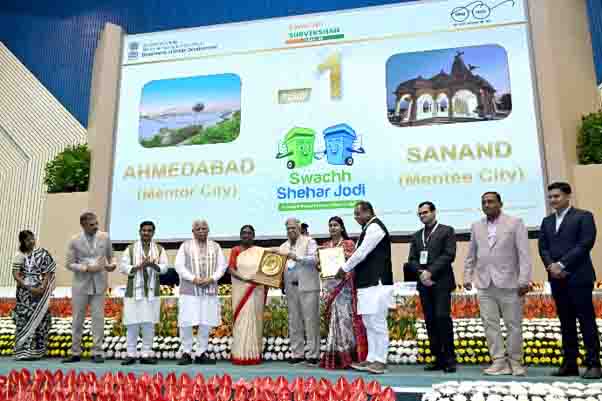
- Ahmedabad–Sanand partnership secures first position in the newly introduced Swachh Shehar Jodi category, highlighting Gujarat’s city-to-city knowledge-sharing model
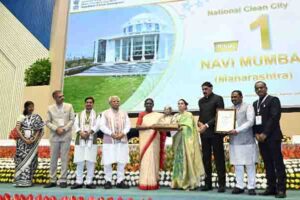
- Surat ranks second in the Super Swachh League, behind Navi Mumbai and ahead of Vijayawada
- President Droupadi Murmu calls cleanliness an indicator of public health, social consciousness and administrative accountability
- Tamil Nadu’s urban local bodies face an opportunity to strengthen citizen participation, waste segregation and municipal service delivery
- Nationwide assessment covers 4,751 cities, with 43 indicators, GPS-enabled monitoring and citizen feedback playing a key role
NE NEWS SERVICE
NEW DELHI, NOV 12
Gujarat has secured a prominent place in India’s urban cleanliness landscape, with Ahmedabad and Sanand emerging as the country’s top-performing mentor–mentee city partnership and Surat finishing among the three leading cities in the prestigious Super Swachh League. The recognition at the Swachh Survekshan Awards 2025-26, presented by President Droupadi Murmu in New Delhi, puts the spotlight on Gujarat’s urban sanitation initiatives while raising an equally important question for other States, including Tamil Nadu: how can national recognition be translated into sustained cleanliness at the neighbourhood level?
Ahmedabad–Sanand: A model of collaborative cleanliness
The Ahmedabad–Sanand partnership clinched the top position in the newly introduced Swachh Shehar Jodi category, followed by Indore–Depalpur and Tirupati–Kuppam.
The initiative brings together 70 mentor cities and 191 mentee cities across 33 States and Union Territories, encouraging experienced urban local bodies to share best practices and help improve sanitation standards in partner cities.
The top three partnerships were selected on the basis of their combined scores, recognising both the mentor city’s performance and the improvements achieved by its mentee partner.
The initiative follows the principle of Each One – Teach One, drawing inspiration from India’s Guru–Shishya tradition of transferring knowledge and experience. For Gujarat, the Ahmedabad–Sanand recognition demonstrates the potential of inter-city cooperation in improving urban waste management and municipal services.
Surat’s second place adds to Gujarat’s distinction
Gujarat’s achievement was further reinforced by Surat securing second place in the Super Swachh League, behind Navi Mumbai and ahead of Vijayawada.
The recognition is significant because the Super Swachh League brings together cities with an established record of cleanliness performance. It also places Gujarat among the leading States in the country’s urban sanitation movement.
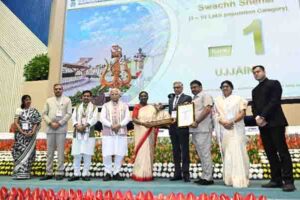
The national awards covered several categories, including population-based city rankings, Swachh Shehar Jodi, riverfront towns, coastal towns and Himalayan cities.
Tamil Nadu: An opportunity to strengthen urban cleanliness
For Tamil Nadu, the latest awards offer an opportunity to examine how its municipal corporations and urban local bodies can further strengthen waste segregation, scientific processing, sanitation infrastructure and citizen engagement.
The newly introduced mentorship model, exemplified by Ahmedabad–Sanand and Tirupati–Kuppam, provides an avenue for Tamil Nadu’s cities to benefit from inter-city knowledge-sharing and adopt successful practices.
Importantly, the Ministry of Housing and Urban Affairs has announced that State First Swachh City award winners will be honoured at separate ceremonies in their respective States. The national announcement does not yet provide the individual Tamil Nadu State First awardee details.
President: Cleanliness reflects social consciousness
Addressing the award ceremony, President Droupadi Murmu emphasised that cleanliness cannot be achieved through the efforts of a single organisation or government department. It requires the active participation of every citizen, household, community and city.
She observed: “Cleanliness is not merely a matter of maintaining the aesthetic appeal of public spaces; it is also an indicator of our health, social consciousness, and administrative accountability.”
The President called upon citizens, particularly young people, women, Resident Welfare Associations and community organisations, to actively participate in cleanliness initiatives, share their experiences and report shortcomings.
She stressed that such engagement should lead to continuous dialogue between municipal administrations and citizens, strengthening trust, transparency and accountability.
The President also underlined that citizens are the best judges of the cleanliness of their surroundings. Citizen feedback, she said, should not remain confined to surveys and rankings but must become an effective instrument for improving municipal services and addressing local challenges.
Technology, start-ups and the next generation of clean cities
Highlighting the importance of innovation, President Murmu called for developing effective, affordable and safe technologies in sanitation. She welcomed the contributions of institutions, including IITs and scientific research organisations, as well as emerging start-ups working to address practical sanitation challenges and generate employment.
She also called for special attention to Tier-2 and Tier-3 cities, which are among India’s fastest-growing urban centres and face distinct developmental challenges.
The President emphasised the need to learn from the experiences of larger cities while developing solutions suited to the specific requirements of smaller urban centres.
A decade of Swachh Survekshan: From 73 cities to 4,751
The 10th edition of Swachh Survekshan marks a significant expansion of India’s urban cleanliness assessment, growing from 73 urban local bodies in 2016 to 4,751 cities in 2025-26.
This year’s assessment covered 43 indicators across 10 critical areas, including source segregation, waste collection and transportation, solid waste management, visible cleanliness, sanitation access, mechanised desludging, used-water management, welfare of sanitation workers and citizen feedback.
More than 3,000 trained assessors conducted extensive field evaluations supported by real-time GPS-enabled monitoring. The assessment process was fully digital, with evidence submission, verification and quality checks incorporated into the framework.
The Ministry also reported that 2.70 crore citizens provided feedback during this year’s survey, while more than 1,700 smaller urban local bodies with populations below 50,000 improved their rankings over the previous edition. More than 350 ULBs registered improvements exceeding 500 positions.
The Swachh Survekshan Awards, organised by the Union Ministry of Housing and Urban Affairs, recognise the contributions of cities and urban local bodies towards the Swachh Bharat Mission-Urban.
The larger message emerging from this year’s awards is that urban cleanliness cannot be sustained through rankings and awards alone. It demands continuous civic participation, accountable municipal administration, scientific waste management and the active involvement of sanitation workers.