- IIT Gandhinagar researchers develop GenR to restore damaged faces without paired training data
- AI framework reconstructs lost facial details while seeking to preserve identity, pose and visual evidence
- GenR tackles denoising, low resolution, missing portions and image artefacts in a single restoration pipeline
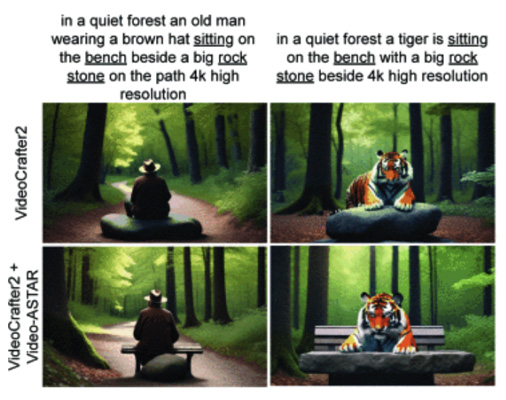
- IITGN–Adobe Research team develops Video-ASTAR to generate text-to-video scenes with consistent objects and relationships
- As World Photography Day approaches, the research points to AI’s emerging role in preserving—and recreating—visual memories
NE SCIENCE & TECHNOLOGY BUREAU
GANDHINAGAR, AUG 18
What if an AI system could rescue the face of a loved one from a fading family photograph—and another could give visual form to a childhood memory for which no photograph ever existed? Researchers at the Indian Institute of Technology Gandhinagar (IITGN), IIT-BHU and Adobe Research are pushing artificial intelligence towards precisely this intriguing frontier: preserving the visual past while giving shape to memories that were never captured on camera.
With World Photography Day falling on August 19, two research initiatives involving IITGN researchers underline how AI is moving beyond simply enhancing pixels. One, Generative Latent Inversion for Blind Face Restoration (GenR), seeks to recover lost or damaged facial details from photographs without relying on paired training data. The other, Video-ASTAR, explores how text descriptions can be transformed into videos while keeping objects, their attributes, relationships and actions consistent from frame to frame.
From damaged pixels to recognisable faces
Old family photographs often carry more than images—they carry memories. Yet fading, blur, noise, missing portions and compression artefacts can gradually erase the very details that make people recognisable.
Traditional restoration can involve painstaking manual intervention or specialised AI systems trained on huge collections of paired clean-and-damaged images. But such datasets cannot realistically represent every combination of degradation encountered in real-world photographs.
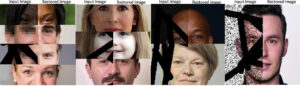
Researchers from IITGN and IIT-BHU have therefore developed GenR, a blind face-restoration framework that does not require paired training data. The system uses a powerful face-generation model to generate possible clean versions of a damaged photograph and progressively refines them so that the reconstructed face remains consistent with the available visual evidence. The study has been published in Pattern Recognition Letters.
GenR employs StyleGAN3-based inversion, essentially working backwards from a real, degraded photograph to identify the latent code capable of recreating it. The approach enables the system to manipulate and reconstruct facial characteristics in a realistic manner.
The framework follows a three-stage optimisation process. It first establishes the broad structure, including identity and pose, before progressively refining facial components such as the eyes, nose and jawline. In the final stage, it concentrates on fine textures and details such as skin and hair.
“This approach judges an image in a way similar to how a human eye would analyse it. It is an effort to keep the final output sharp, realistic, and perfectly recognisable,” said Akbar Ali, a fourth-year PhD student in the Department of Computer Science and Engineering at IITGN and first author of the study. He cautioned that excessive refinement can cause AI to invent details that were never present in the original image.
One AI tool, four restoration challenges
The researchers tested GenR across four types of image degradation—denoising, upsampling, inpainting and deartifacting.
Denoising removes random visual disturbances; upsampling converts low-resolution images into sharper versions; inpainting reconstructs intentionally removed portions; while deartifacting seeks to reduce distortions caused by blur and pixelation.
The findings indicated that GenR could consistently improve visual quality across these different degradation scenarios. For single-degradation tasks, the pipeline generated a clean image in about 30 seconds, according to the study material.
Yet the researchers also acknowledge a crucial caveat: when an original photograph is severely damaged, the system may generate a realistic-looking face that does not actually match the person. Excessive parameter tuning can also result in unrealistic memorisation of details. This makes careful regulation and responsible use particularly important, especially in sensitive applications such as forensic analysis.
Potential applications include historical photograph and film preservation, forensic analysis, video conferencing and social media image enhancement.
‘Bringing images back to life’
Dr Shamuganathan Raman, Professor in the Departments of Computer Science & Engineering and Electrical Engineering, Head of the CSE Department and Principal Investigator at the Computer Vision, Imaging, and Graphics (CVIG) Lab, said the work represents an important step forward in blind face restoration.
“GenR represents a significant advancement in blind face restoration. It was interesting to see that this framework offers a flexible and data-efficient alternative to traditional supervised methods. Systems like GenR could play a crucial role in bringing images back to life. Future work may focus on models to improve robustness and generalisation,” he said.
The research team also included Dr Indra Deep Mastan, Assistant Professor in the Department of Computer Science & Engineering at IIT-BHU.
When AI creates a memory that never had a photograph
The second research effort involving Professor Raman moves in the opposite direction—from an existing image towards an image that never existed.
Published in the proceedings of the 2026 IEEE/CVF Winter Conference on Applications of Computer Vision, the study proposes Video-ASTAR, a training-free approach for generating videos from text descriptions.
Consider a simple instruction: a girl runs in a park with a pink balloon in her hand and looks at a brown kitten sitting near a tree.
A conventional text-to-video system may generate an attractive sequence but struggle to preserve all these details over time. The pink balloon could change colour, the tree could disappear or objects could shift position because the system loses track of individual concepts across successive frames.
Video-ASTAR seeks to address this problem by keeping visual elements tied to the words describing them, enabling the generated video to retain the identity and relationships of objects throughout the sequence.
The team included Dr Prajwal Singh, postdoctoral fellow at the CVIG Lab, and Dr Kuldeep Kulkarni and Dr Harsh Rangwani, research scientists at Adobe Research, India.
From inherited photographs to inherited visual memories
Together, the two studies suggest a fascinating dual role for AI.
GenR works backwards, attempting to restore visual information that has been damaged or lost. Video-ASTAR works forwards, converting descriptions into visual sequences when no photograph exists.
The possibilities are especially evocative for families and cultural institutions. A grandfather describing how he played hide-and-seek with his grandfather at the age of five may have no photograph documenting that moment. A sufficiently detailed description could, in principle, be translated into a visual approximation—allowing younger generations to imagine how their ancestor might have looked, moved or dressed.
In this sense, AI could become a bridge between documented memory and imagined memory—preserving photographs inherited from the past while helping visualise experiences that survived only through oral recollection.
The research also resonates with the broader goals of the IndiaAI Mission and Digital India programme, as well as UNESCO’s Memory of the World initiative, which emphasises the protection of documentary heritage.
The GenR study received support from the Visvesvaraya PhD Scheme, while the second study was supported by the Prime Minister Research Fellowship and the Jibaben Patel Chair in Artificial Intelligence. The Video-ASTAR work was also part of Dr Prajwal Singh’s internship at Adobe.