- IIMA Endowment Fund launches collaborative platform for outcome-driven social responsibility
- Rural livelihoods, innovation, AI and skilling form four strategic pillars
- Industry, philanthropy, academia converge to shape Bharat@2047 roadmap
- Focus on scalable solutions, evidence-based policy and collective action
NE EDUCATION BUREAU
AHMEDABAD, DEC 13
The IIMA Endowment Fund hosted the first-ever Accelerating India’s Development (AID) Conference at the IIM Ahmedabad campus on Friday, December 12, positioning the initiative as a national platform to move India from intent to impact through collaborative social responsibility.
Conceived amid India’s march toward Viksit Bharat 2047, the conference brought together leaders from CSR, family philanthropy, industry, government, academia and development practice to align resources, ideas and action around the country’s most pressing development priorities.
From Vision to Measurable Outcomes
AID designed to translate ideas, research and capital into impact
Drawing on six decades of academic excellence and nation-building at IIM Ahmedabad, AID aims to bridge the gap between policy intent and on-ground outcomes by fostering collaboration across sectors.
The initiative is anchored on four strategic pillars:
- Rural Entrepreneurship & Livelihoods
- Innovation and Research for Good
- AI for Good
- Training for Good
Together, these pillars seek to strengthen community capabilities, catalyse inclusive growth, leverage technology for governance and welfare, and build a skilled social workforce.
Institutional Role in Building Viksit Bharat
Leadership, MSMEs and skilling highlighted as growth engines
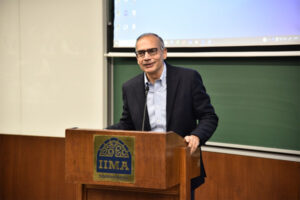
Opening the conference, Bharat Bhasker, Director, IIM Ahmedabad, underlined the scale of India’s development ambition and the role institutions must play in enabling it.
He said, “Achieving a developed India by 2047 requires a non-linear, accelerated transformation, one that takes us from a $4-trillion economy to nearly $35 trillion- an almost eight-fold increase. MSMEs, which are already a major contributor to exports and employ around 15 crore people, will be central to this growth. To meet this demand, we will also need an increase in skilled professionals. IIM Ahmedabad, along with other IIMs, must play a pivotal role in building this talent and supporting India’s next phase of development.”
Sunil Maheshwari, Dean, Alumni & External Relations, said the AID pillars reflect IIMA’s long-standing ethos of leadership development and community engagement, creating structured pathways for sustained societal impact.
From Corporate to Collective Social Responsibility
Collaboration, scale and accountability stressed
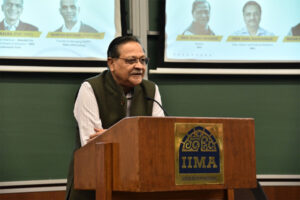
Deep Kalra, Chairman, IIMA Endowment Fund Board, called for a shift in approach to development financing and execution.
He said, “We need to move from corporate social responsibility to collective social responsibility. With strong regulators and progressive policies, it is now about leveraging our resources more effectively. The IIMA Endowment Fund serves as an important platform to design scalable solutions and contribute meaningfully to national development.”
Madan Mohanka, Chairman, Tega Industries, highlighted the transformative role of the case-method pedagogy at IIM Ahmedabad, crediting it with shaping leaders capable of real-world problem-solving. He stressed that India must evolve into a job-creating economy and unlock entrepreneurial potential across sectors to realise its development goals.
Rethinking India’s Development Model
Distinctive paths, independent thinking urged
Naresh Kothari, Founder and Managing Partner, Alpha Alternatives, urged participants to reconsider India’s self-perception in development efforts.
He said that while individual contributions may appear small, collectively they represent immense national potential, adding that India must chart its own development path by embracing alternatives, independent thinking and models rooted in its unique strengths.
Research, Dialogue and Action at the Core
40 speakers deliberate on scalable development pathways
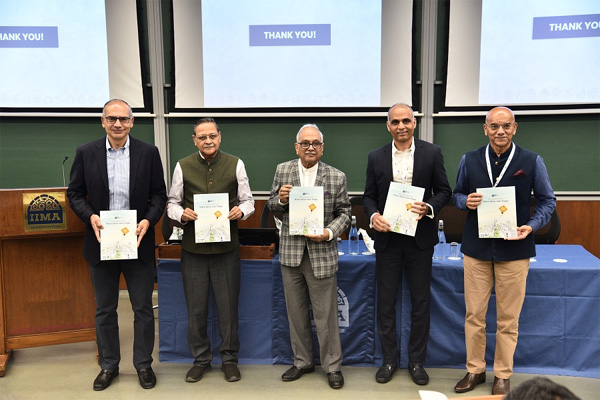
A key highlight of the conference was the launch of a research report showcasing faculty work from the past five years across the four AID pillars, reinforcing IIMA’s commitment to evidence-based policymaking.
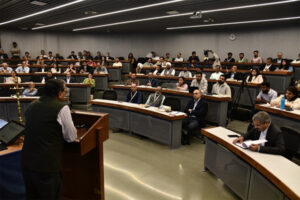
The conference featured thematic panel discussions on family offices as impact multipliers, blended finance, women’s entrepreneurship, AI for inclusion and governance, academia’s role in scaling development models, and strengthening India’s social workforce. Forty speakers shared insights on how collaboration, technology and community-centred design can accelerate progress toward Bharat@2047.
Five Years of IIMA Endowment Fund Impact
Momentum to continue beyond the conference
The event also marked five years of the IIMA Endowment Fund, which has played a key role in institution-building, alumni engagement and advancing public-purpose initiatives.
Delivering the closing address, Srikrishnan Srinivasan, CEO, IIMA Endowment Fund, said the discussions at AID reflected a shared commitment to advancing India’s development, adding that the momentum generated would continue to guide efforts toward scalable and sustainable impact.