- Gujarat’s farmer-owned dairy cooperative emerges as the world’s strongest dairy brand with a 93/100 Brand Strength Index and AAA+ rating
- Amul’s brand value surges 22% to USD 5 billion, while it also ranks second-strongest food brand globally
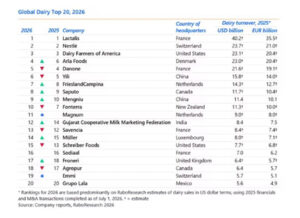
- The cooperative climbs to No. 12 in Rabobank’s Global Dairy Top 20, up from 14th last year
- Behind the global brand is a three-tier network of 18,600 village dairy cooperatives and 36 lakh milk producers, majority of them women
NE DAIRY & COOP BUREAU
ANAND, AUG 31
From the milk poured by millions of farmers in Gujarat and across India to supermarket shelves in more than 50 countries, Amul has turned a cooperative movement into a global brand—and a new international ranking has put that remarkable journey firmly in the world’s dairy spotlight.
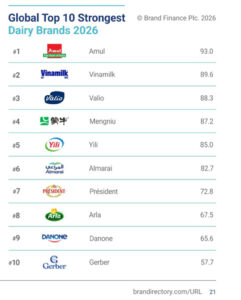
Gujarat Cooperative Milk Marketing Federation Ltd. (GCMMF), which markets products under the Amul brand, has been ranked the World’s Strongest Dairy Brand in Brand Finance UK’s Food & Drink 2026 study, which assesses the world’s most valuable and strongest food, non-alcoholic beverage and dairy brands.
Amul’s brand value has risen 22% to USD 5 billion, accompanied by an impressive Brand Strength Index (BSI) score of 93.0 out of 100 and an AAA+ brand-strength rating.
But the bigger story behind the ranking is what makes Amul different from conventional global food giants: the brand’s foundation rests on a farmer-owned cooperative structure that has linked rural producers with consumers on a global scale.
Amul’s global scoreboard
The Brand Finance recognition places Amul among the world’s leading food brands across multiple parameters.
Amul has been ranked:
- World’s strongest dairy brand
- Second-strongest food brand globally
- Fourth-most valuable dairy brand globally
- 13th-most valuable food brand globally
- The only Indian brand among the Top 50 global food brands
The rankings underline the extraordinary transformation of an Indian cooperative brand from a domestic milk movement into a globally recognised food and dairy powerhouse.
From farmer cooperatives to a $5-billion brand
Amul’s growing brand value is backed by an enormous consumer footprint.
The federation said the brand is trusted by more than one billion consumers across 50-plus countries, with Amul products selling more than 24 billion packs annually.
Yet the numbers tell only part of the story.
At the heart of Amul’s business is a three-tier cooperative structure comprising more than 18,600 village dairy cooperatives and 36 lakh milk producers, the majority of whom are women.
This model has enabled millions of dairy farmers to participate directly in the organised dairy economy while creating a large-scale supply chain capable of serving consumers across India and international markets.
The cooperative model has therefore made Amul more than a dairy brand.
It has become an economic bridge between India’s villages and the world’s markets.
Another global climb: Rabobank puts Amul at No. 12
Amul’s Brand Finance recognition comes alongside another significant global achievement.
The federation has been ranked No. 12 in Rabobank’s Annual Global Dairy Top 20 report 2026, improving from No. 14 last year.
The Rabobank ranking evaluates the financial performance of the world’s largest dairy companies and cooperatives, making Amul’s improved position another indication of the scale and strength of India’s farmer-owned dairy institution.
Taken together, the two recognitions offer two different measures of success:
Brand Finance measures the power and strength of the Amul name; Rabobank measures its position among the world’s major dairy enterprises.
Amul has strengthened its position on both fronts.
When “The Taste of India” becomes a global identity
Amul’s global rise is closely intertwined with India’s own dairy transformation.
The cooperative movement played a major role in taking India from a milk-deficient nation to the world’s largest milk producer, while creating livelihoods for millions of rural households and strengthening national nutrition security.
The result is an unusual combination of commercial scale and social impact.
Every packet sold under the Amul brand represents not just a consumer transaction but the culmination of a cooperative chain connecting milk producers, village societies, processing facilities, distribution networks and consumers.
That is the essence of “The Taste of India”—a brand identity that has travelled far beyond the geography from which it emerged.
The power of a woman-led rural economy
One of the most significant dimensions of Amul’s cooperative model is its role in strengthening rural livelihoods and women’s participation in the dairy economy.
With the majority of its 36 lakh milk producers being women, the cooperative structure has created pathways for millions of rural families to participate in a formal, organised value chain.
The federation’s model has consequently been associated with inclusive growth, social equity and sustainable rural development, while ensuring that dairy farmers remain central to the value-creation process.
This is perhaps what gives Amul’s latest global recognition a significance beyond brand rankings.
The world’s strongest dairy brand is not simply selling milk; it is carrying the economic aspirations of millions of milk producers to consumers around the world.
A cooperative recognised among global giants
Amul’s achievements have also been recognised within the international cooperative movement.
The Gujarat Cooperative Milk Marketing Federation was ranked the No. 1 cooperative in the world based on GDP-per-capita performance, according to the International Cooperative Alliance’s World Cooperative Monitor 2025, presented at the ICA CM50 Conference in Doha, Qatar.
The recognition adds another dimension to Amul’s global standing.
Its story demonstrates that a cooperative enterprise can combine scale, brand power, financial performance and farmer empowerment without abandoning its foundational purpose.
The Amul lesson
The latest global rankings offer a compelling lesson for India’s consumer and agricultural economy.
A powerful brand does not necessarily have to be built by concentrating ownership at the top.
Amul demonstrates another route: build the brand around millions of producers, create trust among consumers and allow the strength of the network to become the strength of the brand.
From a village milk collection centre to a global supermarket shelf, the Amul journey represents one of India’s most enduring experiments in cooperative enterprise.
Its latest recognition by Brand Finance is therefore not merely a trophy for a dairy company.
It is a global endorsement of the idea that when farmers own the ecosystem, rural prosperity can itself become a world-class brand.