NE HEALTH BUREAU
CHENNAI, SEPT 18
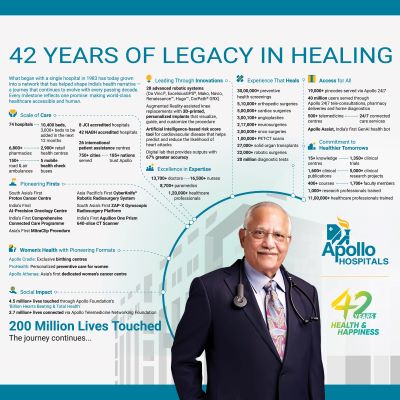
Apollo Hospitals, India’s first corporate healthcare institution, commemorated its 42nd anniversary this week, celebrating a journey that has redefined the country’s healthcare landscape. Since its inception in 1983, Apollo has touched over 200 million lives, built trust across 185 nations, and extended its reach to more than 19,000 pincodes in India.
42 years of care, compassion & countless smiles! On Sept 18, we celebrate a milestone of health & happiness with Apollo Hospitals. Thank you for trusting us with your journey, here’s to many more years of pioneering healthcare for India & beyond.#ApolloHospitals #42YearsOfCare pic.twitter.com/uZVz1C4S8b
— HospitalsApollo (@HospitalsApollo) September 18, 2025
Over four decades, Apollo has performed 51 lakh surgeries and completed 27,000 organ transplants, while also training over 11 lakh healthcare professionals, thus significantly strengthening India’s medical talent pool.
- Over 200 million lives touched, and global trust built across 185 nations
- 5.1 million surgeries | 27,000+ organ transplants | 22,000+ robotic surgeries
- 3 million preventive screenings | 20 million diagnostic tests | 11 lakh professionals trained
- 40 million Indians served through Apollo 24|7 digital health
- 1.9 million vulnerable lives touched through Apollo Foundation’s community programs
Reflecting on the milestone, Dr. Prathap C. Reddy, Chairman, Apollo Hospitals Group, said:
“When Apollo began in 1983, it was not just the birth of a hospital, but the birth of a movement. Over four decades, that movement has grown into a force that has touched 200 million lives, built trust across 185 nations, and redefined what is possible in healthcare. Our vision has always been to make world-class care accessible and future-ready. As India rises on the global stage, Apollo will remain a driving force, shaping healthier societies, advancing medical frontiers, and ensuring that families everywhere can look to the future with hope, health, and happiness.”
Apollo’s journey mirrors India’s own progress in longevity and health standards. By reducing reliance on foreign care, raising clinical benchmarks, and expanding access, Apollo has positioned India as a trusted global healthcare destination.
Dr. Preetha Reddy, Executive Vice Chairperson, emphasized the role of human capital:
“The strength of a nation lies in the health of its people. At Apollo, we have built not just hospitals, but human capital. When we invest in people, we invest in the dignity, resilience, and future of our nation.”
Dr. Suneeta Reddy, Managing Director, highlighted purposeful growth:
“Our expansion has always placed the patient at the core—whether in preventive care, advanced treatments, digital health, or research. As India aims for a $5 trillion economy, healthcare must be its strongest foundation, and Apollo’s mission is to ensure that quality care reaches every corner of this country of 1.4 billion.”
Driving innovation has been central to Apollo’s impact. The group has introduced several firsts in the region, including South Asia’s first Proton Cancer Centre, India’s first AI-Precision Oncology Centre, and the region’s first CyberKnife® Robotic Radiosurgery system. Today, it leads with 28 advanced robotic platforms, AI-powered cardiovascular risk prediction, and augmented reality–assisted surgeries, making cutting-edge medicine accessible today.
Dr. Sangita Reddy, Joint Managing Director, shared a vision for the future:
“The future of healthcare will be borderless, personalized, and powered by exponential technologies. We are integrating AI, robotics, and digital platforms to not just treat disease, but predict and prevent it. Imagine every Indian having a digital health twin, where interventions are precise, affordable, and accessible in real time—that is the future Apollo is building.”
Through Apollo 24|7, more than 40 million Indians now access teleconsultations, diagnostics, and pharmacy services anytime, anywhere. Beyond hospitals, Apollo Foundation initiatives such as Billion Hearts Beating and Total Health have reached 1.9 million vulnerable lives, underscoring the belief that healthcare is a right, not a privilege.