- ‘Chatterjee urges young professionals to remain rooted in values, stressing that architecture must be judged by its human impact and ethical grounding
- University honours Rasik J. Shah, distinguished structural engineer, educator and consultant, and Vidyadhar K. Phatak, one of India’s most respected urban planners, with Honorary Doctorates (Honoris Causa)
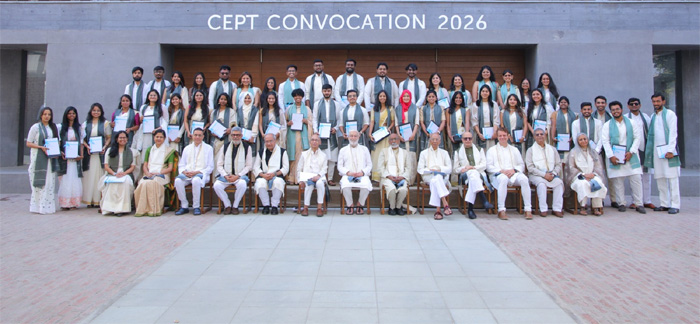
- The convocation sees 392 postgraduate students, 196 undergraduates and one PhD scholar graduate
- 45 students receive University Awards of Proficiency
- Prof Barjor Mehta, President, CEPT University, announced the launch of the MBA in Real Estate
- Climate, AI and accountability: Chairman Sanjay Lalbhai’s call to graduates
R MANICKAVASAGAM
AHMEDABAD, JAN 17
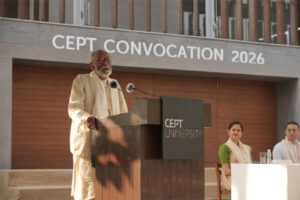
CEPT University marked a landmark moment in its academic journey with its 20th Annual Convocation, where 589 students were conferred degrees across undergraduate, postgraduate and doctoral programmes. The ceremony was anchored by a powerful message from Chief Guest Prof Ashoke Chatterjee, eminent design educator and former Executive Director of the National Institute of Design, who reminded graduates that meaningful architecture and design must go beyond efficiency and spectacle to serve society with care and conscience.
Drawing from decades of professional and institutional experience, Chatterjee urged young professionals to remain rooted in values, stressing that architecture must be judged by its human impact and ethical grounding.
‘Design must be ethical and enduring’
Delivering the convocation address, Chatterjee reflected on his long engagement with public and institutional architecture and said that truly significant architecture is defined by its emotional resonance and moral responsibility. He called upon graduates to evolve into professionals who deliver work that responds sensitively to people, place and collective memory, and to see design as a lifelong commitment to the public good.
He encouraged students to remain reflective practitioners who recognise that the built environment carries social, cultural and ethical consequences far beyond the moment of construction.
MBA in Real Estate Launched; Mehta outlines strategic expansion
Welcoming the gathering, Prof Barjor Mehta, President, CEPT University, announced the launch of the MBA in Real Estate, marking CEPT’s formal entry into management education under its Faculty of Management.
“The launch of our MBA offerings marks an important milestone for CEPT University,” Mehta said. “The MBA in Real Estate recognizes the growing need for professionals capable of steering the rapidly expanding formal real estate sector in the country. CEPT is well-positioned to deliver high-quality education in this emerging field, drawing on our long-standing strengths in architecture, urban planning and design, structural engineering, construction and project management, and urban management. The new program will provide opportunities for students from diverse undergraduate backgrounds to build careers in the market-facing production and management of the built environment.”
Climate, AI and accountability: Lalbhai’s call to graduates
Addressing the graduating cohort, Sanjay Lalbhai, Chairman, CEPT University, underlined that the class of 2026 is entering professions shaped by climate urgency and artificial intelligence, where technology must support—rather than replace—human judgement.
He urged graduates to take responsibility for the long-term environmental impact of their design and material choices, cautioning against speed-driven, disposable construction and calling for buildings and cities that are resilient, humane and built to endure.
Honorary Doctorates, Degrees And Academic Diversity On Display
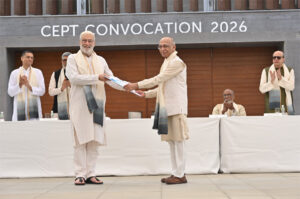
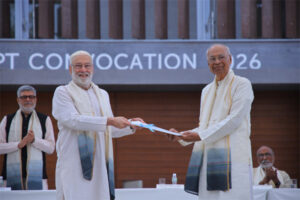
During the ceremony, Rasik J. Shah, distinguished structural engineer, educator and consultant, and Vidyadhar K. Phatak, one of India’s most respected urban planners, were conferred Honorary Doctorates (Honoris Causa) in recognition of their outstanding contributions to structural engineering and urban planning respectively. Shah’s career spans decades of teaching, research and professional practice, while Phatak is widely acknowledged for his five-decade contribution to urban development, policy formulation and planning education in India.
The convocation saw 392 postgraduate students, 196 undergraduates and one PhD scholar graduate, with 45 students receiving University Awards of Proficiency. Faculty-wise, graduates included 213 from Architecture, 95 from Design, 10 from Management, 151 from Planning and 120 from Technology.
Following the central ceremony at Shrenikbhai Plaza, faculty-level convocations were held, where students received their degrees from their respective Deans, concluding the event on a celebratory note that marked both the culmination of academic journeys and the beginning of professional paths.