R ARIVANANTHAM
CHENNAI, FEB 27
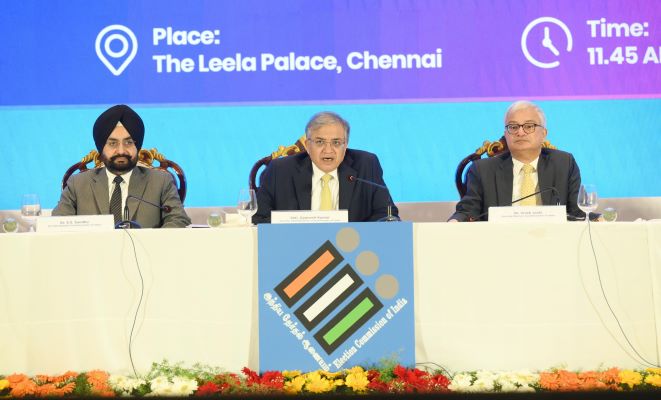
In a powerful endorsement of Tamil Nadu’s electoral readiness, Gyanesh Kumar, Chief Election Commissioner of Election Commission of India, on Friday declared the state’s recently concluded Special Intensive Revision (SIR) of electoral rolls a “model for the country” and “a great success,” while hinting that the upcoming Assembly elections could set new national standards in democratic conduct.
Addressing a press conference after a comprehensive two-day review of poll preparedness, Kumar revealed that political parties have suggested conducting the Tamil Nadu Assembly elections in a single phase, with the final decision to be taken after evaluating logistics, security, and administrative factors.
- Special Intensive Revision hailed as national model, promises cleaner, more credible electoral rolls
- Youth surge, inclusive polling, and digital transparency to define upcoming Assembly elections
- Election Commission weighs single-phase polls as state prepares for historic democratic exercise
“The takeaway from Bihar is that it has been the most flawless elections held in recent decades and I have been assured by all the collectors, SPs and the entire electoral machinery, including enforcement agencies, that Tamil Nadu is going to set records and will be much better than Bihar,” he said.
Electoral Rolls Reform Emerges as National Template
During the review meeting on poll preparedness in Tamil Nadu, CEC Shri Gyanesh Kumar, along with ECs Shri Sukhbir Singh Sandhu and Dr. Vivek Joshi, also felicitated Selvi Jyothikalai, PwD Icon, in recognition of her inspiring contribution to inclusive electoral participation.… pic.twitter.com/4qhLgaZ1fe
— Election Commission of India (@ECISVEEP) February 27, 2026
Praising the Special Intensive Revision exercise, Kumar emphasised its pivotal role in strengthening democratic integrity.
“The recently concluded SIR of electoral rolls in Tamil Nadu is a model for the country and a great success,” he said, underscoring that the exercise ensured cleaner and more accurate voter rolls.
Responding to criticism from certain political quarters regarding alleged deletions, he defended the process as a demonstration of professionalism and diligence by election officials.
“Pure electoral rolls are the bedrock of democracy,” Kumar said, congratulating booth-level officers (BLOs) and electoral officials for ensuring transparency and credibility.
Youth Power and Inclusive Democracy at the Core
The Commission felicitates first-time voters of Tamil Nadu as they embark on their democratic journey, during the review meeting on poll preparedness ahead of Tamil Nadu Assembly Elections 2026.#ECI #TamilNaduAssemblyElections2026 pic.twitter.com/RDgExeCRmp
— Election Commission of India (@ECISVEEP) February 27, 2026
Tamil Nadu’s electorate is poised to witness a major demographic shift, with young voters emerging as a decisive force.
“The upcoming election will have a higher inclusive focus on youth. There will be 3,060 dedicated assistant electoral registration officers for campaigns in colleges. Tamil Nadu will witness over 12.5 lakh voters aged 18 to 19 years and there are one crore young voters in the 20 to 29 age bracket,” Kumar said.
The CEC also described Tamil Nadu as a politically aware and participative state.
“Though 100 per cent voting is not mandatory as per law, Tamil Nadu’s voting has been highly encouraging and politically conscious,” he noted.
Transparency, Accessibility, and Technology to Define the Polls
In a major boost to transparency and voter convenience, the Election Commission announced extensive infrastructure and digital measures covering over 75,000 polling stations statewide.
Key inclusivity initiatives include:
- 258 women-managed polling stations
- 47 disabled-friendly polling stations
- 265 model polling stations
- Ground-floor voting access for senior citizens and persons with disabilities
Technological upgrades will further enhance voter experience.
“Each polling station will accommodate 1,200 electors. Voter information slips will be like invitations asking people to come and vote, and on the right side the booth numbers will be clearly indicated,” Kumar said.
Electronic Voting Machines (EVMs) will feature colour photographs and larger fonts to improve accessibility, particularly for senior citizens.
The entire election process will be digitally monitored through the ECINET platform.
“The entire polling process will be webcast through ECINET, which will contain information about the election, candidates, affidavits, polling stations, voter turnout and results. The voting percentage will also be constantly uploaded on this centralised digital platform,” Kumar explained.
Robust Counting Protocols to Strengthen Trust
To further reinforce electoral transparency, Kumar highlighted stringent verification mechanisms.
“Mandatory VVPAT counting will take place and even after counting is over, any candidate, on payment of a fee, can match EVMs with VVPATs during the next seven days,” he said.
Additionally, postal ballots will be counted earlier than EVM rounds — a procedural reform aimed at streamlining counting efficiency.
Democracy Rooted in Tradition, Powered by Modern Vision
Reflecting on Tamil Nadu’s rich democratic heritage, Kumar invoked the state’s historic Kudavolai system — one of the earliest known voting methods.
“Tamil Nadu’s glorious past in democracy was proudly mentioned in a conference,” he said, acknowledging the state’s enduring democratic legacy.
He also reiterated the Election Commission’s commitment to conducting free and fair elections.
“I hope that the promise of holding inducement-free, transparent, fair and memorable elections in Tamil Nadu will be showcased by our machinery to the entire country and the world,” Kumar said.
Emphasising adherence to constitutional procedures, he clarified:
“As per law, nominations should be submitted in person and on time. I think the festival of democracy will take precedence.”
Preparations in Full Swing
The CEC conducted detailed reviews with senior police officials, district collectors, enforcement agencies, and state authorities, alongside Election Commissioners Sukhbir Singh Sandhu and Vivek Joshi, senior deputy Election Commissioner Maneesh Garg, deputy Election Commissioner Sanjay Kumar, and Tamil Nadu Chief Electoral Officer Archana Patnaik.
He also honoured booth-level officers for their exemplary role in electoral roll revision and presented EPIC cards to first-time voters, recognising their entry into India’s democratic process.
As Tamil Nadu prepares for its next Assembly election, the Election Commission’s message is clear — the state is not just preparing for polls, but poised to redefine the gold standard of democracy in action.