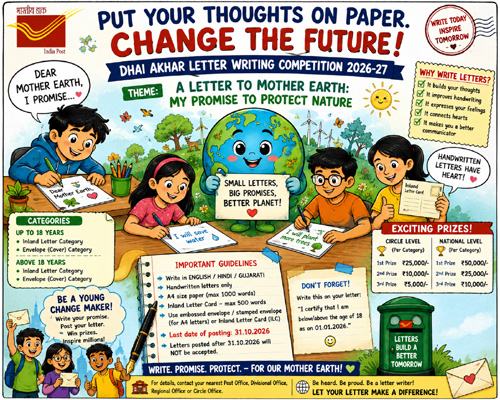
- Department of Posts revives the lost art of handwritten letters through a national competition for children and adults
- ‘A Letter to Mother Earth: My Promise to Protect Nature’ puts pen, paper and the planet at the heart of the 2026-27 contest
- Young writers up to 18 years can compete in Inland Letter and Envelope categories, with National Level first prize of ₹50,000
- Entries may be written in English, Hindi or Gujarati, giving children a chance to express environmental concerns in their own words
- Only handwritten letters accepted, offering a powerful antidote to the instant, screen-driven communication of the digital age
NE EDUCATION BUREAU
AHMEDABAD, JULY 31
What happens when a child puts down the smartphone, picks up a pen and writes—not a text, not an emoji, but a real letter? The answer could be more profound than simply reviving an old-fashioned habit. It could help a generation rediscover the patience of thought, beauty of handwriting, power of personal expression and emotional connection that a handwritten letter can carry.
In an age when children increasingly communicate through instant messages, voice notes and emojis, the Department of Posts’ national-level ‘Dhai Akhar’ Letter Writing Competition 2026-27 is throwing open an old-fashioned door to a remarkably contemporary conversation—with Mother Earth.
The theme this year is “A Letter to Mother Earth: My Promise to Protect Nature”, inviting participants to put their thoughts, concerns and promises for the planet on paper.
And there is one non-negotiable rule that makes the exercise particularly meaningful: the letter must be handwritten.
When a pen replaces the screen
The competition is designed to reconnect participants with the art of letter writing, but its environmental theme gives the exercise an even larger purpose.
A child writing to Mother Earth could speak about disappearing trees, polluted rivers, plastic waste, disappearing birds, extreme weather, water conservation or simply a promise to live more responsibly.
The format encourages youngsters to pause, think, compose and write, rather than type and send within seconds.
For children growing up in a world of keyboards and touchscreens, the exercise can turn handwriting into more than a school skill—it can become a form of personal storytelling.
Kids get their own national stage
The National Level competition has two age groups:
Up to 18 years
- Inland Letter Category
- Envelope (Cover) Category
Above 18 years
- Inland Letter Category
- Envelope (Cover) Category
For young participants, the competition offers something increasingly rare: a national platform where their own handwriting and ideas—not typing speed—take centre stage.
Letters can be written in English, Hindi or Gujarati, enabling participants to express themselves in the language in which they can communicate most naturally.
₹50,000 for the best letter
The competition comes with substantial prize money at both Circle and National levels.
At the Circle Level, winners in each category will receive:
- First Prize: ₹25,000
- Second Prize: ₹10,000
- Third Prize: ₹5,000
At the National Level, winners in each category will receive:
- First Prize: ₹50,000
- Second Prize: ₹25,000
- Third Prize: ₹10,000
The awards could make the competition attractive to aspiring young writers, but its larger reward may be less tangible: the experience of discovering that a carefully written letter can travel beyond a screen and create a lasting connection.
Pen, paper and a promise to earth
Participants writing on plain A4-size paper can submit letters of up to 1,000 words, while letters written on an Inland Letter Card (ILC) should not exceed 500 words.
For A4 letters, participants must use an embossed envelope or an envelope bearing the requisite stamp. Inland Letter Card entries may be submitted in the permitted ILC format.
The last date for posting entries is October 31, 2026. Letters posted after October 31 will not be accepted.
Participants must also certify their age on the letter with the declaration:
“I certify that I am below/above the age of 18 as on 01.01.2026.”
The letter that could outlive the message
The competition arrives at an interesting moment. Children today can send a message across the world in seconds, but the speed of communication can sometimes leave little room for reflection.
A handwritten letter is slower. It demands concentration. It requires the writer to choose words carefully, arrange thoughts and physically transform an idea into something another person can hold.
That is precisely why ‘Dhai Akhar’ could become more than a writing competition.
If a child writes to Mother Earth about planting a tree, saving water, refusing single-use plastic or protecting an animal, the letter becomes a personal pledge. And if thousands of children make such promises on paper, the competition could turn handwriting into an unexpected instrument of environmental awareness.
The Department of Posts has invited participants to contact their nearest Post Office, Divisional Office, Regional Office or Circle Office for further information about the competition.
The deadline is October 31.
But the larger message is timeless:
Before children learn to swipe, perhaps they should also learn to write—and before they inherit the Earth, perhaps they should write down what they promise to do for it.