NE BIZ/FEATURES BUREAU
CHENNAI, JULY 25
What does meaningful banking look like when it steps beyond branches and balance sheets and reaches the doorstep of the communities it serves?
For Indian Bank, the answer unfolded at Neikuppi village in Chengalpattu district, where its Corporate Social Responsibility (CSR) initiatives brought together education support, healthcare access and assistance for differently abled beneficiaries.
- From classrooms to community care, Indian Bank’s CSR outreach delivers education, healthcare and assistive support in Chengalpattu
- MD & CEO Binod Kumar leads welfare initiative with Executive Directors Ashutosh Chaudhury, Shiv Bajrang Singh and Mini T.M.
- School bags and notebooks support students; tricycles and hearing aids empower differently abled beneficiaries
- Health and eye screening camps bring essential preventive care closer to rural residents
- A community-first CSR model strengthens Indian Bank’s connect with beneficiaries and stakeholders
The outreach programme reflected a simple but powerful idea: Financial institutions can create deeper social value when their community engagement is designed around real, everyday needs.
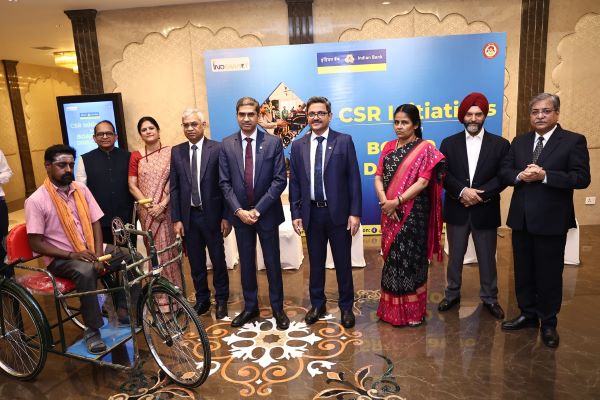
Leading the initiative was Binod Kumar, Managing Director & CEO, Indian Bank, along with Executive Directors Ashutosh Chaudhury, Shiv Bajrang Singh and Mini T.M., and other members of the Bank’s Board.
The programme saw the distribution of school bags and notebooks to students, helping ease educational expenses for families. Tricycles and hearing aids were also provided to differently abled beneficiaries, supporting mobility, independence and improved quality of life.
CSR that puts education at the heart of community development
The educational kits were aimed at helping students continue their academic journey with essential learning materials.
For many families, school supplies can represent a recurring financial burden. By supporting students with school bags and notebooks, the initiative sought to ensure that basic educational needs do not become barriers to learning.
The intervention also reinforces Indian Bank’s focus on inclusive community development, where CSR support extends across age groups and social needs.
Assistive devices turn support into independence
A key feature of the outreach was the distribution of tricycles and hearing aids to differently abled beneficiaries.
The initiative focused not merely on providing material assistance but on improving everyday mobility, communication and independence.
Such targeted CSR interventions can have a direct impact on beneficiaries and their families by helping them participate more actively in education, work and community life.
Healthcare comes closer to the community
The programme also included health and eye screening camps organised in partnership with Apollo Hospitals and Dr. Agarwal’s Eye Hospital at the Panchayat Union Office, Neikuppi.
The camps witnessed strong participation from local residents and brought preventive healthcare and eye screening services closer to the community.
The initiative highlighted the importance of taking basic health services beyond conventional institutional settings and closer to people who may otherwise face difficulties in accessing timely screening.
‘Holistic development’ drives Indian Bank’s outreach
Speaking at the event, Binod Kumar said the Bank remains focused on holistic development spanning education, healthcare and community welfare as a core part of its outreach.
The approach reflects the growing role of CSR in creating sustained community value and strengthening the relationship between institutions and the communities they serve.
By bringing together educational support, assistive devices and healthcare services in a single community-focused programme, Indian Bank demonstrated a CSR model centred on inclusion, accessibility and measurable human impact.
From corporate responsibility to community trust
The Neikuppi initiative also underlined how CSR can become an important bridge between a bank and its wider stakeholder ecosystem — customers, employees, communities, institutions and beneficiaries.
When social initiatives respond to concrete needs, their impact can extend well beyond the day of the programme.
A school bag can support a child’s learning journey. A tricycle can restore mobility. A hearing aid can improve communication. A health screening can lead to early detection and timely care.
That is where CSR moves from a corporate obligation to a meaningful instrument of social change.
Through initiatives such as the Neikuppi outreach, Indian Bank continues to reinforce its commitment to socially responsible banking and inclusive community development, seeking to create meaningful change in the communities it serves.