- Rotary International District 3055’s CSR Conclave brings corporate leaders and community-development stakeholders onto one platform in Ahmedabad
- “Collaborate and create lasting impact” emerges as the central theme linking corporate social investment with grassroots needs
- Rotary Foundation pitches transparency, accountability, execution capability and fund augmentation as key strengths for CSR implementation
- Healthcare, education, skilling, water conservation and rural empowerment figure among priority areas for potential partnerships
NE NEWS SERVICE
AHMEDABAD, SEPTEMBER 20
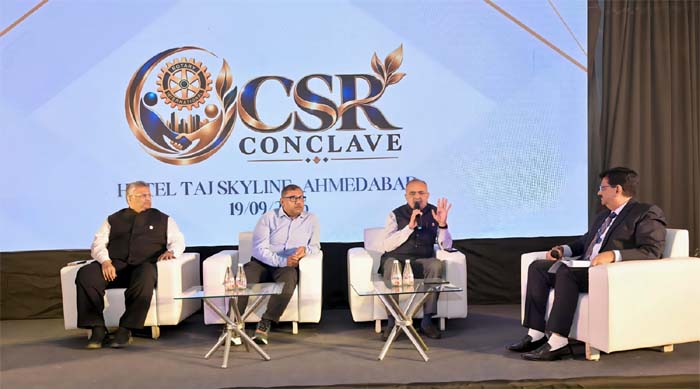
When CSR spending is no longer judged merely by how much is invested, but by how transparently and sustainably it changes lives, who should execute the projects? This larger question underpinned Rotary International District 3055’s CSR Conclave held in Ahmedabad on Saturday, bringing corporate CSR leaders and Rotary’s community-development network together around the theme, “Collaborate and create lasting impact: Together for a stronger, more inclusive society.”
The conclave sought to build a bridge between corporate social investments and grassroots development, with participation from CSR heads, corporate leaders and representatives of foundations and companies including Adani Foundation, Nirma Limited, AM/NS India, Cadila Pharmaceuticals, Harsha Engineers, Monte Carlo, Zen Foundation, Voltas Beko, Kiran Motors, ONGC, GHCL, IFFCO-Tokio and Suzlon, among others.
A pitch for impact beyond compliance
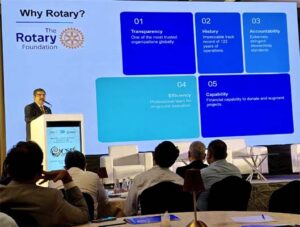
Addressing the gathering, Naimish N Ravani, Rotary District Governor (2026–27), made the case for Rotary as a potential implementation partner for corporate CSR initiatives through a presentation titled “Why Rotary?”
Ravani highlighted five institutional strengths of The Rotary Foundation that, he said, could distinguish it as a CSR implementation partner.
Transparency was presented as a core strength, with the Foundation positioned as a widely trusted non-profit organisation. Proven history was another pillar, with Rotary’s humanitarian work spanning more than 122 years.
He also underlined strict accountability, referring to stewardship standards intended to ensure compliance, governance and fund integrity; execution efficiency, backed by professional teams and grassroots project delivery; and the Foundation’s ability to augment funds through Rotary’s global and district grant mechanisms.
The latter, he said, could enable corporate CSR grants to be supplemented through Rotary’s grant framework, potentially expanding the scale of projects.
‘Measurable, transparent and sustainable outcomes’
Extending an invitation to corporate organisations, Ravani said the expectations from CSR were changing and companies were increasingly looking beyond statutory compliance.
“Corporates today seek not only statutory compliance, but measurable, transparent, and sustainable outcomes from their CSR investments.”
He added: “The Rotary Foundation combines over a century of global credibility with robust grassroots execution capabilities, making it a natural and dependable implementation partner.”
Ravani further said Rotary was prepared to work with more corporate partners to manage and execute CSR initiatives.
“We are opening our arms to associate with more corporates to manage and execute their CSR initiatives in a seamless and completely hassle-free manner.”
He said Rotary would welcome approaches from corporate partners while also proactively reaching out to more organisations to build what he described as “transformative, high-impact partnerships.”
From boardrooms to grassroots
The conclave also opened up deliberations between corporate delegates and Rotary project leaders on areas where CSR intervention could potentially deliver community-level impact.
The discussions covered healthcare infrastructure, quality education, skill development, water conservation and rural empowerment, reflecting sectors where corporate funding and grassroots implementation could intersect.
The conclave concluded with an interactive networking dinner, with discussions laying the groundwork for potential strategic CSR collaborations in the region.
At its core, the gathering placed a larger proposition before the corporate sector: CSR impact depends not only on the quantum of money committed, but also on how effectively, transparently and sustainably that investment reaches the communities it is intended to serve.