
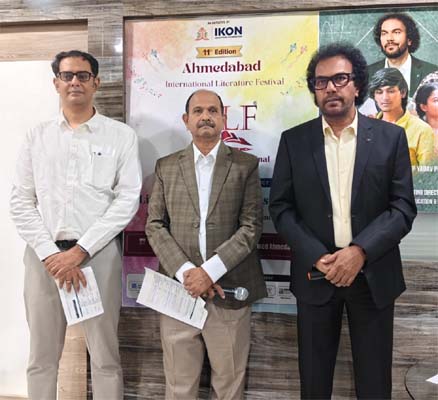
- AILF’s 11th edition, on October 24–25, puts the healing and transformative power of storytelling centre stage
- Writers, poets, filmmakers, educators and international voices converge at The Ummed, Ahmedabad
- From the making of Drop Out to book launches, cinema and creativity, the festival bridges literature and other art forms
- Gujarati and other regional narratives take the spotlight amid the dominance of English and Hindi
- AI, Instagram and changing reading habits prompt fresh questions about engaging younger generations with books
- Organised by the Ikon Education Foundation, the festival seeks to connect cultures, generations and creative disciplines
R MANICKAVASAGAM
AHMEDABAD, OCT 19
What can a story do that a fleeting social-media post cannot? Can a poem help heal an emotional wound, a novel deepen our understanding of another culture, or a film inspire someone to look at life differently? These questions acquire particular significance in an age of instant digital gratification, as the 11th Ahmedabad International Literature Festival (AILF) returns on October 24–25 with an invitation to rediscover the enduring power of the written and spoken word.
To be held at The Ummed, Ahmedabad, the two-day festival will bring together writers, poets, filmmakers, scholars, educators and cultural practitioners under the theme “Literature & the Echoes of Joy – Stories That Heal, Inspire and Redefine Joy.” Its programme spans literary conversations, cinema, Hindi poetry, regional narratives, creative expression and the changing media landscape, with book launches, workshops, masterclasses and cultural performances adding to the experience. The festival is an initiative of the Ikon Education Foundation.
Stories that connect beyond the printed page
For Umashanker Yadav, Founder-Director of AILF, the annual theme reflects the concerns and possibilities of its time.
“Every year, we celebrate the festival on the most relevant topic of that period. This year our theme is ‘Literature & the Echoes of Joy – Stories That Heal, Inspire and Redefine Joy,’” he said.
He explained that the festival would explore how stories connect people, preserve cultural identities and respond to changing social and creative landscapes.
“My film ‘Dropout’ will be screened at this festival. We will also publish five to six books at this festival,” Yadav added.
The inclusion of cinema alongside literary discussions underlines a wider understanding of storytelling: narratives can travel through books, poems, theatre and films, reaching audiences with different interests and experiences.
Can literature compete with the scroll?
The challenge of cultivating a reading habit among young people in an era of artificial intelligence and social-media platforms will be another important talking point.
Sahitya Manch Founder and AI expert Vision Raval said, “In the age of AI, and Instagram, AILF is attempting to make reading compelling for youth and students without diluting literary depth.”
He also pointed to the continuing significance of Gujarati literature and regional-language writing despite the dominance of English and Hindi.
The question is not simply whether young people read fewer books, but how literature can remain relevant in the ways they discover ideas, communicate and understand the world. Can technology become a bridge to reading rather than a substitute for it? Can literary festivals transform passive audiences into curious readers and aspiring writers?
For educators, parents, publishers and cultural institutions, these are questions with implications far beyond a two-day event.
Literary voices meet cinema and creative expression
A diverse roster of participants, including Padma Shri awardee and Gujarati literary figure Dr Kumarpal Desai; Telugu writer P. Lalita Kumari, popularly known as Volga; poet, lyricist and screenwriter Anil Chavda; filmmaker and theatre artist Abhishek Shah; screenwriter and director Sanjay Chhel; filmmaker Umesh Shukla; and educationist Dr Manjula Pooja Shroff, among others will play their vital role in kindling literary fire, added Yadav.
Their presence reflects the festival’s effort to bring literary scholarship into conversation with cinema, education, poetry and contemporary cultural practice.
A film-focused session, “From Dream to Screen: The Making of Drop Out,” is set to examine the journey of the Hindi feature film, bringing together Umashanker Yadav, Vivek Yadav and Sandeep Yadav, according to the programme information supplied by the organisers.
The planned film screening and the announcement of five to six book publications will give audiences opportunities to engage with storytelling beyond panel discussions. The festival website also lists writing workshops and masterclasses, book launches and competitions, poetry, music, cultural performances, art showcases and a curated bookstore. <Cite refs={[“turn149453view0″,”turn530900search5”]}/>
Regional languages deserve a larger conversation
For Gujarat, the festival’s emphasis on regional literature has particular cultural significance. Gujarati writing carries the experiences, humour, memories, social concerns and changing aspirations of its people. Such literature can preserve local identities while also speaking to readers beyond linguistic boundaries.
The challenge is to ensure that regional-language writers are not confined to audiences who already know their work. Translation, cross-language conversations, publishing initiatives and engagement with younger readers can help bring these voices into wider circulation.
The participation of writers and cultural practitioners from different backgrounds offers an opportunity to explore how stories rooted in specific communities can illuminate experiences shared across societies.
The festival’s international dimension is also reflected in its speaker roster, which includes cultural practitioners and scholars from countries such as Vietnam, Madagascar, Bangladesh, Sri Lanka and the Maldives.
A platform for readers, students and creative communities
Founded in 2016 by Umashanker Yadav, AILF has developed into a platform for conversations spanning literature, cinema, governance and the arts. Its official website says previous editions have hosted more than 500 speakers across over 200 sessions.
For students, the festival can offer exposure to writers and practitioners whose work extends beyond textbooks. For aspiring authors and filmmakers, it can open avenues to learn about creative processes and publishing. For educators and parents, it provides an opportunity to consider how reading can nurture imagination, empathy and independent thought. Publishers and literary organisations, meanwhile, can use such gatherings to connect authors with new audiences.
The festival’s larger promise lies in bringing these constituencies into a shared conversation—one in which established voices and emerging talent, local narratives and global perspectives, and traditional literary forms and contemporary media can coexist.
Beyond entertainment, towards empathy
The theme of joy invites a deeper consideration of literature’s place in everyday life. Joy in a story need not mean escapism alone. It can emerge from recognising oneself in another person’s experience, discovering a new perspective, confronting an uncomfortable truth or finding language for an emotion that was previously difficult to express.
At a time when technology is changing how stories are produced, distributed and consumed, the more enduring question is what makes a story meaningful to a human being.
As Ahmedabad prepares to host the 11th edition of AILF, the festival offers an opportunity to celebrate books and creative expression while renewing the conversation about reading, cultural identity and the value of attentive listening.
Ultimately, the measure of a literature festival may lie not only in the number of speakers or sessions it attracts, but also in what audiences carry home: a book they want to read, a language they want to explore, a perspective they had not considered or a story that stays with them long after the event has ended.
FESTIVAL AT A GLANCE
- Event: 11th Ahmedabad International Literature Festival (AILF 2026)
- Dates: October 24–25, 2026
- Venue: The Ummed, Ahmedabad
- Theme: Literature & the Echoes of Joy – Stories That Heal, Inspire and Redefine Joy
- Highlights: Literary conversations, cinema, poetry, book launches, writing workshops, masterclasses and cultural performances
- Official website: ailf.co.in