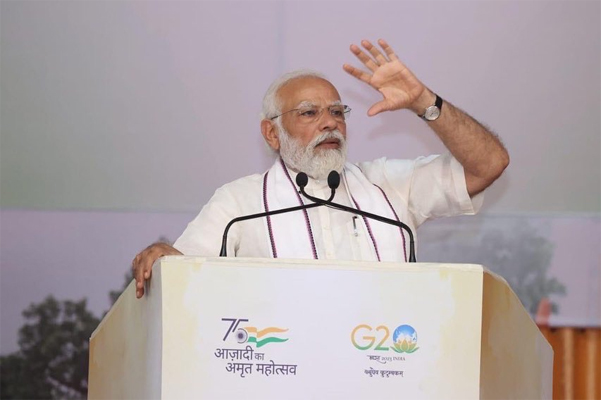
- Two key Railways projects to add 224 km capacity across Maharashtra & Gujarat, boosting mobility, freight and regional growth
- High-level review of 6-lane Shamlaji–Motachiloda stretch signals big acceleration in Golden Quadrilateral upgrades
- Top leadership says enhanced rail-road infrastructure will improve connectivity for 32 lakh people and catalyse economic momentum
- Integrated PM Gati Shakti planning to cut congestion, improve logistics efficiency and support long-term climate goals
NE INFRASTRUCTURE BUREAU
NEW DELHI / GANDHINAGAR, NOV 26
In a major infrastructure boost for Western India, the Union Cabinet has approved two multitracking projects of Indian Railways worth Rs 2,781 crore, even as senior national and state leadership reviewed progress on the six-lane Shamlaji–Motachiloda highway section on NH-48, a critical link on the Golden Quadrilateral connecting Gujarat and Rajasthan.
Cabinet Clears Two Railway Projects Across Maharashtra & Gujarat
The Cabinet Committee on Economic Affairs, chaired by the Prime Minister, approved two key Ministry of Railways projects aimed at increasing line capacity, easing congestion and strengthening regional mobility:
- Devbhumi Dwarka (Okha) – Kanalus Doubling – 141 km
- Badlapur – Karjat 3rd & 4th Line – 32 km
Together, these projects extend the Indian Railways network by 224 km across four districts in Maharashtra and Gujarat, enhancing connectivity for 585 villages with a population of nearly 32 lakh people.
Officials said the expanded network will significantly improve operational efficiency, service reliability, and freight throughput. The initiatives are aligned with the PM Gati Shakti National Master Plan, ensuring integrated multimodal connectivity with long-term logistics efficiency.
Strategic Benefits
- Devbhumi Dwarka (Okha) – Kanalus doubling will improve travel to the Dwarkadhish Temple, boosting pilgrimage routes and aiding the socio-economic development of the Saurashtra region.
- Badlapur–Karjat 3rd & 4th lines, part of the crucial Mumbai suburban corridor, will help meet rising commuter demand and enhance connectivity to Southern India.
- Capacity expansion is estimated to support 18 MTPA additional freight, especially coal, containers, cement, salt, petroleum and food grains.
- The shift to rail transport is expected to save 3 crore litres of fuel, cut 16 crore kg of CO₂, equivalent to planting 64 lakh trees.
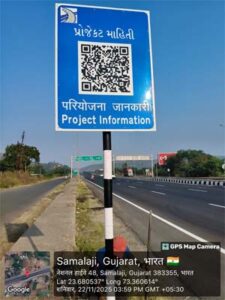
High-Level Review of 6-Lane Shamlaji–Motachiloda Section on NH-48
In a parallel development, the national leadership along with the Gujarat Chief Minister, NHAI Chairman and senior officials carried out an on-ground inspection of the 6-lane Shamlaji–Motachiloda stretch on NH-48.
The inspection covered major structures including:
- Motipura Flyover (Ch. 492) near Himmatnagar
- VUP at Ch. 524 near Majra
All structures on the stretch have been completed except three railway overbridges, which are scheduled for completion by March 2026.
The Minister appreciated the riding quality of the upgraded highway section and emphasised that NH-48 is a vital economic lifeline between Gujarat and Rajasthan. He reiterated the commitment to building safer, faster, world-class highways that catalyse trade, regional development and industry growth.
NHAI’s Commitment
NHAI officials said the ongoing work aligns with the national vision of scaling India’s road infrastructure to unprecedented standards, enhancing passenger comfort and freight efficiency across the Golden Quadrilateral.
A Unified Infrastructure Push for Western India
Between the expanded rail capacity and accelerated highway modernization, the two developments highlight a coordinated effort to strengthen the infrastructure backbone of Gujarat, Maharashtra and neighbouring regions.
Both initiatives underscore a long-term strategy:
- Boosting multi-modal logistics efficiency
- Reducing travel time and congestion
- Supporting pilgrimage, suburban mobility and freight corridors
- Enhancing economic opportunities and employment
- Advancing national climate and sustainability goals
With the twin approvals and project reviews, the Centre signalled a decisive push to ensure Western India’s rail and road networks are future-ready, resilient and capable of supporting the country’s rapid economic growth trajectory.