- Low-cost crawling robot offers a breakthrough solution for inspecting India’s 5 lakh km overhead power network
- Born from a classroom assignment, the innovation tackles deadly manual climbs and costly drone inspections
- ₹15,000 prototype challenges ₹50–60 crore drone economics, cuts risk to grid workers
- Mentorship, lab access and industry backing turn student idea into a national infrastructure solution
NE SCIENCE & TECHNOLOGY BUREAU
GANDHINAGAR, JAN 23
For millions of Indians, overhead power lines fade into the background—until a blackout strikes. For electricity distribution companies, however, these wires represent one of the country’s most persistent and dangerous infrastructure challenges. With over five lakh kilometres of overhead transmission lines, inspection and maintenance remain a high-risk, high-cost operation.
Manual inspections force workers to scale live towers at great personal danger, while industrial drones—though safer—are expensive, battery-limited, and often impractical for long-distance monitoring.
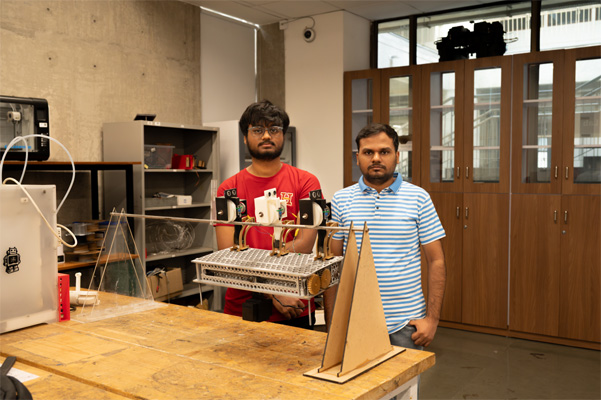
This gap between danger and affordability became the spark for innovation for Nikhil Kumar Lal and Manas Kalal, undergraduate students from the Department of Mechanical Engineering at the Indian Institute of Technology Gandhinagar (IITGN), who have developed a groundbreaking, low-cost robotic system that crawls directly on power lines to inspect them.
From Classroom Problem to National Challenge
The project originated not in a corporate lab, but in a classroom.
“It began as a routine course assignment at IITGN, ‘Find a real-world problem and build a working prototype to solve it,’” said Nikhil Kumar Lal, a final-year BTech student.
As part of their exploration, the duo examined multiple infrastructure sectors before zeroing in on power distribution. The magnitude of the problem soon became apparent.
“Approximately 30 per cent of power loss in the power grid system stems from line failures, and roughly 80 per cent of these failures are attributable to faulty lines that have deteriorated over time,” said Manas Kalal, a fourth-year BTech student.
Rethinking Inspection: Let the Wire Be the Path
Instead of following the industry norm of flying over lines or placing humans on them, the students asked a simple but radical question: why not let the robot use the wire itself as the track?
Working from IITGN’s Tinkerer’s Lab, equipped with basic machining tools, a 3D printer, and continuous mentorship, the team developed a compact robot capable of autonomously traversing high-voltage power lines.
Unlike drones that constantly fight gravity and battery drain, the robot uses the wire as its pathway. It carries a thermal camera and a visual camera to detect hotspots caused by resistance, wear, or material degradation—early indicators of failure.
Engineering Around Real-World Obstacles
Power lines are rarely uninterrupted. Insulators, junctions, and support structures pose major hurdles.
“A robot can easily roll along a straight wire,” explained Nikhil, “but without the ability to bypass obstacles, inspection remains limited.”
To overcome this, the team engineered a disengage-and-reengage mechanism that allows the robot to temporarily detach, cross obstructions, and resume inspection—dramatically extending its operational range.
Stability was another challenge. Real-world power lines sway, curve, and vibrate.
“Excessive vibration can cause the robot to lose contact or topple,” said Manas.
The solution came in the form of a carefully balanced suspension system, controlled wheel engagement, and a lead-damping mechanism that stabilises movement and reduces oscillations even in windy conditions.
Mentorship, Affordability and Industry Validation
The students credit Dr Madhu Vadali, Associate Professor, Department of Mechanical Engineering, IITGN, for guiding them through the iterative engineering process.
“Manas and Nikhil worked over the course of 10 months to speedily transform their idea into a tangible prototype,” said Dr Vadali, who held weekly design and review sessions with the team.
Beyond engineering, affordability became the project’s strongest differentiator.
While industrial drone-based inspection systems typically cost ₹50–60 lakh, the IITGN team developed their prototype for approximately ₹15,000, estimating a market-ready version at ₹3–4 lakh.
Recognising this disruptive potential, Infineon Technologies India Private Limited selected the project under its national CSR initiative, granting ₹5 lakh in funding. The team also received ₹62,500 from Hyundai Motor Group.
“This support has given us the confidence and resources to move beyond a lab prototype and think seriously about real-world deployment,” said Manas.
“To support our future commercialisation plans, we have filed a provisional patent and aim to submit a final application by 2026,” he added.
Towards Safer Grids and National Impact
The team is now refining the robot to handle natural wire sag and curvature, while developing electromagnetic shielding to protect electronics on active high-voltage lines.
By reducing inspection costs by nearly 90 per cent and eliminating risks to human workers, the innovation could enable more frequent inspections, fewer outages, and a more reliable power grid, especially in rural and remote areas.
Looking ahead, the students aim to expand sensing capabilities and partner with utilities to test the robot in real-world conditions.
“We have the mechanical innovation, but we need user insights,” said Nikhil.
Marked by failed prototypes, late nights, and incremental breakthroughs, the project stands as a compelling example of how student-led innovation—backed by mentorship, infrastructure, and industry support—can evolve from a classroom exercise into a solution with national relevance.