R ARIVANANTHAM
CHENNAI, FEB 25
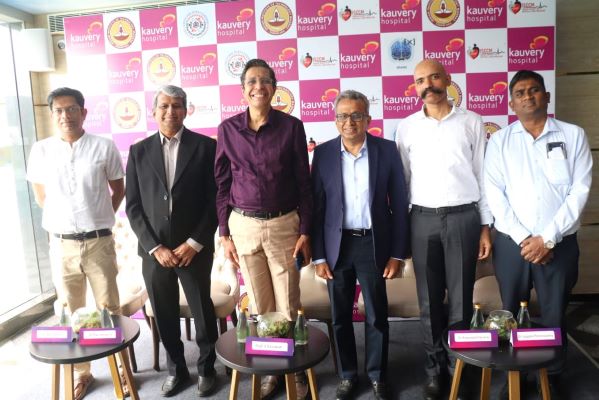
In a defining leap toward intelligent healthcare, the Indian Society of Critical Care Medicine (ISCCM), in collaboration with Kauvery Group of Hospitals and the Indian Institute of Technology Madras, hosted Chennai’s first-ever AI in Critical Care Datathon 2026, transforming intensive care medicine through the power of predictive analytics and interdisciplinary innovation.
- Kauvery–ISCCM–Indian Institute of Technology Madras alliance pioneers real-world AI innovation in intensive care
- Global clinicians, engineers, and data scientists build predictive ICU models for sepsis, shock, kidney injury, and respiratory failure
- Applied artificial intelligence positions India at forefront of data-driven critical care transformation
- Breakthrough initiative promises smarter bedside decisions, improved survival outcomes, and AI-enabled clinical support systems
Held as part of the 32nd Annual Conference of ISCCM, the landmark two-day Datathon brought together critical care physicians, engineers, researchers, and data scientists from across the globe to tackle real-world ICU challenges using authentic clinical datasets.
Participants worked with continuous monitoring data, laboratory values, imaging records, and clinical notes to develop advanced predictive models capable of improving clinical decision-making in life-threatening conditions such as sepsis, shock, acute kidney injury, and respiratory failure.
Critical care, one of medicine’s most data-intensive specialities, demands rapid and accurate interpretation of constantly evolving patient data. The Datathon demonstrated how artificial intelligence can convert complex data streams into actionable insights, empowering clinicians to intervene faster and more precisely in high-acuity environments.
Ten multidisciplinary teams presented working AI algorithms designed to address pressing ICU challenges. Select models will undergo further evaluation for real-world deployment across Kauvery Group hospitals, backed by strict safeguards for data privacy, ethical governance, and patient confidentiality.
The initiative lays the groundwork for deploying sophisticated AI-enabled clinical support systems that promise to enhance patient care, improve outcomes, and redefine critical care delivery.
Prof. V. Kamakoti, Director, IIT Madras, said, “Critical care is one of the most complex and data-intensive areas of medicine. Patients in the ICU are often unconscious and unable to communicate their symptoms, making clinicians heavily dependent on data generated from multiple monitoring devices. The ability to interpret, infer, and predict outcomes purely from this data is crucial. A collaborative platform that brings together doctors and engineers is therefore both unique and essential. This Datathon will generate meaningful insights into how advanced analytics can enhance diagnosis, prediction, and decision-making in critical care.”
Dr. Sridhar Nagaiyan, Coordinator – ISCCM AI in Critical Care Datathon, said, “ISCCM is the largest society of critical care physicians in India, dedicated to promoting excellence and best clinical practices. The AI in Critical Care Datathon, for the first time, brings together critical care specialists from across the world and data scientists from IIT Madras under one roof to collaborate on solving real-world challenges. By working with authentic critical care datasets, the teams are generating clinically meaningful questions and developing models that can advance research and positively influence everyday clinical practice.”
Dr. Aravindan Selvaraj, Co-founder and Executive Director, Kauvery Group of Hospitals, added, “Chennai is rapidly emerging as a hub for technology and artificial intelligence, creating new opportunities for innovation in healthcare delivery. Hosting a Datathon of this nature, the first of its kind in the city, reflects the growing convergence of clinical medicine and data science. As an early adopter of technology, Kauvery Hospital has been integrating AI into both its operational and clinical practices to enhance patient care. One such initiative involves leveraging AI-driven insights from the vast volumes of data generated across the entire continuum of care — from ambulance to ER, from ICU to the ward. This enables the prediction and reduction of critical events, while also automating routine documentation, freeing up valuable clinician and nursing time to focus more on patient care.”
Dr. Manivannan S, Founder and Managing Director, Kauvery Group of Hospitals, said, “Artificial intelligence is steadily transforming healthcare delivery, particularly in critical care where real-time clinical data plays a vital role in decision-making. As AI technologies continue to evolve, healthcare institutions must remain adaptive to these advancements. At Kauvery, we are committed to embracing AI-driven innovations that can support clinicians, enhance precision in care, and ultimately improve patient outcomes while preserving the human element of medicine.”
Beyond the Datathon, the conference featured advanced scientific sessions, workshops, and expert-led discussions highlighting the expanding role of predictive analytics and applied AI in intensive care medicine.
With strong global participation and tangible outcomes, Chennai’s first AI Datathon marks a turning point in integrating artificial intelligence into routine critical care—accelerating India’s emergence as a global leader in AI-powered healthcare.