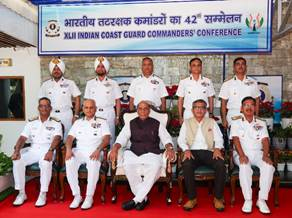
- Defence Minister calls for tech-driven vigilance, women’s empowerment and indigenous strength at Commanders’ Conference
NE NEWS SERVICE
NEW DELHI, SEPT 30
Defence Minister Rajnath Singh on Monday called upon the Indian Coast Guard (ICG) to craft a futuristic roadmap that leverages advanced technologies, strengthens indigenous capabilities, and ensures rapid response to evolving maritime threats. He was addressing the inaugural session of the 42nd ICG Commanders’ Conference at the Coast Guard Headquarters in New Delhi.
Lauding the force as a vital pillar of national security, Singh noted how the ICG has grown from a modest fleet into a formidable maritime sentinel with 152 ships and 78 aircraft. “Warfare today is measured in hours and seconds. Satellites, drones, and sensors have redefined conflict. Preparedness, adaptability and rapid response must be the cornerstones of the ICG’s vision,” he said.
Women, Technology and Multi-Agency Strength
The Defence Minister praised the ICG’s strides in women’s participation, with officers now serving as frontline warriors—from pilots and observers to logistics and law officers. “This transformation reflects our vision of inclusive participation, where women contribute equally in leadership and operational roles,” he highlighted.
He also underscored the ICG’s seamless multi-agency coordination with the Navy, state administrations and civil agencies, calling it one of its greatest strengths. “You are no longer just a security provider—you are a true force multiplier,” Singh said.
Complex Maritime Challenges
Contrasting land and sea borders, Singh stressed the unpredictable nature of maritime security, citing risks from illegal fishing, smuggling, terrorism and cyber intrusions. “A smuggling vessel may look like a fishing boat, and threats may emerge invisibly. Maritime security demands constant vigilance,” he observed.
He warned that emerging challenges like GPS spoofing, cyber-attacks, encrypted communications and electronic warfare are reshaping the threat landscape, urging integration of AI, machine learning, drones and automated systems into India’s maritime security framework.
Record of Service and Humanitarian Role
Since inception, the ICG has apprehended 1,638 foreign vessels and 13,775 foreign fishermen engaged in illegal activities. It has seized 6,430 kg of narcotics worth ₹37,833 crore and rescued more than 14,500 lives in search and rescue (SAR) missions, including 76 missions this year alone.
Rajnath Singh hailed the ICG’s humanitarian ethos:
“While responding to crises, the Coast Guard has always acted swiftly to protect lives and property. The world judges India by how we act in such crises, and the ICG has consistently brought us honour.”
Towards 2047: Secure and Self-Reliant India
Reaffirming the government’s focus on Aatmanirbharta, Singh noted that nearly 90% of the ICG’s capital budget is now spent on indigenous assets, strengthening both security and India’s shipbuilding sector. He urged the commanders to align their strategies with India’s goal of becoming a developed and secure nation by 2047.
Invoking the ICG’s motto Vayam Rakshamah (We Protect), Singh concluded:
“This is not just a slogan but a pledge. It is this pledge, embedded in every ICG personnel, that will ensure we hand over a strong, secure and self-reliant India to future generations.”
The three-day conference, held from September 28–30, 2025, is deliberating on operational performance, logistics, training, human resource development and maritime domain awareness, with a focus on aligning future capabilities with national priorities.