
NE DEFENCE BUREAU
NEW DELHI, JAN 5
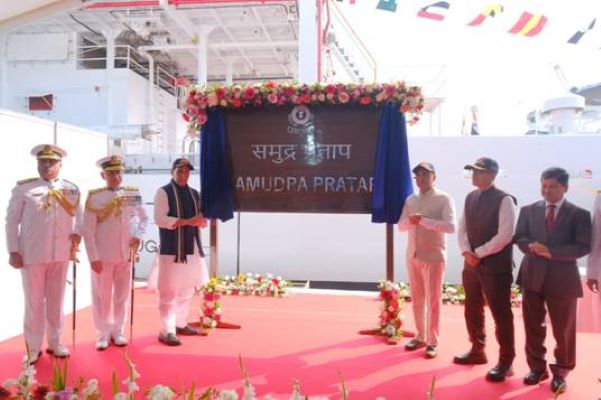
Marking a major milestone in India’s maritime self-reliance and environmental security architecture, defence minister Rajnath Singh on Monday commissioned Indian Coast Guard Ship Samudra Pratap—India’s first indigenously designed Pollution Control Vessel and the largest ship in the Coast Guard fleet—at Goa.
@IndiaCoastGuard Ship Samudra Pratap, the first of two Pollution Control Vessels, will be commissioned by Hon’ble Raksha Mantri Shri Rajnath Singh at @goashipyardltd, #Goa on 05 Jan 26. Built by #GSL with over 60% indigenous content, the 114.5 Mtr, 4,200 ton vessel boasts a speed… pic.twitter.com/8HVXYTbhIr
— Indian Coast Guard (@IndiaCoastGuard) January 4, 2026
Built by Goa Shipyard Limited with over 60 per cent indigenous content, ICGS Samudra Pratap is the first of two specialised pollution control vessels and significantly enhances India’s capabilities in marine pollution response, firefighting, maritime safety and extended coastal surveillance across vast maritime zones.
- ·Largest Ship in Coast Guard Fleet Boosts Environmental Response, Coastal Patrol and Maritime Safety
- Women Officers Join Frontline Ops as India Signals Inclusive, Future-Ready Maritime Force
- “You Cast an Evil Eye, You’ll Get a Befitting Reply”: Defence Minister’s Warning to Adversaries
- From Platform-Centric to Intelligence-Driven: Coast Guard’s Next Strategic Leap
Boost to Bharat's Maritime Strength. @IndiaCoastGuard ship Samudra Pratap the 4th specialized Pollution Control Vessel (PCV) was commissioned today at @goashipyardltd by Hon'ble Defence Minister Shri Rajnath Singh in presence of Hon'ble Chief Minister of #Goa, Defence Secretary,… pic.twitter.com/I3VIRjrRn1
— Indian Coast Guard (@IndiaCoastGuard) January 5, 2026
Describing the vessel as a symbol of India’s growing industrial maturity, the defence minister said, “ICGS Samudra Pratap is an embodiment of India’s mature defence industrial ecosystem; a product of GSL’s modern approach to deal with today’s maritime challenges.” He added that sustained efforts are underway to raise indigenous content in future warships to 90 per cent.
Multi-Role Maritime Guardian with a Strategic Edge
Though designed primarily for pollution control, Samudra Pratap integrates multiple operational capabilities on a single platform. “ICGS Samudra Pratap has been specially designed for pollution control, but its role is not limited to this alone,” the defence minister said. “As multiple capabilities have been integrated into a single platform, the ship will prove to be effective in coastal patrol and strengthen maritime safety.”
Equipped with advanced pollution detection systems, dedicated response boats, high-end firefighting equipment, a helicopter hangar and aviation support facilities, the vessel can operate stably even in rough seas—providing a decisive operational advantage during real-life contingencies.
Clear Message to Adversaries, Commitment to Indo-Pacific Stability
Commending the Coast Guard’s multidimensional role—from oil spill response and coastal cleanliness to search and rescue and maritime law enforcement—the defence minister issued a strong warning to hostile elements. “With the way the Coast Guard is fulfilling its duties, a clear message has been sent to our adversaries that any misadventure will be met with a bold and befitting response,” he said.
On global maritime uncertainty, he underlined India’s stabilising role, stating, “India is a Responsible Maritime Power, ensuring peace and stability in the entire Indo-Pacific.”
Environmental Protection as Moral Responsibility
Calling marine environmental protection a moral responsibility amid climate change and global warming, the defence minister said Samudra Pratap places India among a select group of nations with advanced environmental response capabilities. “Through its quick detection, precise station-keeping and efficient recovery systems, the ship will ensure pollution incidents are controlled in a timely manner, preventing damage to coral reefs, mangroves, fisheries and marine biodiversity,” he said, linking clean seas directly to coastal livelihoods and the blue economy.
Women Officers Break New Ground
In a first for a frontline Coast Guard ship, two women officers have been appointed aboard Samudra Pratap. Hailing the Coast Guard’s move towards a gender-neutral and inclusive force, the defence minister said, “Today, women are not only playing a support role, they are serving the nation as frontline warriors.” He described the two officers as role models for future generations, noting women are now deployed as pilots, observers, air traffic controllers, logistics officers and law officers, and are being trained for hovercraft operations.
Towards an Intelligence-Driven Coast Guard
Emphasising future readiness, the defence minister stressed, “ICG must move from a platform-centric to an intelligence-driven and integration-centric force.” He also highlighted the need to develop specialised career streams in maritime law enforcement, environmental protection and maritime cyber security.
Praising the Coast Guard’s self-reliance push, he said, “The slogan of Aatmanirbharta has become the way of working,” noting that manufacturing, servicing and repair of Coast Guard ships and aircraft are now largely undertaken within India.
From Regional Standard-Setter to Global Leader
Pointing out that the Coast Guard has emerged as a regional standard-setter, the defence minister said the next step is global leadership. “We will have to shape norms in maritime governance, strengthen capacity-building initiatives and promote cooperative frameworks,” he said, expressing confidence that the Coast Guard will set benchmarks followed worldwide.