
R ARIVANANTHAM
The Delhi High Court has asked the Centre to respond to a petition challenging its notification of the Industrial Relations Code, 2020 (IR Code), highlighting that the code was enforced without framing the required rules or constituting tribunals — leaving numerous labour disputes stranded. The court bench — led by Chief Justice Devendra K. Upadhyaya and Justice Tushar Rao Gedela — observed that “the requisite provisions for the transition period permitting smooth transfer … has not been thought of.” As a result, disputes arising before November 21 remain unaddressed.
-
Court Questions IR-Code Implementation; media bodies demand reinstatement of WJA
-
Editorials warn erosion of press freedom is threat to democracy’s conscience
-
Legal experts suggest OSH Code & WJA revocation could face constitutional challenge
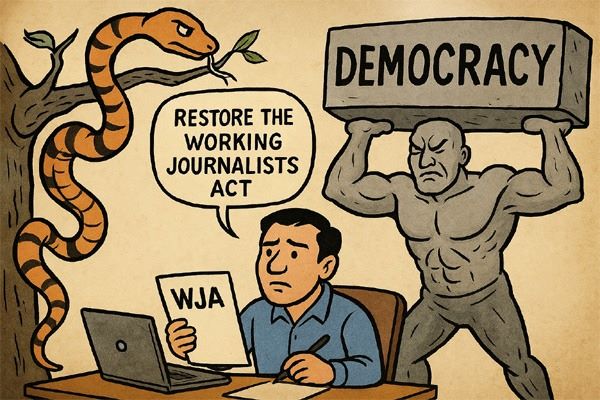
This legal scrutiny has reignited a deeper concern within media circles — about the repeal of the Working Journalists and Other Newspaper Employees (Conditions of Service) and Miscellaneous Provisions Act, 1955 (WJA) and its subsumption under general labour codes. Many journalist bodies, as well as commentary published on public portals, now demand full restoration of the WJA — arguing that generic labour laws cannot safeguard press freedom, editorial independence and the unique working conditions of media professionals.
Read Also:
Restore The Working Journalists Act to revive democracy’s conscience
Gujarat Journalists Union warns Labour Codes ‘Weaken Fourth Pillar of Democracy’
Media Voices and Editorial Appeals: WJA Isn’t Just Labour Law — It’s Democracy’s Conscience
An editorial published recently on navjeevanexpress.com (reflecting the views shared by the Gujarat Journalists Union and allied press bodies) argued powerfully that:
- A democracy without a “free, fearless and economically secure press” is “a democracy diminished.” The WJA was “specifically crafted to protect the freedom of those who hold power accountable.”
- Its repeal and absorption into general labour codes “have left the Indian press precariously exposed.” The piece calls restoring WJA “not merely a labour-rights demand; it is a constitutional necessity to protect the Fourth Estate.”
- Journalism, the editorial argues, carries unique social responsibilities — irregular hours, deadline pressure, public-interest reportage — which cannot be regulated like ordinary employment. The WJA offered essential safeguards: wage boards, protection from arbitrary termination, compensation for unfair dismissals, regulated working hours, and job security.
- Without these protections, the climate-making watchdogs of democracy are at risk. The editorial warns that “when journalists lose their ability to question, democracy loses its ability to breathe.”
This public appeal has echoed across other press-union platforms and voices. One union representative summed up the sentiment: “Protect the messenger, and you protect democracy.”
Legal Challenge to WJA Revocation & OSH Code: Are the Courts Next Battleground?
Legal experts now say the High Court’s handling of the IR Code case may set a precedent — opening the door to challenge broader aspects of the labour overhaul, including the revocation of WJA and application of the Occupational Safety, Health and Working Conditions Code, 2020 (OSH Code).
Key arguments in favour of potential litigation:
- WJA was originally intended as a beneficial, welfare law, protecting journalists from exploitation and ensuring press freedom. Its repeal removes structural protections — and generic laws do not adequately account for the distinctive nature of media work.
- The lack of transitional safeguards (such as tribunals, rules, or sectoral provisions) may amount to a violation of fundamental constitutional rights — including the right to livelihood, due process, and the freedom of the press under Article 19(1)(a).
- With the High Court rulings questioning the code’s implementation framework — especially the absence of tribunals — those who had pending cases under previous laws may find legal recourse reopening. This logic could be extended to media-specific claims as well.
Should courts accept such challenges, media organisations and trade unions may succeed in restoring WJA or securing comparable sector-specific safeguards, thereby safeguarding press freedom and worker rights.
Why This Moment Matters for Media, Labour Rights & Democracy
- The ongoing IR Code case is not just a matter of labour law — it has become a litmus test for structural protections for media professionals.
- With pressure mounting from journalist unions, editorial bodies, and civil-society advocates, the government may face strong political and legal pressure to reconsider the repeal of WJA or introduce a new media-specific statute.
- For journalists — especially in regional, vernacular, and local media — any favourable decision would mean restored wage protections, job security, and strengthened independence; for democracy, it could mean preserving a vital check on power.
- Ultimately, this could mark a turning point: where labour reform and media freedom are reconciled — not pitched against each other — ensuring that rights, welfare, and constitutional values advance together.
(The author is the Executive Editor of this portal and former joint secretary of Madras Press Club)