
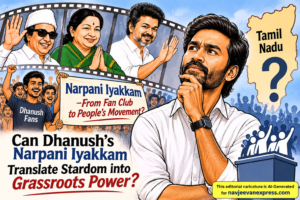
- Vijay’s rise to the Chief Minister’s chair has reopened Kollywood’s political gateway — but the journeys of MGR, Sivaji, Rajini, Kamal, Vijayakanth and others offer Dhanush both a roadmap and a warning
- Narpani Iyakkam’s proposed statewide expansion and possible 2027 local-body debut intensify speculation over Dhanush’s political ambitions
- From 58 organisational districts to more than 100, the actor’s network is being prepared for a wider grassroots footprint
- Vijay’s electoral breakthrough has altered the political calculations of Tamil Nadu’s film fraternity
- MGR and Jayalalithaa converted cinematic popularity into enduring political power; Vijayakanth built a formidable third force
- Sivaji, Rajini, Kamal, Sarathkumar, Khushbu and Radhika illustrate the varied fortunes of celebrity politics
- Seeman’s steady vote-share growth shows that sustained ideology and organisation can matter more than screen stardom

R ARIVANANTHAM
In Tamil Nadu, cinema has never been merely entertainment; it has often been a political language, a platform for social mobilisation and, for a select few, a passage to power. But if the silver screen can create a mass following, can that adulation survive the harsher test of electoral politics? Actor Dhanush now finds himself at the threshold of that question. His move to extend his welfare organisation across all 234 Assembly constituencies comes at a time when Vijay’s spectacular political rise has demonstrated that the cinema-to-politics journey is far from a closed chapter.
Dhanush has not announced a political party, declared his candidature or confirmed that he will contest elections. Yet the organisational preparations around his Narpani Iyakkam have acquired unmistakable political significance. The immediate question is no longer simply whether the actor has political ambitions, but whether he can convert a fan following into a disciplined, socially rooted and electorally credible organisation.
The distinction is crucial. Tamil Nadu has produced cinematic legends who became Chief Ministers, actors who built influential political parties, stars whose political ambitions never materialised and personalities who found a place in established parties. Their experiences offer Dhanush a remarkable political laboratory — but no guaranteed formula for success.
The 234-constituency signal: A welfare movement with electoral possibilities
Dhanush has asked his Narpani Iyakkam to establish a presence in all 234 Assembly constituencies in Tamil Nadu. The organisation, which currently has units in 58 organisational districts, plans to expand to more than 100 units covering all 38 revenue districts, according to its functionaries.
The actor’s October 14 meeting with district-level functionaries in Coimbatore formally transformed his fan club into a welfare movement. Organisers were asked to identify constituencies without an existing unit, establish branches and strengthen those already functioning. The women’s wing has also been accorded priority.
Ahead of his October 25 interaction with supporters at a private college on Old Mahabalipuram Road in Chennai, the organisation undertook an exercise to identify and induct women supporters. The gathering reportedly brought together more than 2,500 women associated with the reorganised movement.
The expansion is being viewed as an attempt to take the organisation beyond film-related activities and create a constituency-level network. Functionaries have reportedly begun discussions on identifying supporters and organisers who could contest the 2027 local-body elections.
The logic is straightforward: an early electoral engagement could help the organisation assess its local influence, identify potential candidates and understand the political realities of individual constituencies well before the 2031 Assembly election.
A source close to the actor was quoted as saying: “Last month, our leader (Dhanush) asked us to expand the movement constituency-wise, establish units in areas where none existed and strengthen the existing structure. We are working towards increasing our presence in the constituencies.”
Another source explained the thinking behind an early electoral exercise: “We do not want to wait until 2031 (Assembly elections) to make our presence felt. We want to be active in the local body elections. The groundwork has to begin now.”
These are statements attributed to sources close to the movement, not a formal political announcement by Dhanush. That distinction must be maintained. The actor has so far kept his political intentions unstated.
Vijay’s arrival has changed the political calculus
The most immediate backdrop to Dhanush’s organisational moves is the remarkable rise of actor-turned-politician C Joseph Vijay, whose Tamilaga Vettri Kazhagam (TVK) has transformed the political conversation in Tamil Nadu and taken him to the Chief Minister’s office.
Vijay’s journey has given fresh credibility to the possibility of a film star building an independent political force. His fan network had been developed over several years through welfare activities and public outreach before it became the organisational foundation of TVK. Student-oriented initiatives, including awards for academic achievers, helped him engage with families and communities beyond the conventional fan base.
Dhanush’s restructuring of his association into a welfare movement, the expansion of its district network and the emphasis on women supporters have invited comparisons with Vijay’s preparatory phase.
But the two actors are not identical political propositions. Vijay cultivated the image of a mass hero whose screen persona often carried the promise of confronting injustice and solving public problems. Dhanush, by contrast, has built much of his artistic reputation through characters marked by vulnerability, social marginalisation, anger and resilience.
That difference could become an advantage if he develops a political identity rooted in social issues and public policy. It could equally become a challenge if the organisation relies primarily on the emotional appeal of his films.
TVK spokesperson M Sathya Kumar welcomed the possibility of new political entrants, saying: “We are happy that TVK is an inspiration for political start-ups.”
But he also underlined the scale of Vijay’s preparation: “Vijay worked for 30 years for this. It is not easy.”
The observation carries a larger message for Dhanush. Political credibility cannot be assembled overnight through a logo, a large gathering or a statewide organisational announcement. It requires sustained engagement, a clearly articulated political position and the ability to remain present when cameras are absent.
The political reaction to Dhanush’s possible entry has already exposed competing interpretations. Tamil Nadu Congress president Manickam Tagore alleged that the developments could be part of a BJP-RSS strategy, describing it as “Plan C” or “Operation D”. TVK general secretary Aadhav Arjuna also alleged that leaders in Delhi were encouraging new political entrants.
Finance Minister N Marie Wilson questioned whether Dhanush could emerge as a serious challenger to Vijay, arguing that the Chief Minister’s organisation had been built through years of grassroots work.
Senior DMK leader S Regupathy, however, maintained that Dhanush had every democratic right to enter politics, just as Vijay had. AIADMK leader K T Rajendra Balaji publicly invited the actor to join the party led by Edappadi K Palaniswami.
These reactions underline how seriously political parties are watching the possibility of another actor entering the electoral arena. They do not, however, establish that Dhanush has reached any political understanding with a party or organisation.
MGR and Jayalalithaa: The gold standard of cinema-to-power politics
Any assessment of an actor’s political prospects in Tamil Nadu inevitably begins with MG Ramachandran, popularly known as MGR.
MGR’s success was not simply the result of a popular screen image. His films frequently projected him as a champion of the poor, a defender of the oppressed and a man who stood against injustice. The cinematic persona was reinforced by his association with the Dravidian movement and his political engagement with the DMK.
He famously described the relationship between the two fields in a line that remains relevant: “Art and politics are the two sides of the same coin.”
After parting ways with the DMK in 1972, MGR founded the Anna Dravida Munnetra Kazhagam, later renamed the All India Anna Dravida Munnetra Kazhagam (AIADMK). He used his films and public appearances to reinforce his political identity. In 1977, he became Chief Minister and remained in office until his death in 1987.
MGR’s achievement was rooted in more than celebrity. He built a party, developed a welfare-oriented political appeal and cultivated a direct emotional connection with voters. His screen image and political organisation reinforced each other.
J Jayalalithaa’s journey was equally extraordinary, though different in its political evolution. A celebrated actor and MGR’s co-star in several films, she entered the AIADMK through the party’s propaganda machinery. She became its propaganda secretary, was elected to the Rajya Sabha and emerged as a formidable leader after MGR’s death.
Her political ascent was neither automatic nor free of internal resistance. She faced intense factional battles before consolidating control of the AIADMK. Her first major electoral triumph came in 1991, when she became Chief Minister.
The lesson from MGR and Jayalalithaa is that cinematic popularity can provide an entry point, but enduring political power demands organisational control, leadership, political judgement and a welfare narrative that voters identify with.
Sivaji Ganesan: When an icon’s following does not translate into votes
The experience of Sivaji Ganesan offers a sharp contrast to MGR’s political triumph.
One of Tamil cinema’s greatest performers, Sivaji had a long association with the Congress and was politically active for decades. In 1988, he launched the Tamilaga Munnetra Munnani (TMM), seeking to create an independent political platform.
But his party failed to win a single seat in the 1989 Assembly election, and Sivaji himself lost from Tiruvaiyaru.
His own reflections on the episode were unusually candid. In his autobiography, he recalled: “I was compelled to start a party for their sake, although I did not require it.”
He also described the defeat as a major disappointment.
The Sivaji experience is a reminder that immense artistic stature and public affection do not automatically create a political constituency. Voters may admire an actor without necessarily endorsing his political leadership or the party he establishes.
For Dhanush, that distinction is fundamental. A packed fan gathering is evidence of popularity; it is not an electoral survey.
Rajinikanth: The political announcement that never became a party
Rajinikanth’s long-anticipated political entry is another cautionary chapter.
For decades, speculation surrounded the superstar’s political intentions. In December 2017, he announced that he would enter politics and subsequently established the Rajini Makkal Mandram as a preparatory platform.
But after repeatedly indicating that a political launch was imminent, he withdrew in December 2020, citing health concerns and the prevailing COVID-19 situation.
In a statement, he said: “With a heavy heart, let me make it clear that I am unable to form a political party and enter politics. Nobody can understand my pain in making this decision.”
He also promised to continue serving people without entering electoral politics.
Rajinikanth’s experience demonstrates that even the most celebrated star, with an enormous and intensely loyal fan base, must confront the demands and personal costs of electoral politics. Public expectations can build for years, but an announcement is not an organisation, and an organisation is not necessarily a party.
Kamal Haasan: Ideology, policy and the challenge of building a third force
Kamal Haasan approached politics with a different emphasis. Rather than relying solely on his cinematic image, he sought to project himself as a reform-minded political voice and launched Makkal Needhi Maiam (MNM) in 2018.
His entry was accompanied by a message of public accountability. Explaining his motivation, Kamal said: “I never used to act for free. You paid money to watch the films I acted in, and that became my salary. But what did I do in return? … That is why a feeling of guilt started (taking shape inside).”
The statement reflected his desire to convert public affection into a sense of civic responsibility.
MNM contested the 2019 Lok Sabha election and the 2021 Assembly election but did not secure the breakthrough needed to become a major independent force. Kamal himself lost the Coimbatore South Assembly constituency in 2021 by a narrow margin.
His subsequent political choices also demonstrated the importance of alliances. In 2024, MNM aligned with the DMK-led alliance, and Kamal was elected to the Rajya Sabha.
Kamal’s journey shows that a celebrity can bring ideas and public debate into politics, but an independent party needs a durable cadre, constituency-level leadership and electoral strategy. A strong ideological pitch alone may not be enough to displace established political formations.
Vijayakanth: The third-force model — and its fragility
If MGR represents the most successful cinema-to-power transition, Vijayakanth remains one of the most instructive examples of an actor building an independent political force.
He launched the Desiya Murpokku Dravida Kazhagam (DMDK) in 2005. In the 2006 Assembly election, the party contested almost the entire State and won only one seat — Vijayakanth’s own from Virudhachalam. Yet its vote share of about 8.4 per cent sent a strong political signal.
In the 2009 Lok Sabha election, DMDK secured more than 10 per cent of the vote despite winning no seat. Its decisive breakthrough came in 2011, when it allied with the AIADMK. The party won 29 of the 41 seats it contested and Vijayakanth became Leader of the Opposition.
That achievement demonstrated that an actor-led party could disrupt the traditional DMK-AIADMK contest and emerge as a serious political force.
But the subsequent decline of DMDK also offers a warning. Its vote share fell sharply in later elections, and the party lost much of its earlier influence. Vijayakanth’s health and the absence of a comparable leadership structure after his decline further complicated its position.
The lesson is that a strong founder can create a political opening, but a party’s long-term survival depends on institutional strength, succession planning and a stable political identity.
Sarathkumar, Khushbu and Radhika: The many routes into party politics
R Sarathkumar’s political journey illustrates the complexities of building a party while negotiating alliances. He entered politics through the DMK, later moved to the AIADMK and founded the All India Samathuva Makkal Katchi in 2007.
His party won two Assembly seats in alliance with the AIADMK in 2011, including his own victory from Tenkasi. But the organisation struggled to expand independently.
In 2016, he told The Indian Express: “There is a vacuum in state politics. People are tired of both Dravidian parties — they are expecting new faces, a new leader. I will work for them.”
Eight years later, in March 2024, Sarathkumar merged his party with the BJP. Explaining the decision, he said much of his political career had revolved around the questions of how many seats his party would contest and which party it would align with. Since he could not serve people sufficiently, he had decided to merge the organisation and work for them.
His wife, actor Radhika Sarathkumar, was subsequently fielded by the BJP from Virudhunagar in the 2024 Lok Sabha election. Her candidature brought another familiar film personality into the electoral arena, though a star’s candidature and an independent political organisation are two very different propositions.
Khushbu Sundar’s journey offers yet another model. She entered the DMK in 2010, moved to the Congress in 2014 and joined the BJP in 2020. She contested the 2021 Assembly election from Thousand Lights but lost to the DMK candidate. She later served as a member of the National Commission for Women and resigned in 2024, saying she wanted to engage more actively in politics.
Her career illustrates how actors can use their public visibility, communication skills and political convictions within established parties, even when they do not build independent electoral organisations.
For Dhanush, these examples underline that entering politics need not necessarily mean launching a party. An actor may choose an independent movement, join an existing political formation, support a coalition or remain engaged in public causes without contesting elections.
Seeman: The power of a message that outlives the star
Seeman’s rise is particularly relevant to any discussion of a new political force in Tamil Nadu.
Unlike actors whose political appeal is primarily rooted in film stardom, Seeman built the Naam Tamilar Katchi (NTK) around an assertive Tamil-nationalist political identity, sustained by speeches, grassroots campaigning and a cadre network.
The party’s performance in the 2024 Lok Sabha election was significant. It increased its vote share from 3.8 per cent in 2019 to 8.2 per cent in 2024, secured more than one lakh votes in 12 constituencies and finished third in six.
It won no seats, but the vote-share growth established it as a political force that established parties could not simply ignore.
Seeman’s experience suggests that a clear political message, sustained mobilisation and a recognisable organisational identity can gradually build electoral relevance even without the backing of a major film-star machinery.
Dhanush, if he chooses to enter politics, will have to answer a question that Seeman’s experience makes unavoidable: what is the political idea that his organisation stands for beyond the personality of its leader?
The real test: From fan club to a movement that can govern
The historical record is clear: Tamil Nadu has never treated cinema and politics as separate worlds. But it has also never guaranteed electoral success to every popular actor who ventured into public life.
MGR and Jayalalithaa built enduring political power. Vijayakanth demonstrated the potential of a third force. Sivaji Ganesan discovered the limits of celebrity appeal. Rajinikanth withdrew before launching a party. Kamal Haasan brought a policy-oriented approach but found independent electoral expansion difficult. Sarathkumar, Khushbu and Radhika took different routes through established political formations. Seeman showed how a sustained political message could build a vote base without cinematic stardom.
Dhanush’s immediate challenge is to move beyond the arithmetic of 234 constituencies and more than 100 organisational districts. Can his movement develop credible local leaders? Will it articulate a political programme on employment, education, agriculture, social justice, urban infrastructure and the welfare of marginalised communities? Can it sustain its activities between elections? Will it have a transparent organisational and financial structure? And, above all, will voters see it as a movement that can solve public problems rather than simply celebrate a star?
The proposed 2027 local-body elections could provide an early test, if the organisation decides to field candidates. Local elections are often less forgiving than celebrity gatherings: candidates must confront neighbourhood issues, local rivalries, public accountability and the everyday expectations of voters.
The political space is also no longer the same as it was when MGR or Vijayakanth entered the fray. Vijay’s rise has altered the landscape, but the DMK and AIADMK retain deep political histories and organisational networks. Seeman has built a distinct vote base, while national parties and smaller regional formations continue to compete for space.
Another actor entering this arena would therefore have to offer more than a familiar face and a popular name.
For now, Dhanush has left the most important question unanswered. His Narpani Iyakkam is expanding, but the actor has not announced a political plunge. The distinction between speculation and declared intent must remain clear.
Tamil Nadu has seen stars become rulers, challengers, party leaders and political also-rans. Dhanush’s next move will reveal whether he wants to join that history — and, if he does, whether he has a political script that voters are willing to endorse.
(Author of this article is R ARIVANANTHAM, Executive Editor (Former Senior Correspondent, THE HINDU) navjeevanexpress.com He can be contacted at hindukgi@gmail.com, navjeevaexpress@gmail.com)