- Panch Sankalpa of NEP 2020 to be the guiding principle for HEIs: Dharmendra Pradhan
- Government aims to raise GER in Higher Education to 50% by 2035: Dharmendra Pradhan
Each university to prepare strategy paper to achieve the vision of Viksit Bharat: Dharmendra Pradhan - First day discussions focus on the Foundational Reforms to Accelerate NEP 2020 Implementation
NE EDUCATION BUREAU
KEVADIA, JULY 10
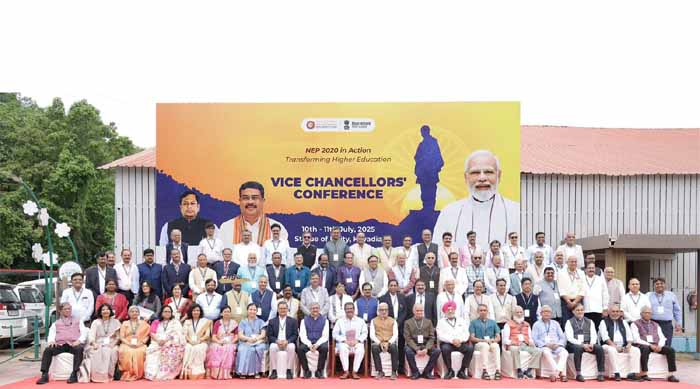
The two-day National Vice-Chancellors’ Conference, hosted at Tent City-2 in Ekta Nagar, Narmada district in Gujarat, was inaugurated by Union Education Minister Dharmendra Pradhan on Thursday.
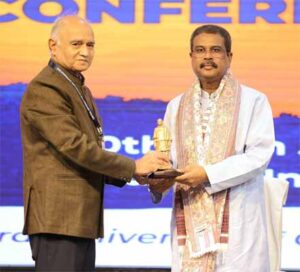
Attended by heads of over 50 central universities from across the country, the conference is centred around the effective implementation and evaluation of the National Education Policy (NEP) 2020, with a broader vision to realise the goals of a “Viksit Bharat 2047.”
Delivering the keynote address, Minister Pradhan emphasised the transformative impact of NEP 2020 on India’s higher education landscape.
“Over the past decade, we’ve seen a significant shift towards inclusive, multidisciplinary, and innovation-driven education. Student enrollment has increased by 30 per cent since 2014-15, with a notable 38 per cent rise among female students. For the first time, the gross enrollment ratio (GER) of women has surpassed that of men. GER among Scheduled Tribes and Scheduled Castes has also shown a marked improvement,” he said.
During his address, Pradhan highlighted the concept of Panch Sanklapa of NEP 2020 which would be the guideline for the VCs in their university gurukuls. The prominent themes being Next-Gen emerging education, Multidisciplinary education, Innovative education, Holistic education and Bharatiya Education. The Minister called upon the VCs to devise changes to implement the objectives of the academic Triveni Sangamam through the following objectives- Celebrating the past (India’s richness), calibrating the present (India’s narrative correction), and creating the future (India’s role in the global order). This would ensure understanding the past, uncovering the present and unfolding the future in the contemporary framework.
The minister emphasised that it was important to raise the GER in higher education to 50% by 2035 by taking definitive actions in critical areas such as redesigning curricula, building digital systems, training faculty and promoting multidisciplinary approaches. For attaining this objective, it was imperative for the Vice Chancellors to act as catalysts in shaping the mind-set and aspirations of students. Pradhan emphasised that universities must follow “Students-First” approach, students should be the centre of all our reforms as they constituted the core of our national strength for the future. He called upon the Vice Chancellors to ensure that the institutions being built for the future where skilled and future ready to promote ready work force and students were empowered to be job creators, social entrepreneurs and ethical innovators.
During the course of his address, the minister called upon the participants of the meeting to prepare a strategy paper for a full implementation of NEP 2020 for Implementation of NEP 2020 in every university. It should include: multidisciplinary integration of subjects, mainstreaming Indian Knowledge System (IKS), devising strategies for tech driven education to promote skilling and up-skilling, campus initiatives focusing on innovation and integration of technology with traditional values and conferences like VC’s conference should be organised in the individual university campuses.
Dr. Hashmukh Adhia, Chancellor, Central University of Gujarat, in his address outlined comprehensively the “Six Principles” of karmayoga and emphasised the role and importance of Indian Knowledge Systems in the lives of individuals, society and the nation. He called upon the participants to practice the principles in achieving their goals and objectives in life.
In his opening remarks, Dr. Vineet Joshi, Secretary, Higher Education, said as we complete five years since the launch of the National Education Policy 2020, this conference provides us with an opportunity to reflect on our progress and refine our roadmap towards achieving the vision of a holistic, multidisciplinary, and globally competitive higher education system. He also noted the NEP 2020 laid out an ambitious, yet achievable, vision for India’s higher education system—rooted in accessibility, equity, quality, affordability, and accountability. It reimagines our institutions not as degree-granting bodies, but as ecosystems of innovation, critical thinking, research, and holistic development.
Dr. Sunil Barnwal, Additional Secretary, Higher Education in his address highlighted the role and importance of the five foundational pillars of NEP 2020 namely Access, Equity, Quality, Affordability and Accountability. He also emphasised the important role of stakeholder partnership of higher education institutions in taking forward the goals of NEP.
Prof. Rama Shanker Dubey, Vice Chancellor of Central University of Gujarat in his address at the conclusion of the inaugural session mentioned that all Central Universities would take proactive steps to implement the vision of Viksit Bharat through their individual campuses.
The discussions over the two days are expected to broadly cover three key areas:
- Strategic Alignment: To ensure that Central Universities are aligned with the policy’s next-phase goals.
- Peer Learning and Knowledge Exchange: To foster dialogue among academic leaders on institutional innovations, enabling environments, and shared challenges.
- Forward Planning and Readiness: To prepare institutions for upcoming policy milestones, regulatory transitions, and the global academic landscape of 2047.
The conference will cover key aspects of higher education – teaching/ learning, research and governance through ten thematic sessions spread over the 2 days aligned with the key pillars of NEP 2020 —Equity, Accountability, Quality, Access and Affordability. These include:
- Understanding and Implementation of NHEQF/NCrF with focus on Four-Year Undergraduate Programme (FYUP)
- Future of Work – Alignment of Courses as per the requirement of future of Job Role
- Digital Education – SWAYAM, SWAYAM Plus, AAPAR with focus on Credit Transfer
- University Governance System – SAMARTH
- Promotion of Equity in HEIs- Fostering an Inclusive and Equitable Environment.
PM Vidya Lakshmi, One Nation One Subscription
- Education in Bhartiya Bhasha and Indian Knowledge System, Bhartiya Bhasa Pustak Scheme
- Research and Innovation including ANRF, CoE, PMRF
- Ranking and Accreditation System
- Internationalisation including Study in India
- Faculty Development – Malaviya Mission Teacher Training Programme
Some of the participating institutions include the University of Delhi, Central University of Haryana, Assam University, Hemvati Nandan Bahuguna Garhwal University, Central University of Rajasthan, Central University of Kashmir, Visva-Bharati, National Sanskrit University, Indira Gandhi National Tribal University (IGNTU), Sikkim University, Tripura University, Jawaharlal Nehru University (JNU), University of Allahabad, and many others.