- Amit Shah says Digital India is now delivering affordable food grains securely and transparently to protect rights of the underprivileged;
- Prahlad Joshi calls CBDC integration a milestone reform with slogan “Har Dana, Har Rupiya, Har Adhikar”;
- Digital food coupons powered by RBI’s Digital Rupee to ensure real-time, leak-proof and corruption-free ration delivery;
- Pilot begins in Gujarat districts with national rollout planned in next 3–4 years under ‘Minimum Government, Maximum Governance’;
- Reform strengthens India’s world-largest food security system serving over 80 crore citizens
NE NEWS SERVICE
GANDHINAGAR, FEB 15
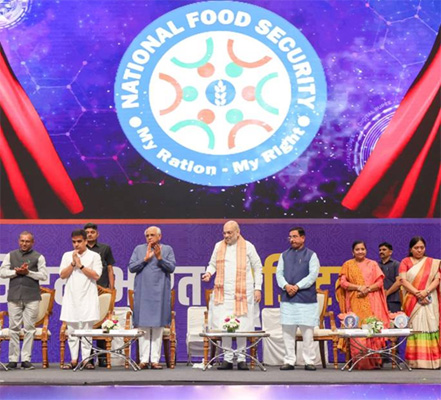
Union Home Minister Amit Shah on Saturday launched the country’s first Central Bank Digital Currency (CBDC)-enabled Public Distribution System (PDS), declaring that Digital India has now entered the realm of food security to ensure transparent, corruption-free ration delivery to the poor.
The pilot initiative, launched in collaboration with the Reserve Bank of India and the Government of Gujarat, marks a revolutionary shift in welfare governance by enabling beneficiaries to receive subsidised food grains through programmable Digital Rupee (₹) coupons — eliminating leakages and strengthening accountability.
“Digital India Now Entering Food Security”: Amit Shah
Launching the CBDC-based ration distribution system in the presence of Gujarat Chief Minister Bhupendra Patel and Union Food Minister Pralhad Joshi, Amit Shah said the initiative represents a historic expansion of Prime Minister Narendra Modi’s Digital India vision.
“Inspired by Prime Minister Narendra Modi Ji, Digital India is now extending to the food and supply system. The same Digital India is now entering the domain of providing affordable food grains to the poor of the country,” Shri Shah said.
He emphasised that the reform reflects the Prime Minister’s pro-poor governance philosophy.
“Prime Minister Modi has given the first right over the country’s resources to the poor, Dalits, backward classes, and tribal communities.”
Highlighting India’s digital transformation, Shah added:
“Earlier, there were 60 crore people in India whose entire families did not have even a single bank account, but today half of the world’s digital transactions take place in India.”
He said the CBDC-enabled system would eliminate corruption and middlemen.
“This system will completely eliminate corruption from the mechanism of providing rations to the poor.”
Technology and Compassion Combined to Protect the Poor
Describing the reform as a fusion of technology and social justice, Shah said:
“This distribution system, a unique blend of technology and Prime Minister Modi’s sensitivity toward the poor, will serve as a secure and transparent mechanism to protect the rights of the underprivileged.”
He added that the system would strengthen the Prime Minister’s governance mantra.
“Prime Minister Modi Ji’s mantra of ‘Minimum Government, Maximum Governance’ is today being implemented on the ground in a new sector.”
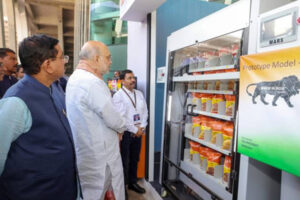
Shah also unveiled the advanced ‘Annapurna’ ration dispensing machine.
“The ‘Annapurna’ machine distributes 25 kg of food grains in just 35 seconds, ensuring accurate quantity, better quality, and transparent distribution.”
He announced nationwide expansion plans:
“This system will be implemented across the entire country in the next 3–4 years — from Kashmir to Kanyakumari and from Dwarka to Kamakhya.”
“Har Dana, Har Rupiya, Har Adhikar”: Prahlad Joshi Calls It Milestone Reform
Union Food and Consumer Affairs Minister Pralhad Joshi hailed CBDC integration as a landmark reform in India’s food security architecture.
“The introduction of Central Bank Digital Currency in the Public Distribution System marks a significant milestone towards ensuring transparency, efficiency and beneficiary empowerment,” Shri Joshi said.
Giving the slogan:
“Har Dana, Har Rupiya, Har Adhikar,” he described the initiative as a transformational step that will strengthen accountability and empower beneficiaries.
He added:
“India’s Public Distribution System, the largest in the world serving more than 80 crore beneficiaries, continues to evolve through technology-driven reforms.”
How the Digital Rupee Ration System Works
Under the CBDC-enabled system:
- Digital food coupons are issued as programmable Digital Rupee (e₹) directly to beneficiary wallets
- Beneficiaries redeem entitlements at Fair Price Shops using QR codes or digital coupons
- Real-time digital tracking ensures transparency and accountability
- Eliminates repeated biometric authentication failures
- Fair Price Shop dealers receive payments instantly
The pilot has been launched in Gujarat districts including Ahmedabad, Anand, Surat, and Valsad, with expansion planned to Union Territories such as Chandigarh, Puducherry, and Dadra & Nagar Haveli and Daman & Diu.
Strengthening Food Security and Farmers’ Interests
Shah highlighted that India’s food security system has undergone unprecedented reforms under Prime Minister Modi.
“Prime Minister Modi Ji has provided 5 kg of free food grains per person per month to 80 crore people in the country.”
He added that government reforms have uplifted millions.
“Through solid policies, the Modi government has improved the living standards of more than 60 crore people in the last 10 years and lifted 27 crore people above the poverty line.”
He also defended agricultural trade policies.
“Prime Minister Modi has safeguarded farmers’ interests through Free Trade Agreements with the European Union, UK and trade deals with the USA. He stands like a rock in protecting the country’s farmers.”
Criticising previous policies, Shah said:
“The previous government signed the Dunkel Proposal, making farmers insecure, whereas Prime Minister Modi has ensured farmers’ protection and prosperity.”
India’s Welfare Delivery Enters a New Digital Era
The CBDC-based Digital Food Currency pilot marks the next phase of India’s digital governance revolution, building upon reforms such as:
- One Nation One Ration Card portability
- Aadhaar-enabled ration authentication
- Real-time e-POS ration transactions
- Digital supply chain optimisation
By integrating sovereign digital currency into welfare delivery, the government has created one of the world’s most advanced food security systems.
The initiative represents a bold step towards building a transparent, efficient and citizen-centric governance model — ensuring that every grain reaches its rightful beneficiary without leakages.