R ARIVANANTHAM
CHENNAI, DEC 15
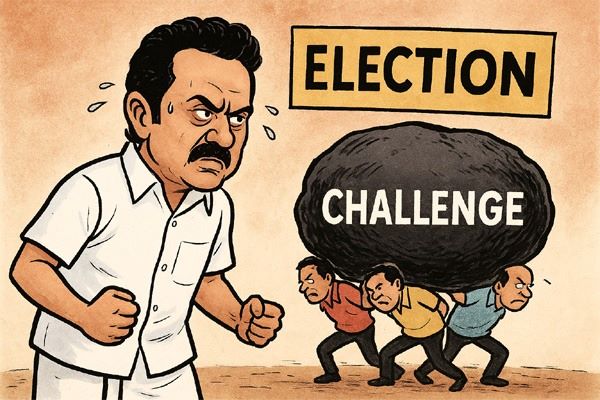
With the 2026 Tamil Nadu Assembly elections shaping up to be a multi-cornered contest, the ruling Dravida Munnetra Kazhagam (DMK) has begun sharpening its political strategy—aimed at simultaneously countering the BJP’s expansion bid, managing the emergence of actor-politician Vijay’s Tamilaga Vettri Kazhagam (TVK), and exposing what it terms the AIADMK’s dependence on the BJP.
- From Tiruvannamalai, Stalin Signals DMK’s Strategy for a Multi-Cornered Contest
- Ideology, Federalism and Welfare Delivery to Anchor DMK’s 2026 Poll Narrative
- TVK’s Crowd Power vs DMK’s Cadre Strength: Udhayanidhi’s Subtle Warning
- AIADMK’s Survival Plank Under Scrutiny as BJP Shadow Looms Large
- Youth Mobilisation, Grassroots Outreach and Governance Record to Be DMK’s Electoral Spine
Addressing the DMK Youth Wing North Zone conference at Tiruvannamalai, Chief Minister and party president M K Stalin mounted a frontal ideological attack on the BJP, asserting that the saffron party would never succeed in Tamil Nadu. Reacting to Union Home Minister Amit Shah’s remark that Tamil Nadu would be the BJP’s next political target, Stalin said the state would resist any force that approached it “with arrogance”.
“This is Tamil Nadu. If you come with love, we will embrace you. If you come with arrogance, we will not bow. We will face you head-on and defeat you,” Stalin declared, setting the tone for what DMK insiders describe as a values-driven, identity-centric campaign for 2026.
DMK’s Core Strategy: Ideology Over Optics
At the heart of the DMK’s strategy lies a renewed emphasis on Dravidian ideology, federalism, linguistic pride and social justice—themes Stalin described as the antidote to what he called the BJP’s “sugar-coated lies and regressive ideas”. By positioning itself as the only regional party waging an ideological battle against the BJP, the DMK aims to consolidate anti-BJP votes across caste and class lines.
Party strategists say this approach is designed not just to counter the BJP, but also to differentiate DMK from newer political entrants, especially TVK, which has drawn attention through massive rallies and celebrity appeal.
TVK’s Rise: DMK Warns Against ‘Crowd Politics’
In a veiled but pointed reference to Vijay’s TVK, Deputy Chief Minister Udhayanidhi Stalin cautioned against mistaking crowd mobilisation for political permanence. “A rainbow attracts people, but it is not permanent. It disappears soon. A huge, uncontrollable crowd serves no purpose,” he said.
The message was clear: while TVK may energise sections of first-time voters and urban youth, the DMK is betting on its deep organisational roots, governance record and booth-level machinery to withstand the challenge. DMK leaders privately acknowledge TVK’s potential to split anti-incumbency or floating votes, but insist the party’s disciplined cadre base gives it a decisive edge.
AIADMK’s Plank: ‘Engineless Vehicle’ Narrative
The DMK has also sharpened its attack on the AIADMK, portraying it as a weakened force lacking independent political direction. Udhayanidhi’s remark that the AIADMK is an “engineless vehicle being pulled by the BJP lorry” reflects the DMK’s plan to frame the 2026 contest as a choice between Dravidian autonomy and Delhi-driven politics.
This narrative seeks to undermine the AIADMK’s traditional vote base by projecting it as subordinate to the BJP, thereby squeezing the principal opposition from both ideological and organisational flanks.
Youth, Welfare and Grassroots Push
Responding to calls for greater youth representation in the 2026 elections, Stalin urged party workers to embed themselves at the grassroots, take government schemes to every household and earn their positions through sustained work rather than entitlement.
“Meet the people, live among them, and do not expect comfort,” Stalin told party cadres, signalling that performance and ground connect, not just loyalty, will shape candidate selection.
Political observers see this as part of the DMK’s broader strategy to convert governance achievements into electoral capital, while keeping the cadre energised amid emerging political competition.
As Tamil Nadu moves closer to 2026, the DMK appears determined to fight on multiple fronts—ideologically against the BJP, organisationally against TVK’s rise, and politically against a diminished but still relevant AIADMK—turning the election into a referendum on identity, governance and federal values.