- National fortnight sparks new ideas, policy dialogues and youth engagement across India
- Leaders underline entrepreneurship as the driver of innovation, economic resilience and cultural renewal
- EDII unveils Vision Document for Centre on Temple-Based Economy to boost heritage-linked livelihoods
NE EDUCATION BUREAU
AHMEDABAD, NOV 20
The Entrepreneurship Development Institute of India (EDII), Ahmedabad, in collaboration with the India Think Council, marked the grand culmination of Udyamita Pakhwada 2025 alongside the 5th Cultural Economy Conclave, bringing together policymakers, scholars, industry leaders and cultural thinkers for a national dialogue on entrepreneurship and India’s heritage-driven economy.
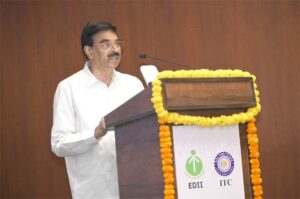
The event was graced by Odisha Governor Dr Hari Babu Kambhampati as Chief Guest, with Gujarat’s Minister for Forests, Environment, Climate Change, Science and Technology Arjun Modhwadia as Guest of Honour. Also present were Neerja A Gupta, Vice-Chancellor, Gujarat University; Uday Mahurkar, noted author and former Central Information Commissioner; Dr Sunil Shukla, Director General, EDII; and Saurabh Pandey, Founding Director, India Think Council.
Entrepreneurship as a Force for National Transformation
Governor Kambhampati applauded EDII’s nationwide entrepreneurship movement: “EDII is performing a noble task by shaping entrepreneurs who will define India’s future. A country aiming for innovation-led growth must nurture entrepreneurial minds from an early stage. Entrepreneurship becomes transformative when government, industry and institutions work in tandem.”
He praised the 15-day national celebration of Udyamita Pakhwada and the Cultural Economy Conclave’s efforts to link heritage, history and traditional trade practices with contemporary economic thinking.
Minister Modhwadia emphasised the relevance of the initiative: “Entrepreneurship and start-ups are the need of the hour. Udyamita Pakhwada has created awareness, skills and new perspectives. When coupled with the Cultural Economy Conclave, it brings unique insights into how cultural beliefs and values influence economic behaviour.”
Academic Institutions as Catalysts for Entrepreneurship
Speaking on the role of universities, Neerja A Gupta noted: “Every academic institution contributes to nation-building in its own way. EDII, with its dedicated focus on entrepreneurship, plays a pivotal role in economic growth by nurturing talent and converting ideas into enterprises.”
Uday Mahurkar added: “The confluence of entrepreneurship and culture is the foundation of India’s next phase of growth. Youth equipped with skills, purpose and cultural consciousness will propel inclusive development.”
Udyamita Pakhwada: Reaching Communities Across India
Sharing details of the 2025 edition, EDII Director General Dr Sunil Shukla said: “Through the Udyamita Pakhwada across 10 states and 3 Union Territories, we engaged with youth, women and communities at large, helping them view entrepreneurship as a viable career. Our collaboration with the Cultural Economy Conclave aligns perfectly with EDII’s vision of embedding entrepreneurship deep within society.”
EDII Unveils Vision Document for Centre for Temple-Based Economy
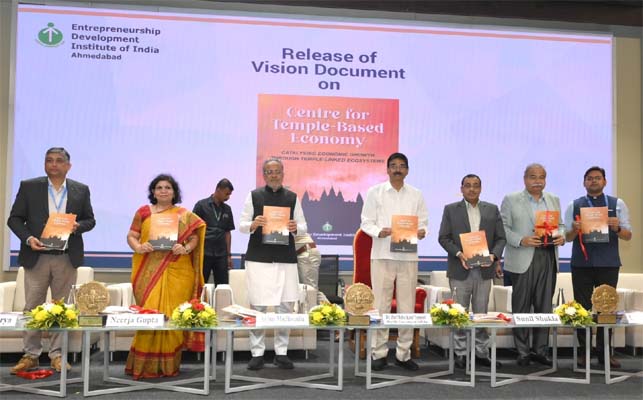
A key highlight of the event was the release of the Vision Document for the Centre for Temple-Based Economy, unveiled by Governor Kambhampati. EDII has previously conducted extensive studies on temple-town economies such as Ayodhya, Varanasi, Mathura–Vrindavan and Gorakhpur, identifying their potential for tourism-led and culture-driven economic expansion.
The proposed Centre will focus on:
- Research on heritage-linked value chains
- Entrepreneurship and skilling in temple-town ecosystems
- Innovation in traditional craft, services and cultural industries
- Sustainable livelihood creation rooted in India’s spiritual and economic heritage
A Shared Vision for Inclusive Growth
In his vote of thanks, Saurabh Pandey emphasised the importance of continuous collaboration between academia, policy circles and cultural institutions to strengthen India’s entrepreneurial landscape.
The event marked a powerful confluence of ideas, reaffirming that India’s economic future lies at the intersection of innovation, entrepreneurship and cultural capital.