R ARIVANANTHAM
NEW DELHI, OCT 3
India’s ambitious Electronics Components Manufacturing Scheme (ECMS) has drawn an unprecedented ₹1,15,351 crore worth of investment proposals, almost double the original target, marking a historic response from both domestic and international players.
𝐄𝐂𝐌𝐒: 𝐀 𝐋𝐚𝐧𝐝𝐦𝐚𝐫𝐤 𝐢𝐧 𝐈𝐧𝐝𝐢𝐚’𝐬 𝐄𝐥𝐞𝐜𝐭𝐫𝐨𝐧𝐢𝐜𝐬 𝐌𝐚𝐧𝐮𝐟𝐚𝐜𝐭𝐮𝐫𝐢𝐧𝐠 𝐉𝐨𝐮𝐫𝐧𝐞𝐲
The Electronics Component Manufacturing Scheme (ECMS) has received an extraordinary response, with 𝐜𝐨𝐦𝐦𝐢𝐭𝐦𝐞𝐧𝐭𝐬 𝐨𝐟 𝐨𝐯𝐞𝐫 ₹1.15 𝐥𝐚𝐤𝐡 𝐜𝐫𝐨𝐫𝐞… pic.twitter.com/yVvroGItO2
— India Cellular & Electronics Association (ICEA) (@ICEA_India) October 2, 2025
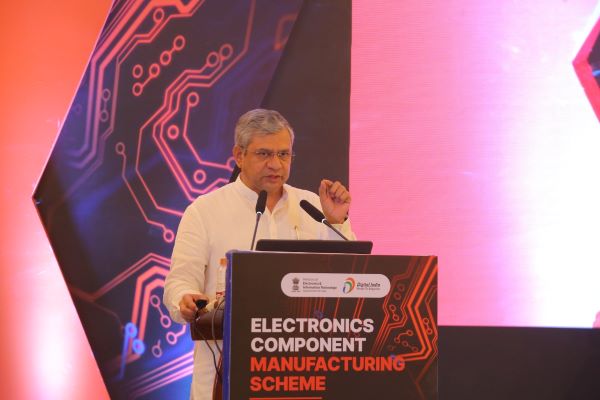
- Union Minister Ashwini Vaishnaw Urges States to use the opportunity & develop the electronic manufacturing industry in their states asserting, it gives jobs to youths in big numbers
- Huge Response reflects Domestic Industry’s Deep Commitment to India’s Self-Reliant Electronics Manufacturing Vision as well as a Testament to Growing Global Confidence in India
- The scheme is projected to create 1,42,000 direct jobs well above the target of 91,600 and a manifold number of indirect jobs, demonstrating its potential to drive large-scale employment.
The scheme, with a fiscal outlay of ₹22,919 crore, was launched in May 2025 to deepen India’s electronics manufacturing ecosystem. In just a few months, it has attracted 249 applications and is projected to generate production worth ₹10.34 lakh crore over the next six years, compared to the initial target of ₹4.56 lakh crore.
Jobs & Service Industry Growth
The scheme is expected to create 1.42 lakh direct jobs, far surpassing the original goal of 91,600, along with hundreds of thousands of indirect jobs in the service industry — including logistics, testing, design services, supply chain management, maintenance, and after-sales support. This ripple effect will strengthen India’s service economy, particularly in Tier-2 and Tier-3 cities, where most ancillary units are expected to come up.
Forex Earnings & Export Push
By fostering domestic production of critical components, India will reduce heavy reliance on imports, thereby saving billions in foreign exchange. At the same time, large-scale manufacturing and integration into global supply chains will open up vast export opportunities, turning India into a net exporter of electronics components in the long run. This dual benefit — import substitution plus export expansion — will substantially boost India’s forex reserves and balance of payments.
States Must Seize the Opportunity
Union Minister Shri Ashwini Vaishnaw urged states to build favorable ecosystems for the electronics industry. “This is a golden chance to attract investments, create lakhs of jobs for our youth, and ensure India’s full participation in global value chains,” he said. Highlighting the booming electronics manufacturing sector, now valued at ₹13 lakh crore, the Minister emphasized that ECMS will complete India’s value chain integration — from components to finished products.
Global Confidence in India’s Manufacturing
According to Shri S. Krishnan, Secretary, MeitY, the scheme is designed to significantly increase domestic value addition while linking India to global supply chains. The overwhelming response, he added, is a testament to the policy stability, competitive advantages, and growing global trust in India’s manufacturing ecosystem.
With ECMS complementing earlier schemes like PLI for mobiles and IT hardware, EMC, and SPECS, India is firmly on track to achieve the $500 billion domestic electronics manufacturing vision by 2030-31, while simultaneously creating millions of jobs and driving forex earnings through exports.