
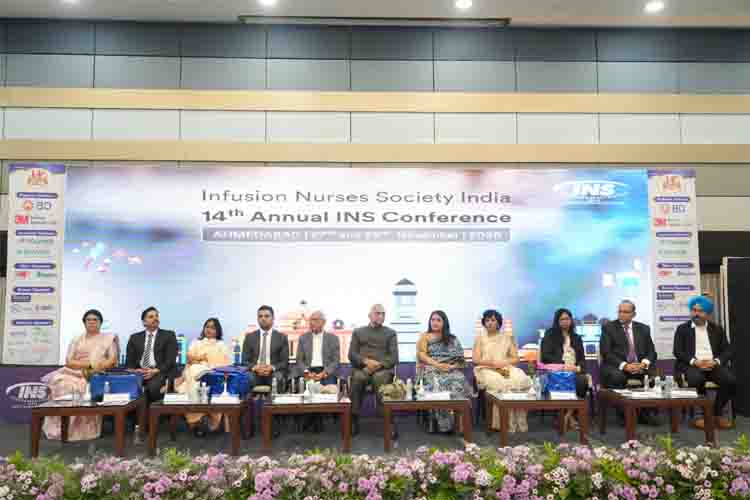
- 14th National Annual Conference brings Gujarat and national nursing fraternity onto a common platform
- Focus on elevated patient-centred infusion care, clinical excellence and safer treatment practices
- Nursing leaders, educators, clinicians and students explore emerging challenges and best practices
- Conference underscores the critical role of nurses in preventing complications and improving patient outcomes
- Calls for continuous professional development, knowledge-sharing and nurturing the next generation of nursing leaders
NE HEALTH BUREAU
AHMEDABAD, NOV 28
Every drop of an infusion carries a responsibility; every nursing intervention can make a difference between routine treatment and safer, better patient outcomes. Bringing this critical dimension of modern healthcare into focus, the Infusion Nurses Society (INS) India convened its 14th National Annual Conference, INS Gujarat 2026, in Ahmedabad, rallying nursing leaders, clinicians, educators, practising professionals and students around a compelling message: patient safety must remain at the heart of infusion care.
Held under the theme “Every Drop Matters: Elevated Patient-Centred Infusion Care,” the conference seeks to strengthen clinical competence, promote evidence-based infusion practices and empower nursing professionals to deliver safer, more effective and compassionate care. Its underlying message is unequivocal: infusion therapy is not merely about administering fluids or medication; it is about precision, vigilance, accountability and putting the patient first.
Nursing expertise: The frontline defence against infusion-related risks
Infusion therapy is indispensable across critical care, oncology, emergency medicine and several other specialities. Yet, its clinical importance also demands stringent safeguards against complications, including catheter-related infections, incorrect administration, infiltration and extravasation. Safe infusion practices therefore depend on appropriate vascular access, aseptic techniques, continuous monitoring and the demonstrated competence of healthcare professionals.
India’s own regulatory guidance on intravenous fluid administration underscores the importance of trained personnel, evidence-based clinical judgement, hand hygiene, sterile procedures and infection-control protocols. These principles reinforce the need for specialised infusion nursing education and institutional adherence to safety standards.
The emphasis on standardised practice is also reflected in the Infusion Nurses Society’s Infusion Therapy Standards of Practice, which provide evidence-based guidance for clinical decision-making, vascular access management, infection prevention and patient safety.
INS leadership calls for an empowered nursing workforce
Highlighting the pivotal contribution of nurses to healthcare delivery, Col Binu Sharma, CEO, INS India; Capt. Madhukary Ray, President, INS India; and the Governing Council stressed that nurses are central to safe, compassionate and effective healthcare.
“Nurses are central to the delivery of safe, compassionate and effective healthcare. Their clinical expertise, vigilance and ability to connect with patients make a meaningful difference at every stage of treatment.”
They emphasised that INS Gujarat 2026 would provide a common platform for nursing students, practising professionals and experienced leaders to learn from one another, exchange knowledge and strengthen their capabilities.
“Empowering our nursing workforce through education, collaboration and leadership development is essential to building a stronger healthcare system and delivering better patient outcomes,” they said.
The leadership further underscored the importance of professional networking and sharing clinical experiences to bridge the gap between academic learning and practical healthcare delivery.
Sharmishtha Nayi highlights professional growth and leadership
Sharmishtha Nayi, Organising Chairperson, INS Gujarat 2026, highlighted the importance of continuous professional development in an increasingly technology-driven and rapidly evolving healthcare environment.
“The conference also highlights the importance of continuous professional development in a rapidly evolving healthcare environment. For nursing students and early-career professionals, it offers an opportunity to gain exposure to contemporary healthcare practices, interact with experienced professionals and develop the skills and confidence required to take on future leadership roles,” she said.
The conference also seeks to encourage participation from government nursing colleges, nursing schools, academic institutions and healthcare establishments across Gujarat. Such institutional engagement is expected to strengthen academic-industry interaction, facilitate knowledge-sharing and create wider opportunities for professional advancement.
Putting patients before procedures
Beyond technical proficiency, the conference seeks to reinforce a fundamental principle of healthcare: every patient deserves safe, individualised and compassionate treatment. The quality of infusion care depends not only on clinical protocols and technology but also on the nurse’s ability to anticipate risks, recognise warning signs, communicate effectively and respond promptly to complications.
By bringing nursing professionals from diverse clinical and academic backgrounds together, INS Gujarat 2026 aims to foster a stronger culture of evidence-based practice, professional accountability and continuous learning.
The 14th National Annual Conference thus represents an important step towards strengthening infusion nursing in Gujarat and encouraging wider collaboration with the national nursing fraternity. Its central message resonates beyond the conference halls: when nursing expertise is strengthened, patient safety is reinforced and healthcare outcomes stand to improve.
The initiative reflects INS India’s commitment to nurturing competent nursing professionals, developing future clinical leaders and advancing patient-centred infusion care.