R ARIVANANTHAM

With Prime Minister Narendra Modi’s proposed visit to Madurai on February 23, Tamil Nadu’s electoral discourse has entered a phase where faith, caste identity and political symbolism are beginning to speak louder than manifestos. While officially framed as campaign logistics, the announcement that Modi may visit the Thiruparankundram Murugan temple has ignited a wider debate on how religion increasingly intersects with electoral strategy in a state long shaped by Dravidian rationalist ideology.
The National Democratic Alliance (NDA) is set to formally kick-start its Tamil Nadu Assembly poll campaign from Madurai, with senior BJP and AIADMK leaders inspecting venues, including Amma Ground, for a massive public rally. Tamil Nadu BJP president Nainar Nagenthran confirmed the likelihood of Modi’s temple visit, describing it as part of the Prime Minister’s schedule during the Madurai leg of the campaign.
- As Modi’s Madurai visit looms, temples, symbols and identity emerge as silent but powerful campaign narratives
- From Thiruparankundram to Amma Ground, religion becomes political language — subtly shaping voter psychology
- Caste equations simmer beneath development rhetoric in India’s most literate state
- Welfare politics, symbolism and counter-symbolism collide ahead of Assembly polls
- Between Dravidian legacy and nationalist appeal, voters face competing worldviews
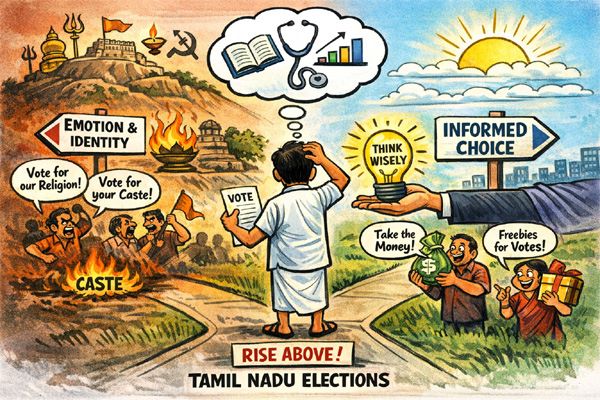
- An appeal to citizens: rise above inducements, emotions and identity to vote consciously
While such visits are not unprecedented, their timing and symbolism carry weight in a politically conscious state where religion has traditionally remained in the background of electoral narratives, unlike in parts of northern India.
Religion as Signal, Not Slogan
Political observers note that temple visits during election season often serve as signals rather than overt appeals — subtle acknowledgements of cultural identity aimed at consolidating sentiment without explicit religious messaging.
The Thiruparankundram hill, one of the six sacred abodes of Lord Murugan, is already at the centre of a legal and political controversy over the lighting of the deepam atop the hill. The DMK government maintains that the structure in question is a survey stone and has cited law-and-order concerns, even as the Madras High Court directed arrangements for lighting the lamp. The matter is now before the Supreme Court.
For the BJP, the issue feeds into its broader narrative of positioning itself as “pro-spiritual”, while accusing the ruling DMK of being “anti-faith” — a charge the DMK has consistently rejected.
Nagenthran alleged that several temples were demolished under the present regime and accused the state government of acting against Hindu sentiments. The DMK, on its part, has framed such allegations as attempts to communalise Tamil Nadu’s political landscape.
The Caste Cauldron Beneath the Surface
Beyond religion, caste arithmetic remains a decisive — though often understated — force in Tamil Nadu politics. Despite being India’s most literate state and a pioneer of social justice movements, caste affiliations continue to shape voting patterns, candidate selection and alliance dynamics.
Madurai and southern Tamil Nadu, in particular, are politically sensitive regions where community loyalties, sub-regional identities and historical grievances intersect. While parties publicly emphasise development, welfare and governance, caste-based mobilisations often operate quietly at the grassroots.
Political analysts argue that education has not erased identity politics, but has instead made it more layered — blending aspiration, entitlement and cultural pride.
Welfare vs Conscious Choice
The BJP has sharply criticised the DMK government’s welfare politics, particularly the inclusion of ₹3,000 cash assistance in the Pongal gift hamper, alleging electoral inducement. Nagenthran even urged voters to “take the money but vote with conscience,” a statement that itself sparked debate on electoral ethics.
At the same time, BJP national leaders claimed widespread public dissatisfaction with the DMK’s governance and said NDA workers are prepared to take Prime Minister Modi’s vision of a corruption-free Tamil Nadu to every polling booth.
The DMK counters such claims by pointing to its social justice legacy, welfare delivery and administrative record, accusing the BJP of importing religious polarisation into a state that historically resisted it.
A State at an Ideological Junction
Tamil Nadu today stands at an ideological junction — between Dravidian rationalism and cultural nationalism, between welfare populism and aspirational politics, between identity-driven mobilisation and issue-based voting.
For voters, particularly the youth and first-time electorate, the challenge lies in separating emotion from evaluation. Religion and caste may shape identity, but governance, education, employment and social harmony ultimately shape everyday life.
An Appeal Beyond Parties
As political temperatures rise, civil society voices increasingly stress the need for informed voting — urging citizens to look beyond cash incentives, symbolic gestures and polarising narratives.
In a state often described as ‘Kalvi Sirandha Tamil Nadu’ (education-rich Tamil Nadu), the real test of democracy may lie in whether voters can transcend identity politics and make choices rooted in accountability, transparency and long-term vision.
The coming weeks will reveal not just who campaigns better — but whether Tamil Nadu’s electorate chooses emotion, identity, or informed judgment.
(Author of this article R Arivanantham is the Executive Editor of navjeevanexpress.com, he can be contacted on hindukgi@gmail.com, navjeevanexpress@gmail.com)