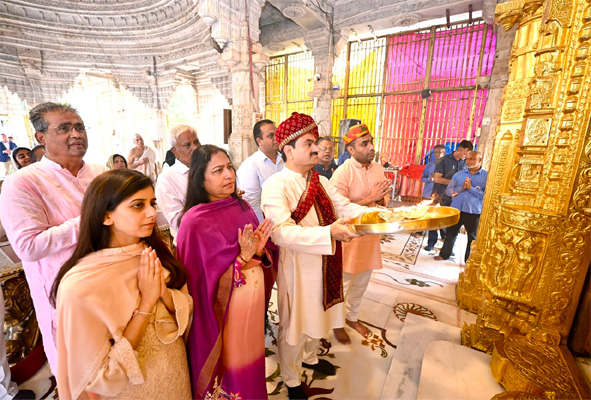

- Paryushan ahead: Gautam Adani, Dr Priti Adani, Karan and Paridhi offer prayers at the revered Jain pilgrimage centre in Gujarat
- A moment of thanksgiving: Mahudi visit brings together faith, humility, introspection and gratitude ahead of the eight-day Shwetambar festival
- Seva as spiritual calling: Adani’s philosophy of “Seva Hi Sadhana Hai” finds resonance in a family visit rooted in prayer and service
- From Mahudi to Taranga: Visit follows the Adani family’s earlier pilgrimage to the Shri Ajitnath Bhagwan Shwetamber Jain Derasar at Taranga Hills
By NE SPIRITUAL BUREAU
AHMEDABAD, AUG 19
In a quiet confluence of faith, gratitude and thanksgiving, Adani Group Chairman Gautam Adani joined his family at the revered Mahudi Jain Temple in Gandhinagar district on Wednesday, offering prayers and seeking divine blessings ahead of the spiritually significant Paryushan Mahaparva.
Adani was accompanied by his wife, Dr Priti Adani; their elder son, Karan; and daughter-in-law, Paridhi. The family’s visit to the historic Jain tirth came as the Shwetambar community prepares for its eight-day festival of prayer, fasting, self-discipline and introspection, beginning September 8 and culminating in Samvatsari on September 15 — the Festival of Forgiveness.
The pilgrimage carried a deeper resonance of gratitude and service, values that have long been associated with Adani’s personal philosophy, “Seva Hi Sadhana Hai” — selfless service is the highest form of worship.
Through the Adani Foundation, the social welfare and development arm of the Adani Group, initiatives spanning education, healthcare, livelihoods, rural development, women’s empowerment and community infrastructure have been undertaken across India. The philosophy of seva has consequently remained a recurring theme in Adani’s public articulation of social responsibility.
Mahudi: A sacred destination of faith and protection
Historically known as Madhupuri, Mahudi is among Gujarat’s prominent Shwetambar Jain pilgrimage centres. The sacred tirth is associated with temples dedicated to the 24 Jain Tirthankaras, while the separate shrine of Shri Ghantakarna Mahavir draws devotees seeking strength, protection and the overcoming of obstacles.
Unlike the Tirthankaras, Ghantakarna Mahavir is revered as a protective deity in Jain tradition. The shrine has consequently acquired a distinctive place in the spiritual landscape of Mahudi, attracting devotees from Gujarat and beyond.
For the Adani family, the visit offered an opportunity to pause amid the demands of public life and turn towards prayer, reflection and thanksgiving at one of Gujarat’s most revered Jain destinations.
Paryushan: A festival of introspection and forgiveness
The Mahudi pilgrimage comes weeks ahead of Paryushan Mahaparva 2026, which will be observed by the Shwetambar Jain community from September 8 to 15.
Paryushan is regarded as one of the most important periods in the Jain spiritual calendar, emphasising prayer, fasting, self-restraint, introspection and purification of the mind. Its culmination in Samvatsari is particularly significant, as devotees seek forgiveness for their thoughts, words and actions and extend forgiveness to others.
The spirit is captured in the Jain tradition of Micchami Dukkadam — a heartfelt expression of seeking forgiveness and letting go of grievances.
Against this spiritual backdrop, the Adani family’s visit to Mahudi acquired an especially meaningful dimension — a moment to pray, give thanks, seek blessings and reflect on the values of compassion, humility and forgiveness.
A continuing pilgrimage in Gujarat
The Mahudi visit follows Gautam Adani and Dr Priti Adani’s pilgrimage earlier this year to the Shri Ajitnath Bhagwan Shwetamber Jain Derasar at Taranga Hills in North Gujarat, where they offered prayers on Akshaya Tritiya.
The latest visit thus marks another personal connection with Gujarat’s rich Jain spiritual heritage, with the Adani family returning to a sacred space where devotion and community traditions have remained intertwined for generations.
The visit also comes shortly after the conclusion of the US Department of Justice proceedings involving Gautam Adani, his nephew Sagar Adani, Executive Director of Adani Green Energy Ltd, and others, with the indictment dismissed with prejudice on August 10.
At Mahudi, however, the focus was firmly on faith and thanksgiving as the family offered prayers in anticipation of Paryushan — a period when Jain philosophy turns inward, urging individuals to examine themselves, seek forgiveness, forgive others and renew their commitment to compassion and selfless service.
In that sacred setting, “Seva Hi Sadhana Hai” took on a particularly poignant meaning: service as prayer, gratitude as humility, and forgiveness as the highest expression of spiritual renewal.