NE INFRASTRUCTURE BUREAU
NEW DELHI, JAN 29
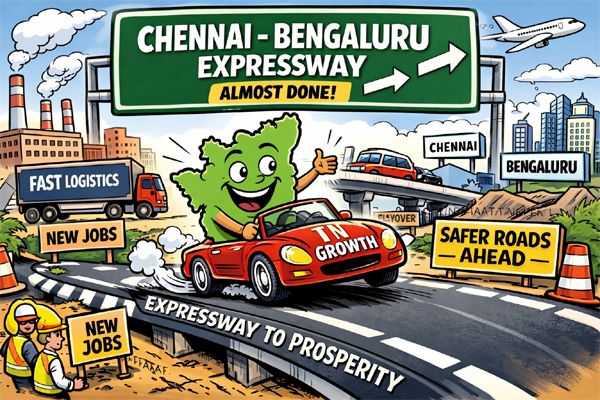
The long-awaited Chennai–Bengaluru Expressway is moving decisively towards completion, with key stretches in Tamil Nadu regaining momentum after years of delays, positioning the State for a major leap in connectivity, logistics efficiency, and economic growth.
- Stalled NH-48 six-laning revived, fresh contracts awarded, progress back on track
- Phase-III expressway stretches across Tamil Nadu, unlocking faster travel and safer highways
- Industry, logistics, jobs, and road safety in Tamil Nadu to see multi-layered gains
The six-laning of the Sriperumbudur–Karaipettai section of NH-48, part of the Poonamallee–Walajahpet corridor, was originally taken up in 2012 on Build-Operate-Transfer (BOT)-Toll mode. However, repeated defaults by the concessionaire led to termination of the agreement in 2016, forcing the project to be restructured and the balance works split into three separate packages.
Subsequently taken up on Engineering, Procurement and Construction (EPC) mode, the project faced further delays due to the non-availability of pond ash and fly ash from thermal power plants, a critical requirement for embankments and approach roads to structures such as vehicular underpasses, pedestrian underpasses and flyovers.
Out of the total 34 km, 17.2 km has been completed. The remaining 16.8 km has now been awarded through a fresh bidding process at a cost of Rs 341.50 crore on November 7, 2024. Work commenced on January 27, 2025, with a targeted completion by October 2026. As of now, 20% physical progress has been achieved, and efforts are underway to adhere to the scheduled timeline.
In parallel, Phase-III of the Bengaluru–Chennai Expressway, covering 106 km—of which 94 km lies in Tamil Nadu and 12 km in Andhra Pradesh—is being executed under the Hybrid Annuity Mode across four packages. Initial challenges related to land acquisition, utility shifting, Extra High Tension power lines, railway approvals and forest clearances have all been resolved.
Work is progressing in three packages spanning 80.2 km, with around 90% completion, and these stretches are expected to be ready by July 2026. Construction in the remaining 25.5 km package has been halted since May 2025 due to financial constraints faced by the concessionaire, and the process of substituting the concessionaire is currently underway.
Meanwhile, the existing highway is being maintained in a traffic-worthy condition. Temporary diversions through service roads, necessitated by ongoing structural works, have caused inconvenience, but fresh overlays on service roads have already been completed to ensure smoother traffic flow.
As part of the six-laning and expressway development, all major intersections are being equipped with modern crossing infrastructure, including vehicular underpasses, pedestrian underpasses, flyovers and grade separators. Accident-prone black spots identified along the corridor are also being addressed with dedicated safety structures to reduce fatalities and enhance commuter safety.
This information was provided by the Union Minister for Road Transport and Highways, Nitin Jairam Gadkari, in a written reply to the Lok Sabha.
How Tamil Nadu Will Benefit
For Tamil Nadu, the expressway is set to be a game-changer:
- Travel time between Chennai and Bengaluru will be drastically reduced, boosting business travel and tourism.
- Industrial corridors around Sriperumbudur, Kanchipuram, Ranipet and Vellore will gain faster access to ports, markets and supply chains.
- Logistics and freight movement costs will drop, strengthening Tamil Nadu’s position as a manufacturing and export hub.
- Thousands of jobs will be generated during construction and through allied services post-completion.
- Road safety will significantly improve with grade-separated crossings and elimination of accident black spots.
Once operational, the expressway will not just connect two major metros, but power Tamil Nadu’s next phase of economic expansion through speed, safety and seamless mobility.