R ARIVANANTHAM
CHENNAI, SEPT 17
What if the journey to correcting a cleft deformity could one day begin even before a baby is born? That frontier of medical research is drawing attention in Chennai, where a newly recognised comprehensive cleft care reference centre is combining specialised treatment, research and professional training—with a vision that extends from infancy through adulthood and towards exploring possibilities before birth.
- A MILESTONE FOR CLEFT CARE: Smile Train designates Chennai’s Cleft and Craniofacial Centre a Comprehensive Cleft Care Reference Centre.
- 7.5 LAKH LIVES IN INDIA: Smile Train CEO Susannah Schaefer tells Navjeevan Express about the organisation’s support for people with cleft conditions in India.
- A GLOBAL NETWORK OF HOPE: The US-based NGO works with more than 150 local medical facilities and hospitals worldwide and has supported nearly two million people.
- A QUESTION THAT LOOKS TO THE WOMB: Dr Syed Altaf Hussain says research is under way into correcting cleft deformities before birth.
- CARE BEYOND THE OPERATING THEATRE: Surgery, orthodontics, speech and hearing, nutrition, oral health and psychological support brought together.
- FROM TREATMENT TO TRAINING: The reference centre aims to strengthen referral services, clinical capacity, research and knowledge-sharing in India and abroad.
Smile Train, the world’s largest cleft-focused organisation, on Thursday designated the Cleft and Craniofacial Centre at Sree Balaji Medical College Hospital and Dr Rela Medical Centre, Chennai, as a Comprehensive Cleft Care Reference Centre (CCRC). The recognition is aimed at strengthening access to high-quality, multidisciplinary cleft care while advancing clinical capacity through training, research and knowledge-sharing.
Speaking to navjeevanexpress.com, Smile Train President and CEO Susannah Schaefer said the US-based non-governmental organisation had extended support to around 7.5 lakh people in India for cleft-lip correction. Globally, she said, Smile Train had partnered with more than 150 local medical facilities and hospitals and supported nearly two million people.
The milestone in Chennai also brought into focus an emerging research question: whether cleft deformities could eventually be corrected before birth. Responding to a query, Dr Syed Altaf Hussain, Director of the Cleft and Craniofacial Centre, said research was under way into correcting the deformity while babies were still in the womb. The research, however, should be distinguished from established clinical treatment: no claim was made that prenatal correction is currently an available or routine procedure at the centre.
A reference centre with a wider mission
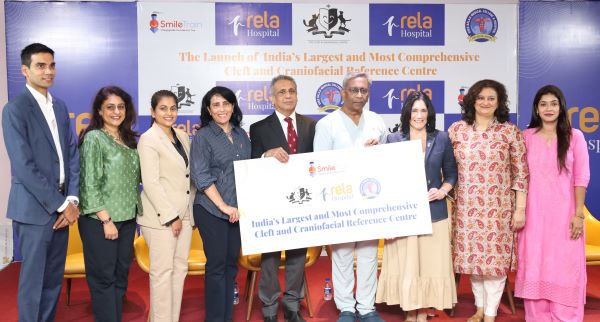
A commemorative plaque marking the CCRC was unveiled by Susannah Schaefer in the presence of Mamta Carroll, Senior Vice President and Regional Director, Asia, Smile Train; Dr J Srinisha, Chairperson, Sree Balaji Medical College and Hospital; Prof. Mohamed Rela, Chairman, Rela Hospital; and Dr Syed Altaf Hussain, Director, The Cleft and Craniofacial Centre.
The designation builds on one of the earliest multidisciplinary cleft care programmes established in association with Smile Train in 2001. The centre has been functioning in its new state-of-the-art facility at Sree Balaji Medical College Hospital and Dr Rela Hospital since 2022.
Its multidisciplinary team provides care for children with clefts from birth through the completion of growth and beyond, reflecting the fact that treatment can involve several specialists and interventions at different stages of life.
The reference-centre model is intended to extend the programme’s contribution beyond individual patient treatment by supporting referrals, professional training, research and the exchange of clinical knowledge.
One centre, multiple specialities
The programme brings together expertise across the full spectrum of cleft care, including:
- Plastic, maxillofacial and ENT surgery
- Paediatrics and paediatric anaesthesiology
- Orthodontics, speech and hearing
- Nutrition and oral health
- Clinical psychology
The surgical services include primary lip and palate repair and alveolar bone grafting, alongside secondary and complex procedures such as revision surgeries, distraction osteogenesis, orthognathic surgery, treatment of velopharyngeal dysfunction and cleft rhinoplasty.
This coordinated approach recognises that cleft care is not confined to a single operation. Depending on the individual’s condition and development, treatment may involve surgical, dental, speech, hearing, nutritional and psychological support over time.
Building a broader cleft-care ecosystem
Through the CCRC, clinical services will be complemented by referral, training and research capabilities, enabling the centre to contribute to the development of cleft-care professionals as well as patient services.
Its affiliation with Bharath Institute of Higher Education and Research further strengthens its role as a referral, research and resource hub for cleft-care professionals from India and abroad.
In her comments, Susannah Schaefer, President and CEO of Smile Train, said:
“The launch of the Comprehensive Cleft Care Reference Centre reflects our commitment to building sustainable models of care that extend beyond individual treatment. By bringing comprehensive clinical expertise together with training, research and knowledge sharing, centers such as this can strengthen the broader cleft care ecosystem. This is another important step by Smile Train towards ensuring that people with clefts have access to quality care throughout their treatment journey.”
‘Every child with a cleft deserves comprehensive care’
Dr J Srinisha, Chairperson, Sree Balaji Medical College and Hospital, said:
“Being recognised as India’s largest and most comprehensive Cleft and Craniofacial Reference Centre is a significant milestone for our institution. This recognition reflects our commitment to making high-quality, multidisciplinary cleft care accessible to more patients. Through our continued collaboration with Smile Train, we aim to strengthen clinical excellence, advance research and training, and ensure that every child with a cleft has access to comprehensive care and the opportunity to lead a healthier, more confident life.”
Prof. Mohamed Rela, Chairman, Rela Hospital, said:
“The recognition of our Cleft and Craniofacial Centre as a reference centre marks a significant step in our mission to offer comprehensive cleft care that is on par with International standards. By bringing together specialists across multiple disciplines, we aim to support as many children and adults as possible. Our partnership with Smile Train reinforces our commitment in ensuring cleft and craniofacial care reaches people irrespective of their socio-economic backgrounds.”
Research looks towards the future
Dr Syed Altaf Hussain, Plastic Surgeon and Director of The Cleft and Craniofacial Centre, said:
“Every person with a cleft has a different care journey, often requiring multiple interventions and specialists at different stages of growth and development. Over the years, we have built a multidisciplinary programme that allows these specialists to work together around the patient’s needs, including managing complex cleft conditions. The inauguration of the CCRC will enable us to build further on this work, strengthen referral care and expand our contribution to training, research and knowledge sharing.”
His response on research into correcting cleft deformities in the womb adds a forward-looking dimension to the centre’s work. Any potential prenatal intervention would require careful scientific validation and clinical evaluation before it could be considered an established treatment option.
The recognition of the Chennai centre thus brings together two complementary priorities: delivering coordinated care to people living with cleft conditions today, while developing the clinical knowledge and research capacity that may shape future treatment.