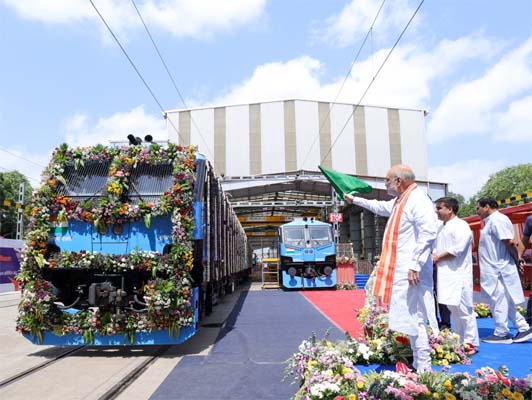
- Amit Shah flags off country’s first LNG-powered train as ₹1,472-crore railway projects take shape in Ahmedabad
- ₹700-crore WAG-12 maintenance shed inaugurated to strengthen high-capacity freight locomotive operations
- Kavach protection extended to key Gujarat routes while Sabarmati–Sarkhej doubling work gets under way
- Railway diesel consumption cited as falling from 293 crore litres in 2015–16 to 108 crore litres in 2024–25
- Electrification reaches 99.6%, while double-stack freight operations target a major expansion in carrying capacity
- Sabarmati’s transformation—from a station where passengers once struggled for basic connectivity to a multimodal rail hub—takes another leap
NE RAILWAY BUREAU
AHMEDABAD, SEPT 27
Can India’s railway network cut its dependence on diesel while carrying more freight, improving safety and modernising infrastructure at the same time?
A new answer emerged from Sabarmati on Sunday as Union Home Minister and Minister of Cooperation Amit Shah flagged off the country’s first LNG-powered train and inaugurated development projects worth ₹1,472 crore, giving Gujarat’s railway infrastructure a major technology-and-capacity push.
The package includes a ₹700-crore WAG-12 Maintenance Shed, deployment of the Kavach train-protection system on key routes and the commencement of doubling work on the Sabarmati–Sarkhej section.
Shah said the LNG-powered train would contribute to environmental protection, describing the initiative as an important step towards cleaner railway operations.
Sabarmati’s green rail moment
The choice of Sabarmati carries its own symbolism.
Recalling the historical association of the area with Mahatma Gandhi’s experiments in Satyagraha, simple living, rural development and khadi, Shah said the journey of translating such experiments into action had begun from Sabarmati itself.
The LNG train now adds a modern technological chapter to that history.
According to Shah, railway diesel consumption declined from 293 crore litres in 2015–16 to 108 crore litres in 2024–25, which he described as a significant but relatively under-recognised achievement.
The shift towards cleaner propulsion comes alongside rapid electrification of the rail network.
99.6% electrification: The final stretch
Shah said railway electrification, which stood at around 30% before 2014, has now reached 99.6%, with the remaining 0.4% expected to be completed soon.
He also cited a sharp increase in annual electrification, saying only 75 km was electrified in 2010–11 compared with 7,188 km in 2023–24.
The electrification push, combined with alternative-fuel initiatives such as LNG, reflects the broader effort to reduce the railway system’s dependence on conventional diesel traction.
One WAG-12, the freight power of hundreds of trucks
Another highlight at Sabarmati was the commissioning of a 12,000-horsepower WAG-12 twin-section locomotive.
Shah said the locomotive can haul nearly the equivalent freight load of 600 trucks, while previously two locomotives were required for comparable operations.
The new WAG-12 Maintenance Shed, built at a cost of ₹700 crore, is designed to support maintenance of these high-capacity freight locomotives.
The development assumes greater significance as Indian Railways seeks to increase freight capacity and improve the efficiency of long-haul goods movement.
Double-stack freight: More cargo, same rail corridor
Shah also highlighted the successful trial of the country’s first long-haul double-stack container train between the Mumbai region and Vadodara.
He said double-stack operations could significantly increase freight-carrying capacity on existing rail infrastructure.
The development of Dedicated Freight Corridors has further strengthened the capacity for long-distance goods movement, while the broader rail network is being upgraded to accommodate increasing passenger and freight traffic.
Kavach moves closer to the frontline
Safety received another major push in Gujarat.
The Kavach automatic train-protection system has been introduced on the Sabarmati–Kalol–Sabarmati section at a cost of ₹48 crore, while implementation work has commenced on the Ahmedabad–Palanpur and Ahmedabad–Samakhiali sections.
Doubling work on the Sabarmati–Sarkhej railway route has also commenced.
Together, these projects target three critical railway priorities: safety, capacity and reliability.
From Sabarmati to a modern rail network
Shah credited the post-2014 period with introducing or accelerating initiatives such as Dedicated Freight Corridors, the Rapid Rail System and upgraded railway stations.
He also referred to India’s hydrogen-powered train technology and the expansion of domestic locomotive manufacturing under the Make in India and Aatmanirbhar Bharat initiatives.
Several of the figures cited by Shah—including comparisons on electrification, coach production, locomotive capacity and safety expenditure—were presented as achievements of the present government.
He also contrasted the current period with previous governments, alleging large-scale corruption in the earlier period and saying, “in 12 years, not even the slightest allegation of corruption has been levelled against Modi.” That statement is a political claim by Shah and is not independently established by the figures cited in his address.
The larger transformation, however, is visible in the infrastructure itself.
At Sabarmati, an LNG-powered train now stands alongside high-capacity freight locomotives, advanced safety technology and expanding rail capacity.
The message from the railway station is clear: the next track for Indian Railways is being laid not merely for faster trains, but for cleaner propulsion, heavier freight, safer journeys and increasingly technology-driven operations.