
- Tricog Health-backed STEMI network spans 167 districts, 3,000-plus health centres and a population exceeding 305 million
- Karnataka cuts artery-opening time from 170 minutes to 65; Maharashtra records a stark survival gap between timely and delayed treatment
- Odisha reports improved survival, while Goa’s pioneering model demonstrates the power of round-the-clock digital cardiac care
- Technology is accelerating diagnosis, but delayed hospital visits, referral gaps and weak follow-up remain formidable challenges
- The next frontier: ensuring that geography, hospital capacity and the time of a heart attack do not determine a patient’s chances of survival
NE HEALTH BUREAU
AHMEDABAD, OCT 10
A heart attack does not wait for a cardiologist to arrive, a specialist hospital to become accessible or the morning shift to begin. Yet, across much of India, the time between a patient’s first symptoms and life-saving treatment can determine the difference between survival and irreversible heart damage. A seven-state initiative using digital electrocardiograms (ECGs), artificial intelligence-assisted interpretation and round-the-clock cardiac expertise is attempting to change that equation—bringing critical decisions closer to the patient and potentially saving thousands of lives.
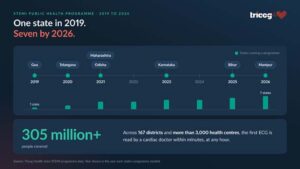
Since 2019, government-led ST-Elevation Myocardial Infarction (STEMI) programmes supported by Tricog Health have expanded across Goa, Telangana, Maharashtra, Odisha, Karnataka, Bihar and Manipur. The network now covers 167 districts, more than 3,000 health centres and a population of over 305 million, creating a connected pathway intended to identify serious heart attacks rapidly and initiate appropriate treatment without losing precious minutes.
STEMI is among the most dangerous forms of heart attack. A coronary artery becomes acutely blocked, cutting off the heart muscle’s blood supply. Every delay can increase the extent of permanent damage and the risk of death. The programme’s central principle is straightforward: equip the facility where a patient first seeks help with a digital ECG, transmit the tracing for rapid assessment by a cardiac doctor at any hour, and activate a predefined treatment and referral pathway.
KARNATAKA’S RACE AGAINST THE CLOCK
Karnataka offers a striking illustration of what a coordinated system can achieve. The time between a patient’s arrival at the hospital and the opening of the blocked artery fell from 170 minutes in March 2023 to 65 minutes in May 2026. The time taken to administer clot-busting treatment also declined, from 34.5 minutes to 14.2 minutes.
The programme has diagnosed more than 11,000 heart attacks and reports over 9,600 lives saved—more than nine a day. NITI Aayog has subsequently described the Karnataka initiative as an AI-powered cardiac lifeline.
These figures highlight a critical distinction in emergency medicine: identifying a heart attack is only the beginning. The real test is whether diagnosis leads to treatment quickly enough to restore blood flow and limit damage to the heart.
TIMELY TREATMENT CAN CHANGE THE ODDS
The strongest argument for strengthening STEMI networks lies in the reported difference in outcomes between patients who receive timely reperfusion—the restoration of blood flow to the heart—and those who do not.
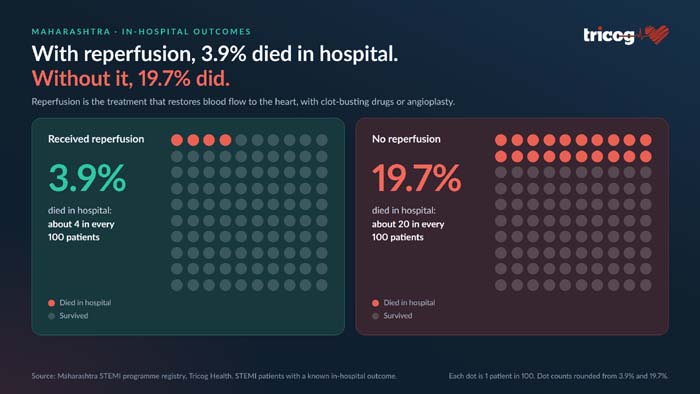
In Maharashtra, in-hospital mortality was reported at 3.9% among patients treated in time, compared with 19.7% among those who did not receive timely treatment. The comparison underlines the potentially devastating consequences of delays, although outcomes can also be influenced by the severity of illness and other patient factors.
Maharashtra’s programme now extends across all 34 districts, reaching community and primary health centre levels. More than 22,000 health workers have been trained, while nearly five million ECGs have been read. The programme reports a reduction in overall STEMI mortality from 20% to 15.5%.
The message is clear: sophisticated cardiac facilities remain essential, but a well-connected primary-care network can help identify patients earlier, direct them to appropriate treatment and reduce avoidable delays.
Odisha, meanwhile, reported an increase in survival among enrolled patients from 79% in August 2025 to nearly 88% in March 2026. Its programme estimates that it is saving around 12 lives a day.
GOA’S MODEL OFFERS A BLUEPRINT
Goa, where the initiative began in 2019, remains an important reference point. A review commissioned by the Union Health Ministry and conducted through the Population Research Centre in Dharwad found that the programme was delivering treatment within approximately 15 minutes, well inside the 90-minute benchmark used by the assessors for timely care.
The review concluded that a STEMI programme built around existing staff and primary healthcare infrastructure could serve as a model for expanding reperfusion services in a resource-constrained country.
The Goa programme has since logged more than 460,000 diagnoses and identified over 22,000 major heart attacks. It reports detecting a critical case in an average of three minutes, illustrating the potential value of connecting frontline health facilities with specialist expertise.
The larger lesson is that emergency cardiac care need not depend exclusively on building new specialist hospitals everywhere. Existing facilities can become more effective when equipment, trained personnel, specialist decision-making and referral arrangements operate as one coordinated system.
THE GAPS THAT TECHNOLOGY CANNOT FIX ALONE
Despite the progress, the programme faces a persistent challenge: patients continue to die when they reach the healthcare system too late or fail to complete the treatment pathway.
Nearly one-third of the heart attacks covered by the programme reportedly occur at night or during weekends. Round-the-clock diagnosis and treatment are therefore indispensable. A system that functions efficiently during office hours but falters at 2 am cannot provide equitable emergency care.
Other shortcomings are less dramatic but equally consequential. Referral forms may be incomplete, ambulance services may not be adequately integrated into the network, and missing patient contact details can make follow-up difficult. As the programme’s review observed, installing machines is often easier than changing established working practices.
The lesson extends beyond technology. Healthcare workers must follow standardised protocols; ambulances must be linked to referral arrangements; hospitals must be ready to receive patients; and patients must be tracked to understand whether diagnosis ultimately resulted in appropriate treatment.
Artificial intelligence can support the initial interpretation of an ECG, but it does not eliminate the need for clinical oversight. Under the model described by the programme, AI assists the first reading, while a Tricog doctor reviews and signs off on every case. Monitoring outcomes also helps identify where patients are still falling through the cracks.
FROM PILOT SUCCESS TO SYSTEM-WIDE CHANGE
These lessons resonate with discussions at the National CVD Summit, where a central concern has been how to translate established cardiovascular-care knowledge into consistent delivery across India. Awareness campaigns alone cannot bridge the gap between recognising symptoms and receiving timely, appropriate treatment.
The seven-state initiative offers an example of a more operational approach: governments lead the care pathway, frontline facilities initiate diagnosis, specialists provide rapid interpretation, and patients are directed towards treatment through defined referral arrangements.
“A heart attack in a district town should not carry a worse sentence than one in a city,” said Dr Charit Bhograj, Founder and CEO of Tricog Health.
“What these seven states have shown is that when the government owns the pathway, and the first ECG is read by a doctor within minutes, survival changes. The technology is ready. The work now is making sure no patient reaches us too late,” he added.
The public-health stakes are substantial. Cardiovascular disease is India’s leading cause of death, while ischaemic heart disease accounts for a major share of acute coronary conditions. STEMI demands particular urgency because an obstructed artery can rapidly destroy heart muscle if treatment is delayed.
The seven-state experience suggests that reliable, connected STEMI systems could be an important part of India’s response. But the next measure of success must go beyond the number of ECGs read, districts covered or machines installed. It must establish whether more patients receive appropriate treatment in time, whether improvements reach remote and underserved communities, and whether reported survival gains are sustained.
The ultimate test is not how quickly a machine detects a heart attack. It is how reliably the healthcare system turns that detection into a life saved.