
NE SCIENCE & TECH BUREAU
VISAKHAPATNAM/SURAT, OCT 12
Can India turn its industrial expansion into a dependable pipeline of skilled local talent rather than leave young jobseekers struggling to bridge the gap between classroom learning and factory-floor demands? A ₹440-crore industry–academia partnership spanning Gujarat and Andhra Pradesh seeks to address that challenge by bringing nine Government Industrial Training Institutes (ITIs) under an industry-led transformation programme, linking technical education more closely with the needs of modern manufacturing.
- Nine Government ITIs, two states, one skilling mission: AM/NS India partners the Centre and state governments to upgrade five institutes in Surat and four in Visakhapatnam
- ₹440 crore to reshape technical training: Approved investment comprises ₹240 crore for the Gujarat cluster and ₹200 crore for Andhra Pradesh
- Industry takes a 51% stake: Dedicated SPVs will oversee modernisation and operations, with the Centre and respective state governments holding 24.5% each
- From workshops to workplaces: Modern laboratories, industry-aligned curricula, emerging trades and hands-on training aim to strengthen employability
- NAMTECH brings academic expertise: AM/NS India’s technical education partner will support curriculum enhancement, faculty development and training reforms
- PM-SETU’s larger ambition: The ₹60,000-crore national initiative seeks to upgrade 1,000 Government ITIs and strengthen five National Skill Training Institutes
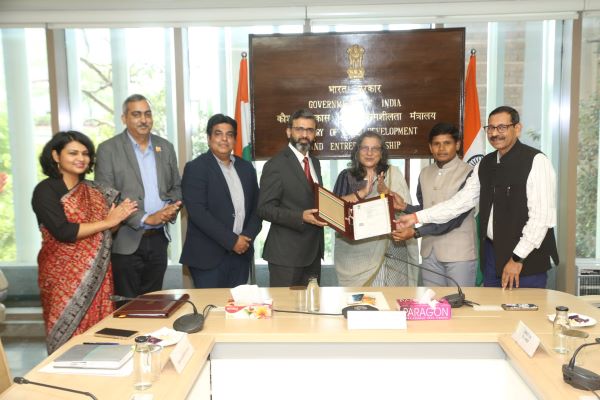
ArcelorMittal Nippon Steel India (AM/NS India), a joint venture between ArcelorMittal and Nippon Steel, has signed Shareholders’ Agreements (SHAs) with the Directorate General of Training (DGT), Ministry of Skill Development and Entrepreneurship (MSDE), and the governments of Gujarat and Andhra Pradesh for upgrading ITI clusters in Surat and Visakhapatnam under the Pradhan Mantri Skilling and Employability Transformation through Upgraded ITIs (PM-SETU) scheme.
The agreements establish the framework for implementing approved Strategic Investment Plans (SIPs), with ₹240 crore earmarked for five Government ITIs in Surat and ₹200 crore for four institutes in the Visakhapatnam cluster. Together, the projects represent an important step towards bringing industry participation, contemporary training infrastructure and employment-oriented technical education into the public ITI ecosystem.
The partnership also places Gujarat and Andhra Pradesh within a common national skilling framework, offering a model through which industrial expertise can help public training institutions prepare young people for emerging manufacturing opportunities.
Industry moves from participation to institutional partnership
Under the agreements, dedicated Special Purpose Vehicles (SPVs) will be established to manage the upgradation and operations of the respective ITI clusters. AM/NS India will hold a 51% stake in each SPV, while the Government of India and the concerned state government will each hold 24.5%.
The arrangement formalises a shared institutional responsibility: industry contributes manufacturing expertise and operational insights, while the governments bring their public training infrastructure and skilling mandate into the partnership.
The Visakhapatnam cluster’s Strategic Investment Plan was the first to receive approval from the National Steering Committee under PM-SETU, according to the project details.
The Surat and Visakhapatnam projects together account for ₹440 crore of approved investment, comprising ₹240 crore and ₹200 crore, respectively. The two initiatives form part of the wider PM-SETU effort to encourage industry-led transformation of Government ITIs.
Andhra Pradesh: Training shaped around industrial needs
In Andhra Pradesh, the ₹200-crore project will cover four institutes: Government ITI (Old), Kancharapalem; Government ITI (Girls), Industrial Estate, Visakhapatnam; Government ITI, Bobbili; and Government ITI, Narsipatnam.
Kancharapalem will serve as the principal training centre, supporting the other three institutes through shared facilities and resources.
The planned interventions include modernising workshops and laboratories, upgrading existing courses, introducing new trades and strengthening instructor training. Students are expected to gain greater exposure to practical learning, workplace-relevant equipment and technical practices aligned with manufacturing and related industries.
Nara Lokesh, Andhra Pradesh Minister for IT, Electronics and Communication, Human Resource Development and Real-Time Governance, said:
“Our priority is to ensure that Andhra Pradesh’s industrial growth creates opportunities for our young people. This partnership with AM/NS India will help students at four Government ITIs gain practical skills that employers need. By improving training facilities and bringing industry expertise into technical education, we aim to strengthen their employability and help them participate in the State’s growth.”
The project seeks to improve the connection between technical training and employment opportunities as Andhra Pradesh expands its industrial and manufacturing base.
Gujarat: Five ITIs in the Surat cluster
The parallel ₹240-crore project in Gujarat will cover five Government ITIs in the Surat cluster, extending the same industry-led approach to technical education in one of the state’s important industrial regions.
For Gujarat, the significance lies in the opportunity to align vocational training more closely with the technical and workforce requirements of manufacturing employers. Modernised training facilities, updated curricula, new-age trades and stronger instructor capabilities are intended to improve the workplace readiness of ITI graduates.
The combined initiative offers both states a common framework for improving public technical education while allowing training interventions to respond to the needs of their respective industrial ecosystems.
Its longer-term impact will depend on how effectively upgraded facilities translate into better instruction, stronger practical competencies and measurable employment outcomes for graduates.
AM/NS India and NAMTECH bring industry–academia expertise
AM/NS India will implement the projects in partnership with the New Age Makers’ Institute of Technology (NAMTECH), its academic and technical partner.
While AM/NS India will contribute its manufacturing experience and industry insights, NAMTECH will support curriculum enhancement, training-delivery reforms, faculty development and academic innovation.
Ashutosh Telang, Director and Vice President – HR and Administration, AM/NS India, said:
“AM/NS India aims to strengthen the employability of young people in Andhra Pradesh. Through this partnership, we will bring our manufacturing experience and NAMTECH’s technical education expertise to four Government ITIs in the Visakhapatnam cluster. Better facilities, hands-on learning and stronger instructor training will help students build skills that employers need, preparing them for jobs in manufacturing and related industries while strengthening the pool of skilled local talent.”
The interventions are expected to give trainees more opportunities to apply classroom learning to practical tasks, while equipping instructors with updated technical knowledge and teaching capabilities.
The partnership’s central proposition is that vocational education becomes more effective when industry requirements inform both what students learn and how they learn it.
PM-SETU’s national skilling ambition
PM-SETU has a total outlay of ₹60,000 crore and aims to upgrade 1,000 Government ITIs through industry partnerships, besides strengthening five National Skill Training Institutes.
The Surat and Visakhapatnam agreements add to the programme’s broader objective of improving training infrastructure, introducing industry-relevant skills and strengthening the employability of young people.
Debashree Mukherjee, Secretary, Ministry of Skill Development and Entrepreneurship, said:
“The signing of these agreements is not the finish line, but the starting point of a transformative journey for our ITIs. As India secured a place among the Top 10 in world’s leading performers at WorldSkills competition held in Shanghai recently, we must now aspire for PM-SETU institutions and Aspirational Institutes to become centres of excellence that nurture future WorldSkills champions. Our goal is not only to upgrade infrastructure, but to elevate aspirations, quality and outcomes across the skilling ecosystem”.
The broader challenge is to ensure that capital investment and upgraded infrastructure deliver sustained improvements in training quality, employer confidence and job prospects. For Gujarat and Andhra Pradesh, the test will be whether these nine institutes can emerge as stronger bridges between public technical education and industrial employment.
The ₹440-crore partnership sets the institutional framework in motion. Its ultimate measure of success will be the skills young people acquire, the jobs they secure and the extent to which industry and academia continue to work together beyond the initial infrastructure upgrade.