- 2,000-bed Adani Arogya Mandir to rise on 51.75 acres at Bengal Silicon Valley Tech Hub, New Town
- 1,000 beds to cater to economically weaker sections eligible under State and Central health insurance schemes
- Academic medical centre to combine cancer care, medical education, precision medicine, AI and clinical research
- Project expected to serve more than 2 million outpatients and 200,000 inpatients annually and create about 10,000 jobs
- Adani Group announces investment roadmap of over ₹1 lakh crore in West Bengal across infrastructure and energy sectors by 2035
NE BUSINESS/HEALTH BUREAU
KOLKATA, SEPT 24
What if Kolkata’s next big healthcare landmark is designed not merely to treat patients, but to train doctors, advance medical research, develop new technologies and make specialised treatment more accessible to economically weaker sections?
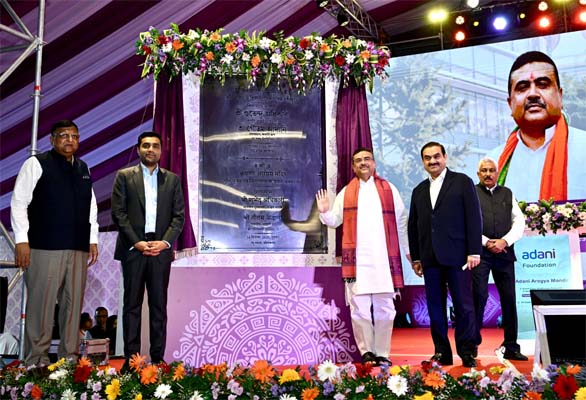
That vision moved a step closer to reality on Thursday with the foundation stone being laid for the 2,000-bed Adani Arogya Mandir at Bengal Silicon Valley Tech Hub, New Town, Kolkata—an over ₹4,000-crore healthcare and academic medical centre that aims to create a comprehensive healthcare ecosystem for Eastern India and beyond.
West Bengal Chief Minister Suvendu Adhikari laid the foundation stone in the presence of Gautam Adani, Chairman, Adani Group. The project, to be executed by the Adani Foundation, is aligned with the state’s 2026 healthcare vision and is projected to cater to more than 200,000 inpatients and over two million outpatients annually, while generating around 10,000 jobs across the healthcare ecosystem.
The 51.75-acre campus is envisioned as much more than a conventional multi-speciality hospital. It will bring together a hospital, medical college, nursing and allied healthcare education, step-down and transitional care, research facilities and accommodation for patients’ relatives and healthcare professionals.
‘Not just a hospital campus’
“We look forward to your presence to rebuild Bengal. The final vision is not just a hospital campus, it will be a fully integrated healthcare city. Nowhere in India is there a hospital of this high standard. The hospital will give a big boost to medical tourism. This is historic, meaningful and an auspicious day for us. Viksit Bharat 2047 can happen only if Bengal develops,” Adhikari said.
Adani said the institution would be a world-class, not-for-profit medical institution with 2,000 beds.
“The Adani Arogya Mandir will be a world-class, not-for-profit medical institution that will have 2,000 beds—with a thousand beds catering to economically weaker sections of society, eligible under State and Central health insurance schemes,” Gautam Adani said.
The 1,000-bed commitment for economically weaker sections gives the project a significant public-health dimension, potentially widening access to advanced healthcare for beneficiaries covered under government health insurance programmes.
Cancer care, AI and precision medicine
The first phase of the multi-speciality hospital will focus on cancer care, with advanced tertiary and highly specialised treatment services. The project envisages subsequent Centres of Excellence covering a range of specialities and super-specialities.
The academic ecosystem will include a medical college with an annual intake of 150 undergraduate students, more than 100 postgraduates and over 40 super-specialists. A College of Nursing and an institution for allied healthcare and paramedical education will add another layer to the talent pipeline.
The research architecture is equally ambitious, encompassing genomics, precision medicine, biomedical informatics, artificial intelligence, clinical trials, molecular sciences and applied biomedical research.
The stated objective is to translate scientific discoveries into improved diagnosis, treatment and prevention, while developing new clinical pathways, technologies and intellectual property in collaboration with international partners.
The Adani Foundation has engaged Mayo Clinic Global Consulting, US, and SingHealth, Singapore, to bring expertise in clinical care, academic medicine, digital health, quality, workforce development and innovation.
A healthcare magnet for Eastern India?
The project is also positioned as a response to the movement of patients outside the region for highly specialised treatment. By bringing advanced clinical care, medical education and research together on one campus, the initiative aims to create a major destination for healthcare in Kolkata and reduce the need for patients to travel outside Eastern India for specialised services.
The proposed Meditel and Vishram Gruh will provide accommodation for relatives of patients, while residential facilities are planned for healthcare professionals and their families.
Adani, drawing a parallel with Mundra in Gujarat, which became the Group’s foundation for large-scale projects, described West Bengal as its “karmabhoomi” in the East.
He also announced an investment roadmap of over ₹1 lakh crore by 2035 across ports, logistics, renewable energy, power generation, power transmission and distribution, roads and bridges, green cement and hyperscale data centres.
Beyond healthcare: heritage and culture
The Group also announced initiatives extending beyond its core industrial and healthcare investments.
It has signed two MoUs with the West Bengal Government covering the restoration of the historic Writers’ Building and support for Kolkata’s Durga Puja ecosystem through Adani Pujo Preview, aimed at taking Bengal’s art and cultural traditions to a global audience.
The initiative is expected to support puja organisers, artists, artisans, service providers and the wider ecosystem. The Group also announced support for the revitalisation of Kumartuli Ghat.
For Kolkata, therefore, the Adani Arogya Mandir is being positioned not simply as another large hospital, but as a proposed healthcare–education–research ecosystem, with affordability, specialised treatment, talent creation and medical innovation woven into one campus.
The larger question now is whether this integrated model can translate its scale into accessible, high-quality healthcare and a stronger medical ecosystem for Bengal and the wider Eastern region.