NARASIMHAN KASTHURI/R ARIVANANTHAM
SAN FRACISCO/CHENNAI, SEPT 6
From the classrooms of India to the corridors of Silicon Valley, Anil Chakravarthy’s ascent to the top job at Adobe is a story of technology, transformation and timing—and his appointment comes precisely when artificial intelligence is forcing the software industry to rethink what it means to create, work and connect with customers.
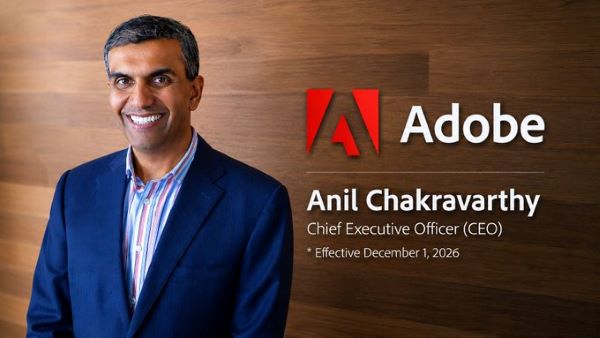
Adobe’s Board has named Chakravarthy as its next President and Chief Executive Officer, effective December 1, 2026, when he will also join the company’s Board of Directors. Long-serving CEO Shantanu Narayen will transition to Executive Chair, setting the stage for a leadership handover that preserves continuity while placing Adobe’s next phase firmly in the AI era.
- Indian-origin technology veteran to become Adobe President & CEO on December 1, succeeding Shantanu Narayen after an 18-year transformation
- The engineer-turned-enterprise strategist brings three decades of experience spanning McKinsey, cybersecurity, cloud data and AI
- Chakravarthy’s Adobe journey has already reshaped Customer Experience Orchestration, GenStudio and AI-led enterprise products
- His mandate: Turn Adobe’s AI advantage into the next engine of growth as agentic software rewrites creativity, productivity and customer experience
- Narayen moves to Executive Chair, backing Chakravarthy to lead Adobe through its next AI-driven era
- A Bengaluru-linked, IIT Varanasi-MIT technocrat now stands at the helm of one of Silicon Valley’s most influential software companies
For Adobe, this is more than a change of guard.
It is an engineer’s moment to lead a company whose future is increasingly being defined by artificial intelligence, agentic software and the convergence of creativity, productivity, data and customer experience.
And Chakravarthy arrives with a résumé unusually aligned to that mission.
The IIT-MIT technocrat who crossed technology’s fault lines
A graduate in Computer Science and Engineering from the Institute of Technology, Varanasi, Chakravarthy went on to earn a Master’s degree and Ph.D. from the Massachusetts Institute of Technology (MIT).
His three-decade career has traversed management consulting, enterprise security, cloud data management, software products and digital transformation—giving him experience across several of the technological shifts that have shaped modern enterprise computing.
He began his professional journey at McKinsey & Company, rising to become co-leader of its E-Business Practice in the Silicon Valley Business Technology Office.
He subsequently moved into technology leadership at VeriSign and Symantec, where his responsibilities spanned enterprise security, product management, engineering and operations.
At Symantec, he led major product portfolios covering information security, data loss prevention, endpoint protection, mobile security, encryption and other enterprise technologies—experience that gave him a strong grounding in the increasingly critical intersection of technology, data and trust.
The Informatica transformation
The next defining chapter came at Informatica.
Chakravarthy joined the enterprise data-management company in 2013 as Executive Vice President and Chief Product Officer and became its CEO in 2015, a position he held until 2020.
At Informatica, he led the company’s transformation towards cloud and subscription services, adding a crucial dimension to his experience: taking an established enterprise technology business through a fundamental change in its operating and commercial model.
That transformation experience now assumes fresh importance at Adobe, where generative and agentic AI are similarly challenging established assumptions about software, workflows and customer value.
Adobe: From Digital Experience to AI-powered orchestration
Chakravarthy joined Adobe in January 2020 as Executive Vice President and General Manager of its Digital Experience business.
Later that year, he assumed responsibility for Adobe’s worldwide field operations, including enterprise sales, professional services and customer success. In December 2021, he was elevated to President of Digital Experience and worldwide field operations.
Under his leadership, Adobe has expanded its Customer Experience Orchestration capabilities and developed products including Adobe CX Enterprise, GenStudio and Brand Visibility, while scaling Adobe Experience Platform and introducing newer AI-powered innovations.
He also championed the acquisitions and integration of Workfront and Semrush, adding further depth to Adobe’s enterprise ecosystem.
Adobe’s own profile describes Chakravarthy as responsible for strategy, engineering, product management and product marketing for its Customer Experience Orchestration business, alongside worldwide field operations.
Now comes the AI test
The biggest question facing Chakravarthy will not be whether Adobe can build AI into its products.
It will be whether Adobe can turn AI into a durable new growth engine without diluting the creative and enterprise franchises that made it a software powerhouse.
The challenge is arriving at speed.
AI-native tools are transforming creative workflows, while competitors are pressing Adobe across design, collaboration and digital content. Adobe therefore needs to persuade customers that its combination of creativity, productivity, data and enterprise customer experience remains uniquely powerful in an increasingly AI-first market.
Chakravarthy’s background makes his appointment particularly significant: he has operated at the intersection of enterprise software, data, cloud, security, product innovation and customer experience—precisely the areas converging in the new AI economy.
His first message: Agentic software is the next frontier
In his first statement as incoming CEO, Chakravarthy offered a clear pointer to where he believes Adobe is headed.
“I’m energized by the opportunity to fuel growth and drive Adobe’s leadership in the next era of agentic software for creativity, productivity and customer experience.”
He also emphasised that Adobe’s future would not be built solely around technology.
“Adobe has a history of building the future — not just through our technology, but through our people and our commitment to customers.”
That formulation could prove central to his leadership philosophy: AI as an enabler of people and customer outcomes rather than technology for technology’s sake.
Narayen’s powerful endorsement
For Chakravarthy, the transition comes with an unusually strong vote of confidence from the outgoing CEO.
Narayen described him as an “experienced transformational leader” with deep knowledge of Adobe and a proven record of building and delivering category-defining products.
More significantly, Narayen said:
“I could not be more confident that Anil is the right person to lead Adobe’s growth in an AI-driven era.”
Narayen, who has led Adobe for 18 years, will become Executive Chair and work with Chakravarthy during the transition.
The Board’s special selection committee, chaired by Lead Independent Director Frank Calderoni, also unanimously backed Chakravarthy, calling him the right leader for Adobe’s next chapter of growth.
A succession that carries an Indian imprint
Chakravarthy’s appointment also extends Adobe’s remarkable association with Indian-origin leadership.
He succeeds Shantanu Narayen, another Indian-origin technology leader who has spent 18 years transforming Adobe from a largely desktop-software company into a diversified cloud and digital-experience powerhouse.
Chakravarthy now inherits that transformed company at another inflection point—one in which generative AI, agentic systems and rapidly changing customer expectations could be as disruptive as the transition to cloud computing was in the previous era.
From cloud transformation to agentic transformation
There is an intriguing thread running through Chakravarthy’s career.
At Informatica, he helped drive the shift towards cloud and subscription software.
At Adobe, he has helped build AI-powered customer experience orchestration.
Now, as CEO, he is being entrusted with perhaps the most consequential transformation yet: moving Adobe deeper into an era in which software does not merely respond to instructions but increasingly acts on behalf of users and businesses.
That is why the December 1 transition is more than a succession date.
It marks the beginning of the Chakravarthy chapter at Adobe—and potentially the next defining chapter in the evolution of creative and enterprise software.