- Gujarat breaks new ground with state-of-the-art BSL-4 bio-containment lab to strengthen national bio-security
- High containment facility to dramatically cut foreign testing dependence and accelerate viral research
- Safe platform for cutting-edge study of infectious and zoonotic diseases under One Health approach
- India’s bio-economy surges with opportunities for youth, innovation and biotech startup growth: Spotlight on Antimicrobial Resistance and need for coordinated scientific action
- Heritage and innovation together: lab launch follows Somnath Swabhimaan Parv, uniting science with culture
NE SCIENCE & TECHNOLOGY BUREAU
GANDHINAGAR, JAN 13
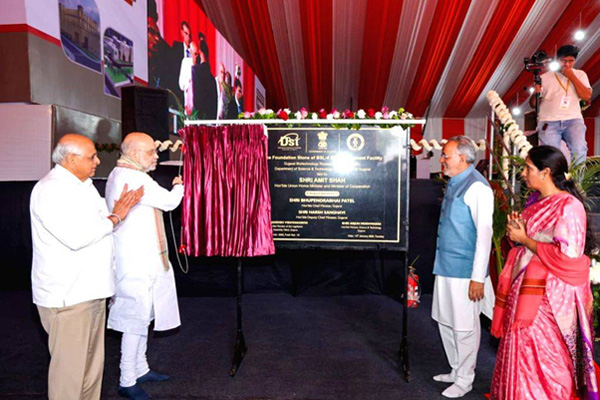
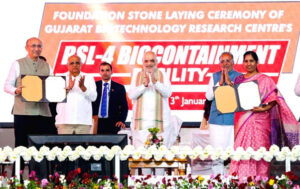
The foundation stone for the BSL-4 Bio-Containment Facility at the Gujarat Biotechnology Research Centre (GBRC) was laid in Gandhinagar, marking a significant milestone in India’s bio-safety and health security infrastructure.
Addressing the gathering, Union Home MinisterAmit Shah said that under Prime Minister Narendra Modi’s leadership, “from the soil of Gujarat today, we are beginning a new era of India’s health security, bio-safety, and development of the bio sector.” He described the facility as a strong protective shield for the nation’s health ecosystem and a testament to the vision that “science and technology should not remain limited to research and development alone, but should become a foundational pillar of the nation’s overall development.”
Shah noted this will be India’s second BSL-4 laboratory after the National Institute of Virology in Pune, and the first implemented by a state government. The ₹362 crore complex, spread over 11,000 square metres, will provide scientists a safe platform to work on highly infectious and deadly viruses and diseases transmitted from animals to humans.
Highlighting strategic gains, Shah said, “After the establishment of the BSL-4 lab, our dependence on foreign countries for testing samples of dangerous viruses will end, and testing will also become faster.” He emphasised that the lab meets global safety requirements and strengthens India’s self-reliance in health security.
Boosting Biotech, Youth & Innovation
Shah pointed to the rapid growth of India’s bio-economy, noting it expanded from USD 10 billion in 2014 to USD 166 billion by FY 2024, a “17-fold growth in just 10 years.” He highlighted the rise of biotech startups from fewer than 500 in 2014 to over 10,000 by 2025, and growth in incubation space and products launched, reinforcing that “our youth are not just job seekers, but job creators.” (dst.gujarat.gov.in)
India’s global role in vaccines was also noted: “India is, in a way, the world’s largest vaccine-producing country. Sixty percent of the world’s vaccines are manufactured in India,” including indigenous innovations like the cervical cancer vaccine Cervavac and the world’s first DNA-based COVID-19 vaccine.
Addressing Emerging Threats & Heritage
Reflecting on past health challenges, Shah said that India’s COVID-19 response was a testament to its capabilities, having vaccinated its entire population of 1.4 billion people swiftly—“a marvel of technology.” He also warned about Antimicrobial Resistance (AMR) as “a silent disaster” that requires a clear strategy, timely treatment and increased awareness.
Reinforcing the harmony between progress and culture, Shah said, “Development and science are not against heritage… both can move forward together.” Citing the recent Somnath Swabhimaan Parv, he said the temple’s resilience and the lab’s foundation stone ceremony together reflect India’s unified march of heritage and science advancing side by side.