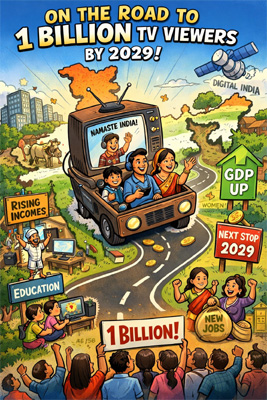
- Economic growth, rural incomes and digital reach to propel India’s TV audience to the 1-billion mark by 2029
- ‘Future of TV in India’ report finds television growing steadily at 2–3% annually, defying disruption narratives
- Rural and lower-income states emerge as the next growth engine of television consumption
- Rs 1 lakh rise in state per-capita GDP can add 25 million new TV viewers in low-income states
- Internet penetration boosts—rather than replaces—television viewership, study finds
- Literacy and demographic shifts reinforce TV’s role in social change and inclusion
NE EDUTAINMENT BUREAU
AHMEDABAD, JAN 23
India’s accelerating economic transformation is set to trigger the next major expansion of television consumption, with the country’s TV audience projected to touch nearly 1 billion viewers by 2029, according to a landmark report by the Indian Institute of Management Ahmedabad (IIMA).
Titled ‘The Future of TV in India’, the study—authored by Prof. Viswanath Pingali (Economics Area) and Prof. Ankur Sinha (Operations & Decision Sciences Area)—presents a data-driven, academic validation of television’s enduring relevance in a rapidly digitising India. The research was supported by the Brij Disa Centre for Data Science and Artificial Intelligence (CDSA) at IIMA.
Steady Growth in a “Mature” Medium
Contrary to predictions of stagnation, the report estimates that India’s television audience will continue to grow at a steady annual rate of approximately 2.37%, expanding to nearly 1.03 billion viewers by 2029. This sustained momentum is attributed to rising disposable incomes, improving literacy rates, expanding household infrastructure, and increasing internet penetration.
The report underscores that television remains deeply embedded in India’s media ecosystem, with growth now being driven less by metros and more by rural India and lower-income states.
Rural India Powers the Next Wave
One of the most significant findings of the study is the sharp rise in television viewership as rural and economically weaker states experience income growth. The analysis projects that by 2029, lower-income states—those with per capita GDP below the national average—will achieve TV penetration levels comparable to today’s higher-income states.
The economic impact is striking:
In states with per capita income below the national average, an increase of Rs 1 lakh in state GDP per capita is likely to result in an additional 25 million television viewers.
As affordability improves, television ownership and consumption are expected to rise disproportionately in these emerging markets.
Internet and TV: A Complementary Relationship
Far from cannibalising television, the report finds that internet penetration is one of the strongest drivers of TV audience growth. States with rising numbers of internet subscribers consistently show higher television viewership, reinforcing the idea that TV and digital video consumption coexist and thrive together.
As broadband and mobile internet reach deeper into rural households, audiences are increasingly consuming content across screens—strengthening, not weakening, television’s role.
Data-Led Modelling Across States
Using a robust statistical regression framework, the IIMA professors analysed variations in television audiences across states over multiple years. The model incorporated key co-variates including:
- Number of internet subscribers
- Gross State Domestic Product (GSDP) per capita
- Literacy rates
- Dependency ratio
- Income levels
- Access to micro-credit
The results reveal that urbanisation, rising literacy, and improving household infrastructure will significantly lift television penetration, especially in rural and low-income regions.
What the Authors Say
Commenting on the research, Prof. Viswanath Pingali, faculty member, Economics Area, IIMA, said: “The objective of our research was to examine and establish concrete data-led indicators around the growth trajectory of television as a mature consumption medium and its pertinent role in India’s socio-economic development. Systematic evaluation methodologies coupled with empirical analysis enabled us to map the evolving factors in television consumption and predict how television audiences within a state change in co-relation with several other demographic and economic factors. There is a clear indication of rising incomes and improving literacy rates, particularly in rural and lower-income regions, creating a multiplier effect that strengthens TV adoption and consumption.”
Prof. Ankur Sinha, faculty member, Operations & Decision Sciences Area, IIMA, added: “The report quantifies the drivers of television audience growth by using models that account for multiple variables simultaneously. The key pattern that emerged consistently was the role of internet penetration in boosting television audiences. It was interesting to note how internet access, demographic composition, and income growth interact in powerful ways, particularly in rural and low-income regions that are also traditionally considered under-penetrated television markets. The state-wise projections presented in the report underscore that the next phase of growth for television will be led by regions undergoing rapid socio-economic transition.”
Television as a Social Catalyst
Beyond numbers, the report highlights television’s broader social impact. Strong correlations were found between literacy rates, dependency ratios, and TV adoption, reinforcing television’s role in education and social development.
Features such as same-language subtitling contribute to improved literacy, particularly in rural India. Television characters often serve as cultural role models, shaping attitudes around personal autonomy, financial independence, and gender norms. Increased exposure to TV content is also linked to higher awareness and more progressive social outlooks within households.
Academic Validation of TV’s Enduring Strength
Described as a breakthrough thought paper, the report introduces a futuristic audience-estimation model that blends economic, demographic, and digital indicators to project television’s evolving footprint in India.
The findings offer more than optimism—they provide independent, academic validation of television’s resilience and relevance in India’s fast-changing media landscape.
Read the full report:
https://www.iima.ac.in/sites/default/files/2026-01/Future%20of%20TV%20in%20India%20Report%20-%20compressed_0.pdf