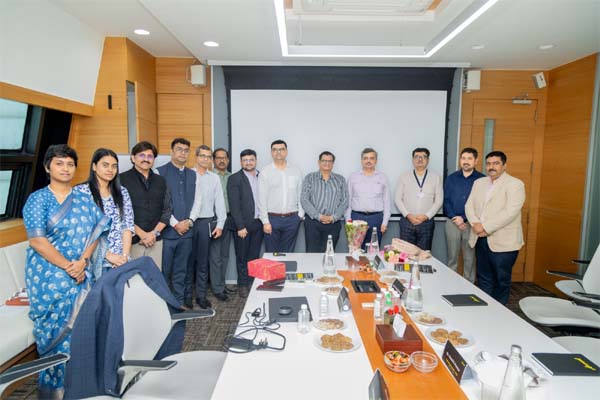
- DoP Secretary Manoj Joshi explores Amneal’s manufacturing, R&D and biosimilars capabilities during Ahmedabad visit
- Kashiv BioSciences acquisition expands Amneal’s integrated global biosimilars platform across research, development, manufacturing and commercialisation
- Industry-academia-government collaboration and an industry-ready workforce emerge as key enablers for India’s next biopharma leap
- Interaction gains significance against proposed ₹10,000-crore Biopharma SHAKTI programme to deepen R&D, infrastructure and innovation
NE PHARMA BUREAU
AHMEDABAD, SEPT 16
India’s pharmaceutical story is entering a new chapter—one in which manufacturing scale must increasingly be matched by research depth, biological innovation and a workforce equipped for tomorrow’s medicines. Against this backdrop, a visit by Department of Pharmaceuticals Secretary Manoj Joshi to Amneal Pharmaceuticals’ Ahmedabad corporate office has put the spotlight on how industry, government and academia can jointly accelerate India’s transition from a global medicines manufacturing hub to a deeper biopharmaceutical innovation ecosystem.
Manoj Joshi, Secretary, Department of Pharmaceuticals, Government of India, visited Amneal Pharmaceuticals’ corporate office in Ahmedabad on Tuesday, where he met company leaders to discuss the organisation’s growth, investments, product pipeline and expanding capabilities.
The discussions covered Amneal’s contribution to pharmaceutical manufacturing and innovation in India, including its capabilities in R&D, complex medicines and biosimilars, with particular focus on the company’s expanded biosimilars portfolio following its acquisition of Kashiv BioSciences.
Biosimilars acquisition adds a new dimension
The Kashiv BioSciences acquisition has strengthened Amneal’s capabilities by bringing together biologics research and development with commercial and manufacturing scale.
The combined platform spans research, development, manufacturing and commercialisation, strengthening Amneal’s biosimilars pipeline and creating an integrated global platform for long-term growth.
Amneal also presented its broader capabilities across advanced manufacturing, complex generics, injectables, peptides and APIs, along with its global manufacturing expertise, innovation capabilities and partnerships supporting pharmaceutical supply chains.
The interaction therefore went beyond the company’s current operations, touching upon the larger opportunity for India to leverage its established pharmaceutical manufacturing base to build greater capabilities in biopharmaceutical innovation.
R&D depth and skilled talent become the next growth drivers
The discussions examined several factors that could determine the pace of India’s biopharma evolution, including R&D investment, innovation capital, advanced research infrastructure, industry-academia collaboration and regulatory science.
The focus on talent assumes particular significance as pharmaceutical companies expand into increasingly complex technologies and products.
Dr. Parva Purohit, Senior Vice President and Head R&D, Amneal Pharmaceuticals, said: “India has a strong foundation in pharmaceutical manufacturing and now has an opportunity to add greater depth in biopharmaceutical innovation. At Amneal, we remain committed to building capabilities across manufacturing, R&D, biosimilars and complex medicines.”
The visit also provided an opportunity to discuss workforce development and ways in which existing government schemes could support the creation of a trained and industry-ready talent pool.
Industry-academia-government triangle takes centre stage
Rahul Maitra, Senior VP, Human Resources, Amneal, said: “We are encouraged by Mr Manoj Joshi’s visit and the productive discussion towards skill development efforts that are underway within the existing government schemes.”
“Pharmaceuticals industry in India is growing rapidly, both in terms of R&D as well as manufacturing. Hence it is important that equal emphasis is laid on industry-academia-government collaborations to attain trained and industry-ready workforce,” Maitra added.
The discussion assumes significance as India’s pharmaceutical sector seeks to move further up the value chain, with advanced research, biological medicines and specialised manufacturing requiring deeper collaboration between laboratories, universities, industry and policymakers.
Biopharma SHAKTI: a ₹10,000-crore opportunity
The interaction comes against the backdrop of the Government’s proposed Biopharma SHAKTI programme, which envisages an outlay of ₹10,000 crore over five years to strengthen India’s biopharmaceutical ecosystem.
The programme’s stated areas of relevance include building research and innovation capabilities, strengthening infrastructure and supporting the development of an ecosystem capable of advancing biopharmaceutical products.
During the Ahmedabad visit, Amneal leaders and Secretary Joshi discussed the company’s investments and capabilities across manufacturing, R&D, biosimilars and complex medicines, as well as challenges and enablers for the next phase of biopharmaceutical growth.
The interaction ultimately underscored a larger strategic question for India’s pharma sector: Can the country’s formidable manufacturing base be converted into an equally formidable engine of biopharmaceutical discovery and innovation?
For companies such as Amneal, the answer increasingly lies at the intersection of technology, capital, talent, research infrastructure and collaboration—with Ahmedabad emerging as an important node in that expanding pharmaceutical ecosystem.