- Once the voice of loved ones, the postcard became a silent chronicler of changing times
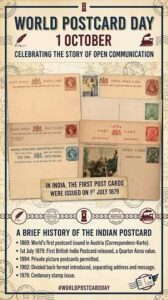
- World’s first postcard issued in Austria on October 1, 1869
- India joined the postcard revolution in 1879 with a 3-paise card
- From weddings and greetings to public movements, postcards have carried history
- Gujarat’s 1.11-crore-postcard campaign rewrote the global record in 2025
NE EDUTAINMENT BUREAU
AHMEDABAD, OCT 4
Before the instant ping of a smartphone, there was the knock of the postman—and the arrival of a postcard could transform the mood of an entire household. A few handwritten lines on a small piece of card once carried the voice of a loved one living miles away. Now, as the postcard completes 157 years of its global journey, its story has become much more than that of an old-fashioned communication medium: it is a story of human emotions, social change and history itself.
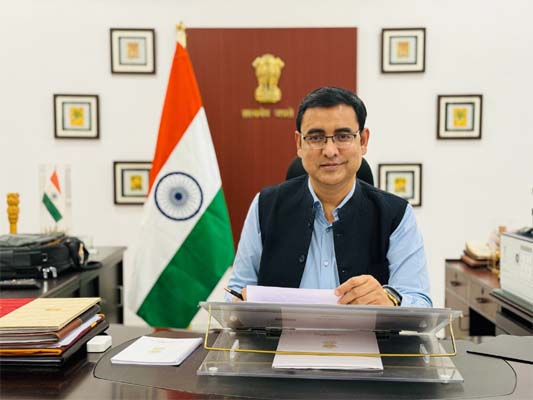
“The postcard has witnessed the changing face of communication—from the postman’s knock to digital messages,” said Postmaster General of North Gujarat Region Krishna Kumar Yadav, noting that the world’s first postcard was issued in Austria on October 1, 1869.
Yadav said postcards have also served as witnesses to important moments in people’s lives and society. “From weddings and greetings to various movements, the postcard has been a witness to history,” he said.
How the postcard was born
The idea of the postcard is traced to Austrian representative Kolbensteiner, who shared the concept with Dr Emanuel Herrmann, a professor of economics at the Military Academy in Wiener Neustadt.
Herrmann found the idea compelling enough to write an article about it in a newspaper on January 26, 1869. The Austrian Postal Authority acted swiftly, and the world’s first postcard was issued just months later, on October 1.
The pioneering postcard was yellow, measured 122 mm by 85 mm, and was deliberately simple in design. One side carried the recipient’s address, while the other was left blank for the message.
Thus began a communication revolution that would eventually spread across the globe.
India gets its own postcard
India entered the postcard era in 1879. According to Yadav’s book India Post: 150 Glorious Years, the first Indian postcard was printed in light brown and priced at just 3 paise.
It carried the inscription “East India Postcard”. The Royal Coat of Arms of Great Britain appeared at the centre, while the upper-right corner featured a red-brown portrait of Queen Victoria wearing a crown.
The humble card quickly caught the imagination of the public. During the first three quarters of the year alone, postcards worth approximately ₹7.5 lakh were sold, demonstrating how rapidly this inexpensive medium became part of everyday communication.
From ordinary messages to collective expression
The postcard subsequently acquired several forms. Until recently, post offices offered Meghdoot postcards, ordinary postcards, printed postcards and competition postcards, priced at 25 paise, 50 paise, ₹6 and ₹10 respectively.
From December 20, 2024, these categories were merged into a single “Postcard” category.
Yet the postcard’s relevance has never been confined to personal correspondence. Politicians, writers, social reformers and public movements have repeatedly used it to reach people and communicate ideas.
In an age dominated by smartphones and social media, the postcard has even demonstrated its capacity to become a tool of mass public expression.
Gujarat writes a new chapter
Gujarat provided a striking modern example of this enduring power when more than 1.11 crore postcards were written by people associated with the cooperative sector to express gratitude to Prime Minister Narendra Modi for GST reforms and other measures.
A total of 1,11,75,000 postcards were written as part of the initiative, earning a Guinness World Records recognition.
The campaign was organised under the aegis of the Department of Agriculture, Farmers Welfare and Cooperation in collaboration with the Department of Posts, Gujarat.
Guinness World Records officials presented the certificate on October 14, 2025, following the counting process at the Sabarmati Riverfront.
Yadav described the initiative as a remarkable demonstration of the postcard’s continuing potential as a medium of collective expression and public participation.
The scale was unprecedented. According to Guinness World Records, the previous record had stood at 6,666 postcards, achieved by the Swiss Agency for Development and Cooperation (SDC), Section Water, Basel, Switzerland.
A small card that refuses to disappear
The postcard may have lost its monopoly over communication, but it has not lost its emotional or historical value.
The telephone made communication faster. Mobile phones made it immediate. The internet made it global. Social media made it instantaneous. Yet none has quite replicated the experience of holding a handwritten message that has travelled physically from one person to another.
That is perhaps why the postcard’s 157-year journey is not simply a story of technological evolution. It is the story of how communication changed—while the human need to connect remained remarkably constant.