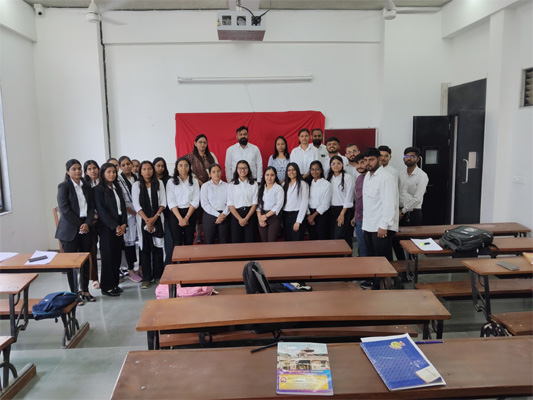
From statute books to simulated benches — young advocates test their courtroom mettle in Ahmedabad. – NE photo
- Students debate maintenance rights under live-in relationships amid evolving statutory framework
- Fictional case challenges understanding of PWDVA and Bharatiya Nagarik Suraksha Sanhita, 2023
- Principal says courtroom simulations build “core competencies” for future legal practitioners
- Young advocates sharpen research, reasoning and real-time litigation skills
NE EDUCATION BUREAU
AHMEDABAD, MAR 3
In a bold academic move to bridge theory with courtroom realities, Daulatbhai Trivedi Law College (DT Law College), part of the Navgujarat Group of Colleges, organised a high-intensity Moot Court competition that placed students at the intersection of live-in relationships, women’s maintenance rights and the newly introduced criminal procedure framework.
The competition centred on a fictional yet legally nuanced case designed to test students’ understanding of Family Law, the Protection of Women from Domestic Violence Act (PWDVA), and the procedural contours of the Bharatiya Nagarik Suraksha Sanhita (BNSS), 2023.
Aim: Translating Classroom Learning into Courtroom Competence
The primary objective of the moot was to prepare students for real-world litigation by exposing them to complex statutory interpretation and evidentiary challenges. Participants were required to argue both for and against claims of maintenance in a live-in relationship, navigating legal recognition, proof standards and procedural nuances under the new criminal code.
Dr Ankitkumar Rami, Principal, DT Law College, underscored the broader academic vision behind the initiative.
“Sustained exposure to moot court competitions that present them with real-world scenarios from courtrooms requiring them to undertake rigorous research and present compelling arguments, enhances advocacy skills, statutory interpretation and confidence. These are core competencies for aspiring legal practitioners in a rapidly evolving legal landscape,” he said.
Simulating Real Litigation Pressure
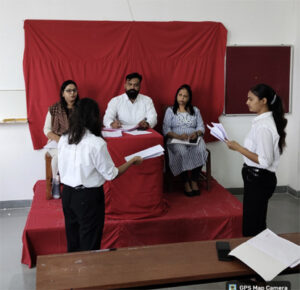
The format replicated authentic courtroom conditions. Students filed written submissions, presented oral arguments before a simulated bench and responded to sharp judicial interventions — a process designed to instil discipline, clarity and professional courtroom conduct.
Dr Lataben Menat, Assistant Professor and coordinator of the event, explained the experiential focus of the competition.
“Our aim was to create an environment where students feel the pressure and responsibility of real litigation. The new criminal laws demand sharper procedural awareness, and this moot ensured that students engaged deeply with statutory changes rather than studying them in abstraction,” she said.
Student Voices: Learning Beyond the Syllabus
Sanjana Nanecha, a first-year student who secured first place, described the experience as transformative.
“Arguing both sides of the case pushed me to think critically about women’s rights and evidentiary standards in live-in relationships. It made me realise how important precise statutory interpretation is under the new criminal code,” she said.
Jaimin Thakar, also a first-year student who finished second, added, “The moot court helped us understand how procedural law under BNSS works in practice. Responding to judicial questions strengthened our confidence and clarity.”
Preeti Kumawat, a third-year student who secured third position, noted, “This competition was not just about winning — it was about understanding the evolving legal framework governing maintenance and domestic relationships. It sharpened our research and advocacy skills.”
Grooming Future Legal Professionals
By focusing on contemporary legal debates such as maintenance rights in live-in relationships and integrating the procedural shifts introduced by the BNSS, 2023, DT Law College has reinforced its commitment to experiential legal education.
The initiative reflects a growing recognition within legal academia that future lawyers must not only understand statutes but also master courtroom strategy, research rigour and persuasive advocacy.