NE RAILWAY BUREAU
CHENNAI, JULY 24
The next big railway technology breakthrough may not always come from outside the system. Sometimes, it begins with a Station Master struggling with paper registers, an engineer coordinating a time-critical track block or a track worker needing a warning seconds before a train approaches.
- e-TSR, RBMS and DOST mark a new phase in Southern Railway’s home-grown innovation journey
- Three in-house applications digitise train signal records, railway blocks and protection of staff working near running lines
- From Station Masters to trackmen, technology is being designed around the people who keep the railway moving
- Real-time alerts, automated records, geo-fencing and live workflows replace paper-heavy, error-prone routines
- Southern Railway’s innovation model shows how field experience can become scalable technology from within the system
Turning precisely such operational challenges into home-grown digital solutions, Southern Railway has launched three in-house applications—e-TSR, RBMS and DOST—designed, developed and deployed to make critical railway operations safer, smarter and increasingly paperless.
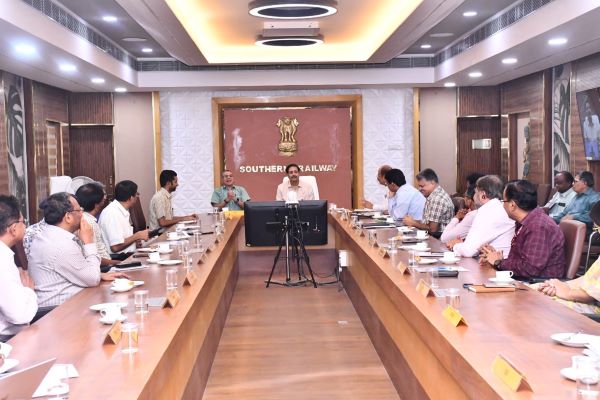
The three applications were launched by R.N. Singh, General Manager, Southern Railway, at a function held at the Southern Railway Headquarters on Friday.
Together, they digitise three safety-sensitive areas of railway working: recording train movements, managing engineering and other operational blocks, and protecting staff working on or near running lines.
The launch represents more than a technology upgrade. It underlines the growing importance of in-house research, field-driven innovation and the ability of railway personnel to convert everyday operational challenges into practical digital solutions.
Speaking on the occasion, Singh emphasised that technology in the railways must ultimately serve the people who operate and maintain the system. The applications, he said, have been designed around the needs of Station Masters, Controllers, Section Engineers and trackmen to reduce drudgery, minimise avoidable errors and, above all, protect lives.
e-TSR: When the paper register gives way to live digital intelligence
The Electronic Train Signal Register (e-TSR) replaces the conventional paper-based Train Signal Register maintained at stations with a secure electronic system.
Train movement events are generated directly from data logger inputs, while timestamps are captured automatically. This substantially reduces manual intervention and the possibility of recording errors, while saving time and paper.
The system is compatible with Absolute, Automatic and Slot working systems and allows red-ink entries with corresponding remarks. It also provides for manual entries during fallback conditions.
A key feature is its integration with RBMS, enabling automatic generation of Line, Power and S&T block entries.
For Station Masters, the shift could mean less time spent maintaining repetitive paper records and more time devoted to efficient train handling and passenger service.
RBMS: Making every railway block visible, traceable and accountable
The Railway Block Management System (RBMS) brings the complete lifecycle of a railway block onto a single digital platform.
From the initial request to sanctioning, availing, extension and final closure, the process is managed through a real-time workflow covering Line, Power and S&T blocks.
The platform uses algorithm-based optimisation for block planning and provides role-specific dashboards with role-based access and OTP authentication.
Its features include:
- Real-time digital workflow for end-to-end block management
- Role-specific dashboards and secure access
- MIS reports with multiple performance indicators
- Location-based features and geo-fencing
- Prevention of multiple Station Master log-ins
- Flexibility to modify block timings
- Archiving of completed blocks
- Seamless integration with e-TSR
By replacing fragmented paperwork with a connected workflow, RBMS is expected to improve visibility, coordination and decision-making across departments involved in railway maintenance and operations.
DOST: A digital safety net for those working beside the tracks
The most direct life-saving potential of the three applications lies in DOST—Delivering Occupational Safety on Track.
In its first phase, DOST addresses one of the most serious challenges faced by railway personnel: the safety of staff working on or near running lines.
The system correlates live train movement information from the signalling network with the GPS location of field staff. When an approaching train presents a potential danger, the system generates advance, location-aware alerts.
The warning system includes:
- Graded Yellow and Red alerts
- Audio, visual, flasher and vibration warnings
- Multilingual voice alerts
- Incident reporting
- Emergency SOS facility
- Train feedback
- Continuous connectivity monitoring
The multiple alert modes are particularly significant in noisy trackside environments, where a conventional audible warning may not always be noticed.
When railway workers become railway innovators
The three applications together point to a larger transformation underway within the railway system: the move from technology being merely procured for the field to technology being created by understanding the field.
A Station Master’s paper register, an engineering block request and a track worker’s safety challenge may appear to be separate operational issues. But e-TSR, RBMS and DOST connect them through a common digital architecture based on real-time data, automation, location intelligence and human safety.
The initiatives are expected to deliver:
- Greater safety for railway staff and train operations
- Reduced manual intervention and paperwork
- Real-time operational awareness
- Faster and better-informed decision-making
- More efficient block management
- Reduced scope for avoidable human error
- Stronger digital connectivity between field operations and railway systems
The applications will directly benefit Railway Supervisors, Controllers, Station Masters and personnel involved in Engineering, Signal & Telecommunication and track maintenance across Southern Railway.
The launch also reinforces Southern Railway’s reputation as a zone that has consistently encouraged innovation within the Indian Railways.
The larger message is clear: the future of railway modernisation will not be built only by adopting emerging technologies; it will also depend on empowering railway employees to identify problems, conduct in-house research and build solutions that work in the real world.