R ARIVANANTHAM
CHENNAI, SEPT 2
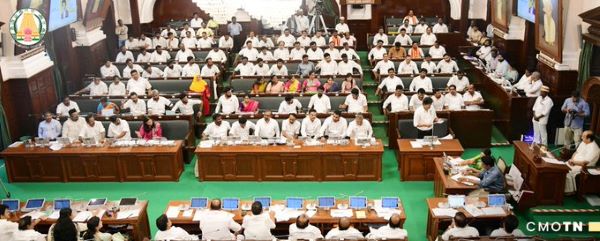
For a city resident, urban development begins long before a flyover or a skyline—it begins when the tap runs, the drain works, the road is walkable and a child can reach school safely. In what could prove to be one of the most comprehensive civic-infrastructure pushes of the new administration, Tamil Nadu Chief Minister C Joseph Vijay on Wednesday unveiled a wide-ranging package of measures covering water, sewage, roads, mobility, waste management, greenery, schools, tourism and basic amenities across the State.
The announcements, made under Rule 110 in the Legislative Assembly, represent a significant attempt to address the infrastructure deficit created by rapid urbanisation and population growth, with the overall urban infrastructure push estimated at more than ₹11,000 crore.
At the centre of the package is a ₹4,800-crore, 400-million-litres-a-day (MLD) desalination plant at Minjur, designed to strengthen drinking-water security for North Chennai, Avadi, Ponneri and Minjur. Alongside it comes a ₹500-crore project to provide 24/7 drinking-water supply to every household in Avadi Municipal Corporation.
The message behind the package is unmistakable: Tamil Nadu’s next phase of urban growth cannot be built on ageing civic infrastructure.
Water security moves to centre stage
The Minjur desalination project is the headline intervention in the water sector. The proposed facility will convert 400 MLD of seawater into potable water, creating an additional source for some of the fastest-growing urban pockets around Chennai.
The State will also invest ₹1,000 crore to improve drinking-water facilities in the Madurai and Cuddalore municipal corporations, nine municipalities and 20 town panchayats. Another ₹300 crore has been earmarked as the first phase for renovating 33 old combined drinking-water schemes, while ₹410 crore will be spent on augmenting the capacity of the Kilpauk Water Treatment Plant in Chennai.
The water strategy comes at a particularly significant moment for Tamil Nadu, where urban expansion is steadily increasing pressure on conventional water sources.
The Government’s approach, therefore, appears to be moving beyond merely adding supply to building a more diversified and resilient urban water system—combining conventional sources, treatment capacity and desalination.
Ageing sewage networks get a second life
If water is one side of the urban equation, sewage is the other—and the Government has placed ageing underground networks squarely on the agenda.
The first phase of renovation of Madurai’s 40-year-old underground sewerage system will involve an estimated ₹2,400 crore. New underground sewerage schemes costing ₹960 crore will cover uncovered and newly added areas of Nagercoil Municipal Corporation as well as Kundrathur and Nandhivaram-Guduvanchery municipalities.
Another ₹236 crore will go towards improving drinking-water and sewerage systems in parts of Chennai, including Perambur, Kolathur, Villivakkam and Egmore.
The significance goes beyond pipes and pumping stations: the administration is effectively acknowledging that urban infrastructure has a shelf life—and that postponing renewal can ultimately cost cities far more.
From potholes to people-friendly streets
Roads, too, figure prominently in the package, with ₹1,850 crore earmarked for road restoration and new construction across urban local bodies, including Chennai. A major component will address roads damaged during drinking-water and underground sewerage works.
Under the Vettri Thamizhagam Vision Plan, the Greater Chennai Corporation will undertake an estimated ₹110-crore programme covering 35 km of people-friendly modern streets across 45 sq km, 15 km of safe access to schools and improvements to 105 traffic islands. Similar works in other municipal corporations will take the combined Integrated Urban Development Project to an estimated ₹275 crore.
The terminology itself signals a change in emphasis—from roads designed primarily to move vehicles to streets designed around people, pedestrians and safer access.
A city that produces power from its waste
Tamil Nadu’s urban reset also seeks to address the growing waste burden.
Waste-to-energy projects will be implemented in Tirunelveli and Salem, with power-generation capacities of 9 MW and 10 MW, respectively. The Tirunelveli project will cost ₹256 crore, while the Salem project will require ₹291 crore, taking the combined investment to ₹547 crore.
It marks a potentially important shift in the urban waste equation: waste is being positioned not merely as something to be collected and disposed of, but also as a potential resource for energy generation.
One crore saplings, 250 parks and better schools
The package moves beyond hard infrastructure.
The Government plans to plant and maintain one crore saplings as a people’s movement, while major parks will be developed in Tiruchirappalli, Tiruppur and Pudukkottai at a cost of ₹130 crore. Another 250 parks will be established across the State at ₹175 crore, taking the park-related investment to ₹305 crore.
Urban local-body schools will receive ₹335 crore for infrastructure improvement, including new classrooms and modern facilities aimed at creating a safer and better learning environment.
This gives the announcement an important environmental and social dimension: the urban model being proposed is not only about more concrete, but also about more trees, parks, safer streets and better public institutions.
Heritage meets urban renewal
The blueprint also reaches into Tamil Nadu’s cultural and tourism economy.
In Chidambaram, Rs 36 crore will be spent on modernising the four car streets around the Thillai Nataraja Temple, including taking drinking-water, underground sewerage, electricity and telecommunications cables underground. A Heritage Walk from Fort St David to Silver Beach in Cuddalore is planned, while ₹50 crore will be spent on beautifying the Kanyakumari coastal area and improving tourist facilities.
Within the Greater Chennai Corporation, ₹100 crore will target areas where basic facilities remain inadequate, covering roads, storm-water drains, street lighting, footpaths, solid-waste facilities, playgrounds and community halls.
The bigger question: can infrastructure keep pace with the city?
The scale and spread of the announcements point to a larger policy challenge facing Tamil Nadu: how to make urbanisation liveable.
The State is already planning for round-the-clock drinking water across Chennai through its broader water infrastructure strategy, while the 2026 Budget had also outlined people-friendly streets, pedestrian pathways, cycling infrastructure, safer school access and junction improvements.
The latest package builds another layer onto that vision.
From desalinating seawater at Minjur to generating electricity from municipal waste in Tirunelveli and Salem; from rebuilding Madurai’s four-decade-old sewer network to creating safer school approaches; and from planting one crore saplings to reviving heritage streets, the Government is attempting to connect the everyday necessities of urban life with long-term city planning.
The real test, however, will not be the size of the announcements but the speed, quality and sustainability of execution. For millions living in Tamil Nadu’s expanding urban centres, the success of the programme will ultimately be measured in something much simpler than budgetary numbers: water in the tap, sewage flowing where it should, roads that survive the monsoon, children walking safely to school and neighbourhoods that remain liveable as cities grow.