- Landmark Initiative to Digitise, Preserve and Globalise India’s Civilisational Knowledge in the Age of AI
- Three-Day Global Indology Conclave Hosted with Ministry of Education’s IKS to Revive India’s Knowledge Traditions
- Shankaracharya Hails Adani’s Effort as a Major Step Toward India Becoming ‘Vishwaguru’
- Programme to Support 14 PhD Scholars, Integrate Classical Wisdom With Modern Research Tools
NE EDUCATION BUREAU
AHMEDABAD, NOV 21

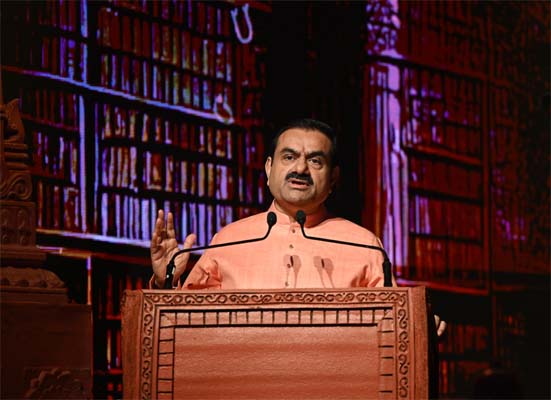
In a landmark announcement that places the Adani Group at the centre of India’s civilisational revival efforts, Chairman Gautam Adani on Thursday committed ₹100 crore to build the Bharat Knowledge Graph — a pioneering digital platform designed to preserve, structure and elevate India’s vast knowledge systems for the Artificial Intelligence era.
The announcement was made at the inaugural Adani Global Indology Conclave, jointly hosted with the Ministry of Education’s Indian Knowledge Systems (IKS) division. The three-day conclave aims to reenergise Indology — the global academic study of India’s languages, philosophies, sciences and civilisational heritage.
‘Repayment of a Civilizational Debt’: Gautam Adani
Unveiling the Adani Group’s long-term mission, Mr Adani said: “As a beginning, I am humbled to announce a founding contribution of ₹100 crore towards building the Bharat Knowledge Graph and supporting the scholars and technologists who will contribute to this Indology mission. This is the repayment of a civilizational debt.”
He warned that failing to actively preserve civilisational frameworks could leave human choices vulnerable to machine-driven logic:
“If a civilization does not actively defend its cultural and emotional frameworks, human behaviour will bend, not towards culture or tradition, but towards the cold logic of the machine’s algorithms.”
‘Major support to my dream of India as Vishwaguru’: Shankaracharya
The guest of honour, Jagadguru Shankaracharya Swami Avimukteshwaranand Saraswati Ji, praised the initiative, saying: “When I assumed the position of Shankaracharya, I had said that my role would become meaningful only when India becomes the Vishwaguru (global teacher). And today, Gautam Adani ji’s initiative is a major support to that very dream of mine.”
The conclave is being held at the Adani Corporate House (ACH) in Ahmedabad from November 20 to 22. It comes at a time when Indology departments worldwide are shrinking, diminishing India’s voice in global civilisational scholarship.
A National Mission for Indology’s Revival
The initiative merges the Adani Group’s nation-building focus with IKS’ mandate under the National Education Policy (NEP) 2020 to embed ancient knowledge systems into contemporary pedagogy and research.
Indology has historically shaped global understanding of India across fields such as mathematics, astronomy, linguistics, political thought, medicine and governance. But decades of declining institutional support have eroded academic depth.
To bridge this gap, the Adani Group and IKS have launched a five-year fellowship programme supporting 14 PhD scholars across premier institutions. Their work will span:
- Paninian grammar & computational linguistics
- Ancient astronomical systems
- Indigenous healthcare traditions
- Traditional engineering & sustainability principles
- Political philosophy
- Heritage studies
- Classical literature
The scholars were chosen through a national consultation involving IITs, IIMs, IKS universities and eminent domain experts.
By merging classical civilisational knowledge with tools such as data science, systems thinking, multimodal archiving and AI, the initiative aims to reposition Indology at the forefront of global academic discourse.
A Civilisational Vision for the Future
Rooted in the ethos of Vasudhaiva Kutumbakam — the world as one family — the mission reflects the Adani Group’s expanding role in strengthening India’s soft power and civilisational leadership.
The Bharat Knowledge Graph is expected to emerge as a global reference architecture for mapping India’s intellectual heritage — from ancient sciences and philosophies to cultural practices and linguistic traditions — making them future-ready and universally accessible.