
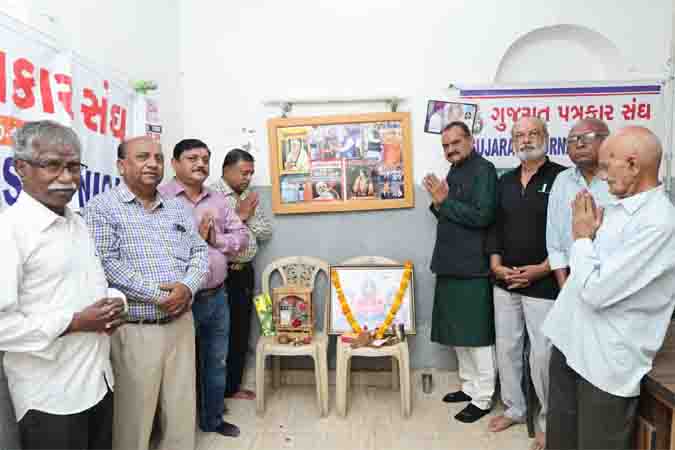
- New Year Puja at union office turns into a renewed resolve to strengthen the fourth estate
- 10-point memorandum seeks pension fund named after Sardar Vallabhbhai Patel
- GJU proposes ₹100-crore initial corpus and 5% share of state media-advertising expenditure
- 2% contribution each from journalists and employers to create a three-way social security model
- Family pension, healthcare, education aid and age-linked pension enhancements on the agenda
- Union also seeks veteran and freelance journalist accreditation reforms and support for independent media
NE NEWS SERVICE
AHMEDABAD, NOV 23
Can a journalist who spends a lifetime questioning those in power look forward to financial security after retirement? And should the people who help sustain democracy through their reporting, investigation and public service have to depend on uncertain post-retirement support?
The Gujarat Journalists Union (GJU) is seeking to turn these questions into a concrete policy commitment, proposing a ₹30,000 monthly pension, a ₹100-crore initial corpus and a comprehensive welfare framework for journalists across the State. Its proposed Gujarat Journalists’ Pension & Welfare Fund would be named after Sardar Vallabhbhai Patel, the Iron Man of India and architect of national integration, as a tribute marking his 151st birth anniversary.
The renewed push comes as the union begins the Gujarati New Year with a ceremonial opening and puja at its office, accompanied by a collective resolve to take the organisation to greater heights.
New Year, renewed resolve
The GJU office’s New Year muhurat ceremony was held on November 16 at 10 am, with president B.R. Prajapati inaugurating the occasion.
The rituals included puja and aarti to Lord Ganesha, Goddess Lakshmi and Goddess Saraswati, with incense, lamps and prasad offered. Union joint secretary Vinay Pandya conducted the worship.
Office secretary Jagdish Meva, joint secretary R. Manickavasagam, treasurer Nilesh Vora and executive committee members Anil Verma, Himanshu Parmar and Naresh Shah participated in the ceremony.
All those present resolved to work collectively to strengthen the Gujarat Journalists Union and take it to greater heights.
Joint secretary Parmanandbhai Soni, who travelled from Halol in Panchmahal district with fellow journalists, was a special invitee. Discussions were also held on the union’s forthcoming programmes and activities.
From ceremony to a policy campaign
The union’s wider agenda centres on a 10-point memorandum to Chief Minister Bhupendrabhai Patel, urging the State Government to move beyond assurances and establish a sustainable social-security system for journalists.
The proposed pension of ₹30,000 a month would cover eligible journalists with at least 20 years of journalistic service or experience, including mofussil and district-level professionals. GJU wants the scheme to cover eligible print, electronic and digital-media journalists irrespective of whether they hold government accreditation, subject to transparent eligibility and service criteria.
The union argues that journalism is a public-service profession and that retirement should not mean the end of dignity or financial security for those who have spent decades informing citizens, scrutinising institutions and raising public grievances.
₹100-crore corpus and three-way funding
At the heart of the proposal is an initial Government contribution of ₹100 crore, supported by a continuing funding mechanism involving the State, journalists and media employers.
GJU has proposed earmarking 5% of eligible State Government media-advertising expenditure for the Fund. It has also suggested a contribution of 2% of Basic Pay from eligible journalists, matched by a 2% contribution from participating media employers.
The union says this three-way arrangement would reduce dependence on annual budgetary allocations and create a continuing social-security partnership.
It has called for the corpus to be protected as far as practicable, with investment income and continuing contributions supporting pension and welfare obligations. An independent, professionally managed board, with representation from the Government, journalists’ organisations and media employers, would oversee the Fund. Annual audits and publicly accessible financial statements are also proposed.
Family security and a wider welfare net
The proposed scheme goes beyond monthly pension payments. GJU has sought family pension for the surviving spouse, subject to prescribed rules, along with age-linked enhancements: an additional 25% at 70 years, 50% at 80, 75% at 85 and 100% at 90.
The union has also called for appropriate inflation or dearness relief to protect the purchasing power of pensioners.
The proposed welfare framework would progressively include health insurance and cashless treatment wherever feasible, critical-illness assistance, accident and disability support, death assistance, emergency financial aid, scholarships for eligible children of journalists, professional training and assistance for essential equipment. Housing-related support could also be considered under applicable Government policies.
A national comparison — and Gujarat’s choice
GJU’s comparative study records monthly journalist pension provisions ranging from ₹10,000 to ₹25,000 in several States and Union Territories. The figures cited in its memorandum include ₹25,000 in Arunachal Pradesh; ₹20,000 in Madhya Pradesh, Chhattisgarh and Maharashtra; ₹18,000 in Rajasthan; ₹15,000 in Bihar, Goa, Haryana, Puducherry and Tamil Nadu; ₹12,000 in Punjab; ₹11,000 in Keralam (budgetary announcement ₹12,500); and ₹10,000 in Assam, Karnataka, Jharkhand, Manipur, Sikkim and Tripura.
The union maintains that several States have also extended welfare support to families through death assistance, disability benefits, healthcare, education, housing and professional assistance.
Against this backdrop, GJU wants Gujarat to set a higher benchmark through an inflation-linked ₹30,000 monthly pension and a comprehensive welfare system.
A long-pending demand
The memorandum points out that the pension demand has been placed before successive State Governments over several years.
It recalls that former Chief Minister Vijaybhai Rupani assured GJU that the demand would be examined during the union’s 60th-anniversary celebrations and the Indian Journalists Union national summit at Vadtal, Anand, on June 1, 2019.
Earlier, Nitinbhai Patel, during his tenure as Deputy Chief Minister, had written to the Information Department on November 29 and December 27, 2018, directing it to examine the proposal and submit a report.
A GJU delegation led by president B.R. Prajapati submitted another memorandum on September 23, 2021, while an IJU-GJU delegation met the Chief Minister’s Office on December 5, 2021.
The union now wants the Government to move from repeated examination to a time-bound implementation decision.
Veteran journalists and the changing media landscape
The memorandum also seeks amendments to the Gujarat State Press Accreditation Rules, 2000, and the 2005 Amendment Rules, particularly Rule 21.
GJU wants a separate accreditation category for experienced independent and freelance journalists, with eligibility based on verifiable professional experience and evidence of continuing journalistic activity. It has proposed that a minimum of 15 years of professional experience may be considered, supported by employment records, service certificates, editorial contributions and current independent work.
The union argues that long professional service should not be judged solely by the number of years a journalist has held a Government accreditation card or by a fixed count of published bylines. The work of senior editors, newsroom leaders, researchers and editorial supervisors, whose contributions may not always carry individual bylines, should also receive due recognition.
It has further sought a stronger recognition framework for veteran journalists with 30 or more years of experience and those aged 65 and above, while also seeking suitable accreditation provisions for eligible digital journalists.
Another key demand concerns experienced journalists who have lost regular employment amid automation and restructuring in the newspaper industry, as well as disputes over implementation of Majithia Wage Board recommendations. Those who have launched genuine digital news platforms or small newspapers to continue their journalistic work should receive fair and equitable opportunities for Government advertisements, subject to transparent and uniform eligibility criteria, GJU has urged.
2027-28 Budget: An opportunity to act
GJU has suggested that the Information Department prepare a detailed scheme within a defined time frame, in consultation with recognised journalists’ organisations and media representatives. It wants the proposal announced in the forthcoming 2027-28 State Budget, with implementation from April 2027.
The union’s appeal is framed around a simple principle: a journalist may retire from active reporting, but the contribution to democracy does not retire.
Its proposed fund, named after Sardar Vallabhbhai Patel, is intended to provide dignity after retirement, security in old age, protection for families, healthcare in times of need and recognition for veterans.
The question GJU places before the State Government is as much about public policy as it is about the value society attaches to journalism: “Who will stand with the journalist when the journalist grows old?”
For the union, the answer must now come through a decision, a funding framework and a time-bound commitment.