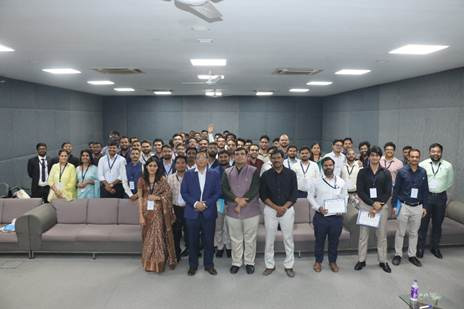
- Sixth Batch of EPFO Enforcement & Accounts Officers Completes Four-Week Intensive Training
- 81 Academic Sessions, 121.5 Training Hours Sharpen Legal & Administrative Expertise
- Motivation, Goal-Setting & Professional Ethics Take Centre Stage
- Top Officials Urge Officers to Deliver Decisive, Service-Oriented Social Security Administration
NE BUSINESS BUREAU
GANDHINAGAR, DEC 28

Reinforcing India’s commitment to law-based, citizen-centric social security governance, Gujarat National Law University (GNLU), Gandhinagar, in collaboration with the Pandit Deen Dayal Upadhyaya National Academy of Social Security (PDUNASS), successfully hosted the valedictory session of a four-week Induction Training Programme for the sixth batch of Enforcement Officers/Accounts Officers (EO/AO) of the Employees’ Provident Fund Organisation (EPFO) under the Ministry of Labour and Employment, Government of India.
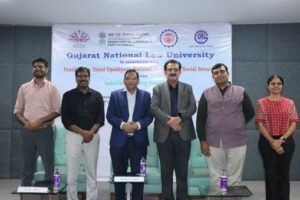
The programme formally concluded on December 26, 2025, in the presence of Mr. Rizwan Uddin, Regional Provident Fund Commissioner-I (RPFC-I) and Chief Learning Officer, PDUNASS, and Dr. Nitin Malik, Registrar, GNLU.
Rigorous Training Framework with Strong Legal Orientation
The induction programme commenced on December 1, 2025, with the participation of 62 newly appointed Enforcement/Accounts Officers. Over 26 days, the officers underwent an intensive learning schedule comprising 81 structured sessions, amounting to 121.5 hours of academic and practical training, delivered by 26 eminent resource persons, including experienced EPFO officers and subject experts.
The curriculum covered a comprehensive spectrum of core legal and administrative domains, including:
- Criminal and Civil Law
- Constitutional Provisions & Principles of Natural Justice
- Evidence Act & Quasi-Judicial Authority Functions
- Labour Laws and New Labour Codes
- Contract Law & Rules of Interpretation
- POSH Act, Cyber Laws & Procurement Management
- Rajbhasha, Professional Etiquette & Personal Grooming
The programme aimed to equip officers with decision-making clarity, legal precision, and ethical governance practices essential for effective EPFO functioning.
Motivation Through Goal Setting: Learning Beyond Classrooms
Earlier on the same day, a special session titled “Motivation Through Goal Setting” was organised at National Institute of Design (NID), Gandhinagar, for postgraduate students. The interactive session focused on success, failure, challenging goals, and roadmap planning, emphasising the importance of discipline, will-power, belief systems, attitude, coordination, and consistency.
Dr. Bhavin Kothari, senior faculty member at NID, facilitated the session, while Mr. Rizwan Uddin expressed appreciation for the students’ enthusiasm and engagement. He encouraged scholars to translate learning into actionable personal and professional goals, aligning with national development objectives.
Landmark Judgements & Employer Responsibilities Explained
On the final day, Mr. Rizwan Uddin, RPFC-I, addressed the trainees in two dedicated sessions, elaborating on the roles and responsibilities of principal employers towards contractual employees. The discussions were anchored around two landmark judicial pronouncements:
- HSWCL vs RPFC (Calcutta High Court)
- FCI vs RPFC (Delhi High Court)
These case studies offered practical insight into statutory compliance, employer accountability, and quasi-judicial adjudication, reinforcing the importance of lawful enforcement.
Valedictory Address: Call for Decisive & Citizen-First Service
During the valedictory session, Dr. Nitin Malik, Registrar, GNLU, lauded the structured execution of the programme and appreciated the discipline displayed by the trainees. He specially acknowledged the efforts of Mr. Hardik Parikh, Course Coordinator, who also presented a detailed report on the 26-day training schedule.
In their concluding remarks, senior officials urged officers to serve national interest through informed, transparent, and responsive governance. Stress was laid on:
- Customer-centric service delivery
- Deep learning and continuous skill upgradation
- Decisiveness, collaboration, and responsiveness
- Upholding justice while securing optimum stakeholder benefits
Trainee officers shared feedback in an open forum, reflecting positively on the academic rigour and practical relevance of the programme.