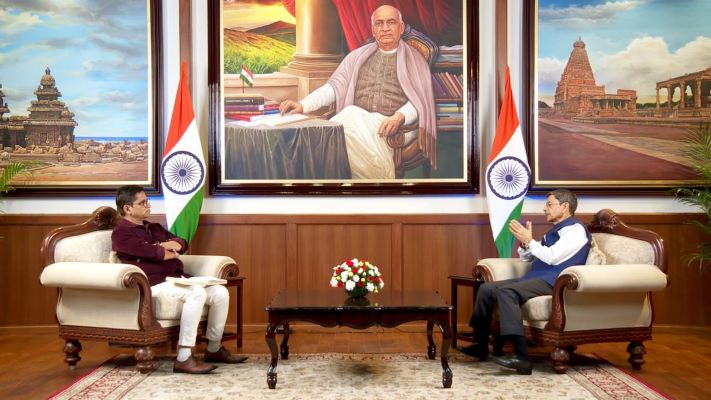
In an exclusive and wide-ranging conversation with Tamil Janam TV at Raj Bhavan, Tamil Nadu Governor R. N. Ravi spoke with unusual candour about his career, the challenges facing Tamil Nadu, and the controversies surrounding his public statements. From recounting his days in conflict zones to addressing accusations of being “anti-Tamil,” the Governor offered a point-by-point rebuttal, asserting that misinterpretations—some deliberate—have distorted his positions. He also elaborated on national security, constitutional duty, linguistic politics, and the cultural stewardship of Tamil heritage.
NE NEWS SERVICE
CHENNAI, NOV 28
Tamil Nadu Governor R. N. Ravi, in an exclusive interview with Tamil Janam TV, described his tenure in the state as a “life-enriching experience,” praising the affection, culture and warmth of Tamil people while cautioning against political narratives that, he said, “seek to isolate Tamil Nadu from the national mainstream.”
- Former top intelligence officer reflects on national service, Tamil culture, and political narratives
- Calls for safeguarding constitutional values, linguistic harmony, and cultural preservation
- Flags concerns over radicalisation, migrant workers’ fears & distortion of historical facts
- Says PM Modi has done “unprecedented service” to Tamil language and culture
- Urges truthfulness in political discourse; denies allegations related to Tamil Thaai Vaazhthu
Edited excerpts:
“Serving in Tamil Nadu is a privilege”
Reflecting on his journey from physicist to journalist, intelligence officer, anti-corruption investigator and finally Governor, he said:
“I am very happy to serve the people of Tamil Nadu and to know its ancient, rich culture. Coming here has enriched my understanding of India.”
He credited Prime Minister Narendra Modi for entrusting him with the responsibility:
“I accepted this role because I have profound admiration for him — not from when he became Prime Minister, but from much earlier.”
Recalling Modi’s 1992 visit to Lal Chowk, Srinagar, he added, “He raised the national flag when even security forces feared stepping in. That courage stayed with me forever.”
“Tamil Nadu is culturally rich — but national security concerns exist”
The Governor affirmed that Tamil Nadu is “one of the nicest states” he has served in, but highlighted the presence of radicalised groups and terror modules operating “with reasonable impunity.”
While central agencies have acted, he said the larger worry is a political culture that keeps itself aloof from the rest of India, a phenomenon he described as unhealthy for national unity.
On criticism of being “anti-Tamil”
Rejecting accusations that he bears hostility towards Tamil language or culture, he said:
“Wherever I travel, I am overwhelmed by people’s love. Tamil is the pride of the nation — the world’s most ancient living language.”
He added that those who accuse him “know the truth but choose political convenience.”
Migrant labour issue: “Fear was real; politics fuelled it”
Responding to the controversy over alleged harassment of Hindi-speaking workers in 2022–23, the Governor cited posters, assaults and threats:
“There was a real fear. Industries collapsed due to workforce shortages. The problem was not people — Tamil people are loving. It was perverse politics that projected migrants as cultural threats.”
He said he personally visited districts to reassure workers and issued appeals to counter panic.
“It is not regionalism, but Tamil exceptionalism”
Governor Ravi criticised what he described as a narrative portraying Tamil Nadu as racially and linguistically distinct from the rest of India, rooted in discredited colonial and European theories:
“Dravidian exceptionalism is based on debunked racial theories and linguistic divisions created by Robert Caldwell. Even other Dravidian languages like Telugu, Kannada, Malayalam face disregard.”
He emphasised that linguistic minorities in the state “fear speaking their mother tongue outside their homes,” and recalled the 2023 Supreme Court ruling restoring their right to teach their language in their own schools.
“Who is actually promoting Tamil?” — Governor draws sharp contrast
The Governor questioned claims of linguistic pride by state political leaders, pointing to:
- Steady decline of Tamil-medium students
- Neglect of Thanjavur Tamil University
- Lack of funding for research, palm-leaf manuscript preservation
- Absence of a single chair in honour of Mahakavi Subramania Bharati
- More than 15 chairs dedicated to just three Dravidian leaders
By contrast, he said PM Modi has delivered “unprecedented service” to Tamil culture:
- Revamped CICT with modern facilities
- Tamil courses at BHU, Gauhati University
- Subramania Bharati Chair at Delhi University
- Thiruvalluvar Centre abroad
- Sengol restored in new Parliament
- Annual Kashi–Tamil Sangamam
- Monuments for Chola emperors announced
“If Nayanmars and Alwars are dismissed as ‘unscientific,’ what remains of Tamil culture?” he asked.
On Assembly walkout & Tamil Thaai Vaazhthu controversy
Calling allegations of disrespect “absolutely false,” the Governor clarified:
“No such incident happened in Raj Bhavan. The only issue was at Doordarshan, where a stanza was missed, and they apologized.”
On walking out of the Assembly, he said:
“I am oath-bound to defend the Constitution. The National Anthem Code mandates playing the anthem at events attended by President or Governor. They refuse to play it. I cannot be a witness to disrespect.”
He said he had repeatedly appealed to the Speaker and Chief Minister — in person and in writing — but with no effect.
On national security: “Borders neglected for decades; course corrected after 2014”
Drawing from his years in intelligence, Governor Ravi criticised past neglect of border infrastructure:
“For 6–7 decades, our northern borders remained inaccessible for months. Villages emptied out because there were no roads, schools or hospitals.”
He credited recent infrastructure — Zoji La tunnel, Atal Tunnel, Sela Pass tunnel, border village development programmes — with transforming border security and restoring civilian confidence.
On drugs entering via international networks, he called it a “sophisticated weapon of war,” requiring coordinated intelligence and strong political will.
(This news story is based on an exclusive interview telecast by Tamil Janam TV. Full credit to the channel and its team for the original conversation.)