R ARIVANANTHAM
CHENNAI, JAN 24
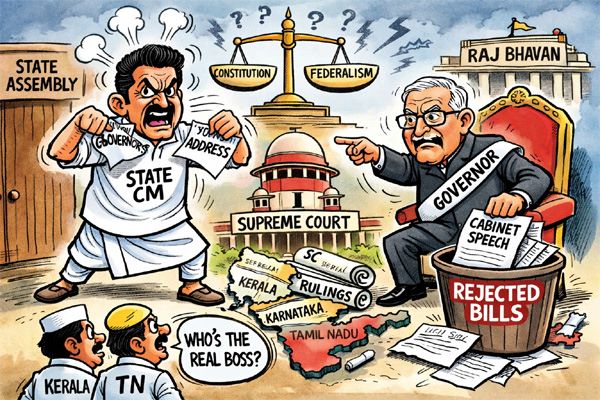
Tamil Nadu Chief Minister M K Stalin on Saturday accused Governor R N Ravi of “insulting the position he holds” by refusing to read the customary inaugural address at the commencement of the Assembly session, triggering a fresh constitutional and political flashpoint between the elected government and the Raj Bhavan.
The sharp exchange in the Assembly comes days after Stalin said his party would explore amending the Constitution to remove provisions mandating the governor’s address at the beginning of legislative sessions, arguing that repeated confrontations were undermining democratic functioning.
- TN CM Stalin flags erosion of federal norms as governor skips Assembly address
- Kerala, Karnataka echo concerns over Raj Bhavan interventions
- Constitutional experts cite Supreme Court limits on gubernatorial discretion
- Debate reignites over Article 176 and the spirit of parliamentary democracy
Saying he was compelled to speak out, Stalin told the House, “I am facing a crisis that was not witnessed during the tenures of former Chief Ministers C N Annadurai, M Karunanidhi, M G Ramachandran, and J Jayalalithaa. The Governor is insulting the position he holds by not reading the speech at the start of the Assembly session and by insisting on playing the national anthem at the beginning.”
Also Read:
Governor vs State: Stalin’s push to scrap Governor’s Address sparks national Federalism battle
He pointed out that established convention in Tamil Nadu mandated the national anthem at the conclusion of the governor’s address, with the Tamil Thai Vazhthu at the commencement. “We are not inferior to anyone in patriotism, and no one needs to teach us,” Stalin said, adding that political challenges were not new to him. “I have faced numerous challenges in the past and overcome them.”
Governor Ravi had earlier declined to read the state government’s prepared address, citing “inaccuracies” in the text, and walked out of the Assembly without delivering it—marking the third such instance. The Governor’s office later said the address contained factual and policy disagreements that could not be endorsed.
Kerala and other opposition-ruled states see parallel confrontations
Tamil Nadu’s standoff mirrors developments in Kerala, where Governor Rajendra Arlekar omitted portions of the cabinet-approved policy speech critical of central policies. In an unprecedented move, Chief Minister Pinarayi Vijayan read out the omitted portions on the Assembly floor, asserting the primacy of the elected government’s mandate.
Similar tensions have surfaced in Karnataka and other opposition-ruled states, where chief ministers have accused governors of delaying assent to bills, altering legislative texts, or exceeding constitutional boundaries—fueling allegations that Raj Bhavans are being used as instruments of political pressure.
What the Constitution says
Under Article 176 of the Constitution, the governor “shall address” the Legislative Assembly at the beginning of the first session each year. While the address is delivered in the governor’s name, its contents are prepared and approved by the Council of Ministers, making it an expression of the elected government’s policy agenda.
Constitutional expert and former Lok Sabha Secretary-General P D T Achary said the governor’s role in such addresses is purely constitutional and not discretionary.
“The governor has no authority to alter, delete or refuse to read the address approved by the cabinet. Any disagreement must be conveyed privately, not demonstrated on the floor of the House,” Achary said.
Legal scholar Gautam Bhatia, who has written extensively on federalism and constitutional morality, observed that such actions risk blurring the separation between ceremonial and executive authority.
“The governor’s address is not a personal speech; it is a constitutional device to communicate the government’s agenda to the legislature. Departing from that framework strikes at the heart of responsible government,” he noted.
Supreme Court precedents reinforce limits on governors
The issue gains added weight in light of multiple Supreme Court judgments curbing gubernatorial discretion. In Nabam Rebia vs Deputy Speaker (2016), a Constitution Bench ruled that governors must ordinarily act on the aid and advice of the Council of Ministers, and cannot exercise discretion unless expressly permitted by the Constitution.
More recently, the apex court held that governors cannot indefinitely delay assent to bills, declaring several long-pending Tamil Nadu bills as deemed passed—an outcome hailed by the DMK government as a reaffirmation of legislative supremacy.
Senior advocate and constitutional expert Sanjoy Ghose said these rulings collectively draw a clear line.
“The Supreme Court has repeatedly emphasised that governors are not parallel centres of power. Whether it is assent to bills or the Assembly address, the governor must respect the will of the elected government,” he said.
Political ramifications and the road ahead
Stalin’s proposal to explore a constitutional amendment, in consultation with other opposition parties, has intensified the debate on whether Articles 175 and 176 need reform or clearer conventions to prevent recurrent confrontations.
However, some experts caution against hasty amendments. Former Additional Solicitor General Indira Jaising observed that the issue lies less with the text of the Constitution and more with its interpretation.
“The Constitution already provides sufficient clarity. What is required is constitutional discipline and adherence to democratic conventions, not structural changes driven by political conflict,” she said.
As governors and elected governments continue to clash across states, the unfolding controversy is fast becoming a defining test of India’s federal balance, with courts, constitutional experts, and political stakeholders closely watching how far executive overreach—and resistance to it—will go.