NE SCIENCE & TECH BUREAU
NEW DELHI/SHRIHARIKOTA, SEPT 4
What if India could keep a far more persistent eye on the Earth—not merely revisit a location periodically, but watch vast regions with much greater frequency from geosynchronous space? That question has moved a significant step closer to reality.
- EOS-05 becomes India’s first dedicated imaging satellite designed to operate from geosynchronous orbit
- 2,367-kg spacecraft precisely injected into intended Sub-Geosynchronous Transfer Orbit about 18 minutes after liftoff
- Mission marks ISRO’s first successful launch of 2026 and GSLV’s 19th flight
- Heaviest satellite yet launched by GSLV underscores growing maturity of India’s indigenous launch capability
- PM Modi hails mission as an “outstanding achievement” and a “proud moment” for the nation
- ISRO–industry partnership gets fresh thrust as EOS-05 strengthens India’s Earth-observation and strategic capabilities
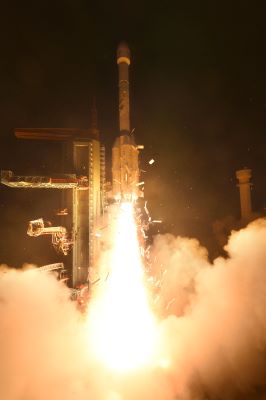
The Indian Space Research Organisation (ISRO) has successfully launched the GSLV-F17 carrying EOS-05, placing the 2,367-kg advanced Earth-observation spacecraft precisely into its intended Sub-Geosynchronous Transfer Orbit (Sub-GTO) after a pre-dawn liftoff from the Second Launch Pad at the Satish Dhawan Space Centre, Sriharikota.
The launch at 2.55 am on Friday marked the first successful ISRO launch of 2026, the 19th flight of the Geosynchronous Satellite Launch Vehicle (GSLV) and another important demonstration of the reliability and growing payload capability of India’s indigenous launch architecture.
More significantly, EOS-05 is India’s first dedicated imaging satellite designed to operate from geosynchronous orbit, giving the country a new class of Earth-observation capability. Once it reaches its operational orbit at roughly 36,000 km altitude, the spacecraft is expected to provide frequent, near-continuous imaging of large areas—an important advantage for applications ranging from agriculture and disaster management to environmental monitoring and strategic needs.
PM: ‘Outstanding achievement’, proud moment for India
Yet another outstanding achievement by ISRO and a proud moment for our nation.
The successful launch of GSLV-F17 carrying EOS-05, India’s first-ever imaging satellite from Geosynchronous orbit is a reflection of the excellence, innovation and growing capabilities that define… https://t.co/fXzwnSmwAF
— Narendra Modi (@narendramodi) September 4, 2026
The success drew immediate praise from Prime Minister Narendra Modi, who described it as “yet another outstanding achievement by ISRO” and “a proud moment for our nation”.
In a post on X, Modi said: “The successful launch of GSLV-F17 carrying EOS-05, India’s first-ever imaging satellite from Geosynchronous orbit is a reflection of the excellence, innovation and growing capabilities that define India’s space sector.”
The Prime Minister also highlighted the expanding partnership between ISRO and Indian industry, saying it was “adding new strength and scale to our space programme” and expanding India’s capabilities across the entire space ecosystem.
The message assumes added significance as India seeks to broaden participation by domestic industry in the space sector while retaining ISRO’s role as the country’s principal technological anchor.
2,367 KG ‘eye’ rides GSLV’s evolving muscle
The mission was not merely about putting another satellite into orbit.
At 2,367 kg, EOS-05 is the heaviest satellite launched by the GSLV, according to ISRO Chairman V. Narayanan, reflecting the progressive strengthening of the launch vehicle’s structural and propulsion systems.
“I am very happy to announce that the GSLV-F17 vehicle has successfully and precisely injected the advanced Earth observation satellite EOS-05, the Geo Imaging Satellite, into the intended and required orbit,” Narayanan said after the launch.
He also confirmed that the satellite was in “perfect health” and that its solar panels had been deployed successfully. Calling the mission a “great achievement”, he credited the collective effort of ISRO scientists, industrial partners and academic institutions.
“This success is the culmination of the hard work of the entire ISRO team along with our industrial partners and academia,” Narayanan said.
The GSLV’s three-stage architecture combines solid, liquid and cryogenic propulsion, with its indigenous cryogenic upper stage enabling it to carry heavier spacecraft towards geosynchronous transfer orbits. The successful GSLV-F17 mission therefore represents not only a satellite accomplishment but also another confidence-building milestone for India’s heavy-lift launch capability.
From sub-GTO to a new ‘eye in the sky’
EOS-05 was initially injected into a Sub-Geosynchronous Transfer Orbit, about 18 minutes after liftoff. From there, the spacecraft will undertake the required orbital manoeuvres to reach its operational geosynchronous orbit.
The distinction matters.
Most conventional Earth-observation satellites operate from lower orbits and repeatedly pass over a region. A geosynchronous platform, by contrast, can remain aligned with a broad region for extended periods, enabling much more frequent observation.
That capability could prove valuable for agriculture, water resources, urban planning, forestry, ocean resources, environmental monitoring and disaster management, while also adding strength to strategic applications.
In effect, India is adding a new kind of “eye in the sky”—one designed not merely to look down, but to watch more persistently.
A comeback mission with a bigger payload
The success also carries an important institutional significance.
GSLV-F17 is the 19th GSLV flight, following the successful GSLV-F16/NISAR mission of July 2025 and the GSLV-F15/NVS-02 mission of January 2025. The GSLV-F17 mission thus extends a recent sequence of successful GSLV flights after the unsuccessful GSLV-F10/EOS-03 mission of August 2021.
For ISRO, the EOS-05 success is consequently both a fresh beginning for 2026 and a validation of years of incremental engineering improvements.
Narayanan pointed specifically to advances in the vehicle’s structural design and propulsion systems that have enabled GSLV to accommodate increasingly heavier payloads.
And ISRO is not treating the achievement as an endpoint.
Narayanan said the organisation is targeting six more launches during the current financial year, including an uncrewed Gaganyaan mission later this calendar year.
Congress salutes scientists, flags larger debate
The achievement also drew appreciation from the Opposition.
Congress president Mallikarjun Kharge congratulated the ISRO team, saying EOS-05 would further strengthen India’s Earth-observation capabilities.
“We are immensely proud of our scientists, space engineers and researchers whose dedication and ingenuity continue to take India’s space programme to greater heights,” Kharge said.
He added that “the makers of modern India laid the foundations of our space programme with vision and foresight, and generations of our scientists have built upon that legacy with remarkable achievements.”
Congress general secretary in-charge communications Jairam Ramesh also described the launch as a landmark achievement that would add to India’s strategic capabilities, while simultaneously raising concerns about what he described as a changing role for ISRO and greater privatisation of the space sector.
Thus, the launch has managed to achieve something unusual in India’s often polarised political landscape: scientific achievement has drawn applause across the political divide, even as differences remain over the future architecture of the space programme.
Success today, bigger ambition tomorrow
EOS-05’s importance ultimately extends beyond a successful countdown and a precise orbital injection.
The mission demonstrates the growing ability of India’s launch vehicles to carry heavier spacecraft, expands the country’s Earth-observation architecture and showcases a satellite platform capable of providing much more persistent imaging from geosynchronous space.
For agriculture, disasters, environmental monitoring and strategic applications, the value of such persistent observation could be considerable.
For ISRO, the mission represents another successful chapter in the evolution of India’s launch capability.
For Indian industry, it reinforces the expanding opportunity to become an integral part of a larger space ecosystem.
And for the country, perhaps the most important message came from the Prime Minister himself: the GSLV-F17/EOS-05 success reflects “excellence, innovation and growing capabilities” in India’s space sector.
The rocket has returned from the launch pad with another success etched into its record.
But the larger story is already looking upward: India is no longer merely reaching orbit—it is steadily learning how to use orbit to watch, understand and serve the Earth better.