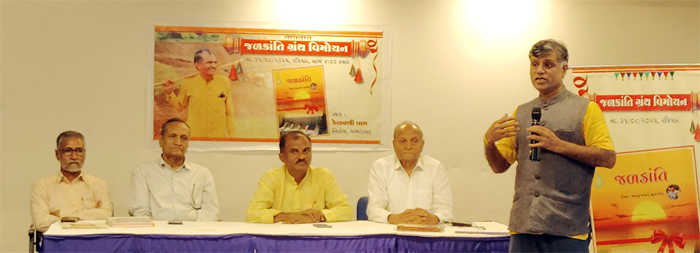
- Union Jal Shakti Minister & Gujarat BJP President C.R. Patil, Union Minister Mansukh Mandaviya, former chief secretary P.K. Lahiri, Vasantbhai Gajera, R.P. Patel, Jerambhai Vansjalia, Kanjibhai Bhalala and other dignitaries will remain present at the book launching ceremony
- This book has been read by more than 20 scholars and described it as a world-inspiring history of hydrology and water revolution.
- ‘Jalkranti Granth’ will be published in Gujarati, Hindi and English and sent to 200 countries around the world to inspire water crisis prevention
NE ENVIRONMENT BUREAU
AHMEDABAD, AUG 28
Water crisis is the main problem prevailing in the whole world, Aiming to throw more light on this crucial issue, Tamil Saint Thiruvalluvar in his ‘Thirukkural’ says,
“When water fails, functions of nature cease, you say;
Thus when rain fails, no men can walk in ‘duty’s ordered way’.”
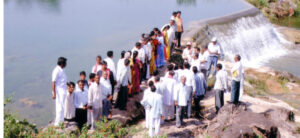
Gujarat Chief Minister Bhupendrabhai Patel will release a book on water conservation at Leuva Patel Samaj, Kelvani Dham Nikol here on Sunday.
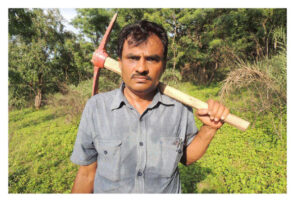
The book has been written by Mansukhbhai Suvagiya, the progenitor of Gujarat and the pioneer of Jalkranti (Water Revolution), whose hard work inspired Gujarat to fight against water crisis.
Union Jal Shakti Minister & Gujarat BJP President C.R. Patil, Union Minister Mansukh Mandaviya, former chief secretary P.K. Lahiri, Vasantbhai Gajera, R.P. Patel, Jerambhai Vansjalia, Kanjibhai Bhalala and other dignitaries will remain present. at the book launching ceremony.
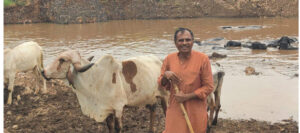
Speaking with the media, Mansukhbhai Suvagiya, who brought about the water revolution in the state, said, “I was inspired to write ‘Jalkranti Granth’ so that the future generation would know the knowledge and experiences of the water crisis that I gained after my 30 years of water conservation penance. For this, I stayed at the Tapovan Vidyapeeth in the historical town of Dhumli in Barda Dungar for 97 consecutive days and wrote the 225-page ‘Jalkranti Granth‘. This book includes spiritual chapters like water element, types of rain, properties of constellations, effects of lightning and thunder, underground water testing, history of model villages of water conservation, solution to solve the world water crisis and human structure and attainment of life through karma.”

He further said , “This book has been read by more than 20 scholars and described it as a world-inspiring history of hydrology and water revolution. ‘Jalkranti Granth’ will be published in Gujarati, Hindi and English and distributed in 200 countries around the world to inspire water conservation. Apart from ‘Jalkranti Granth’, the income received from the sale of eight other books written by me is used by the Jalkranti Trust for national service.”
Revolutionary Saint Swami Shri Sachchidanandj hails Suvagiya
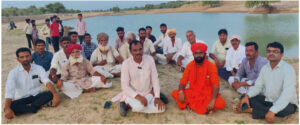
With the aim of making Mansukhbhai’s check dam-lake project nationwide, the country’s first Jal Kranti Day was celebrated on the land of Jamka on 20-11-99. Revolutionary Saint Swami Shri Sachchidanandji named the check dam-lake project Jal Kranti. He declared Mansukhbhai Suvagiya as the pioneer of Jal Kranti.
Mansukhbhai says, “If we want to make India a developed nation in the whole world, we can achieve development through the production of agricultural products in large quantities and their export, which is the main identity of our country, an agricultural country. For this, we all have to resolve to build 51 lakh check dams-ponds and 51 lakh farm ponds across India with the support and effort of all,”
Five-pronged plan pays rich dividend
To eradicate the water crisis that arose in the 80s in the state of Gujarat, Mansukhbhai Suvagiya, a farmer’s son who had only passed 11th standard, made a five-pronged plan of 5 to 51 check dams-ponds per village. In which, village organization, public fund, selection of a suitable place for the check dam-pond, a new very cheap design of the check dam developed by himself that would last for 100 years, and with the help of labor, he resolved to implement this plan village by village, and established the Jalkranti Trust by making 50 thousand people take the pledge of water conservation. The Jalkranti Trust has built more than 3,200 check dams and ponds in more than 300 villages of Gujarat, Maharashtra, Rajasthan and Madhya Pradesh. Due to which the agricultural production of the villages has increased to Rs 30 crore.